R ARIVANANTHAM
CHENNAI, JAN 6
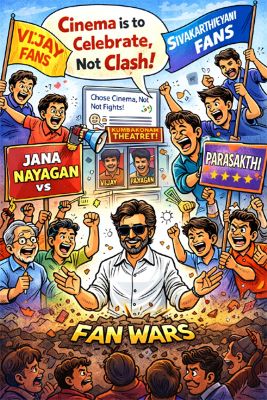
In Tamil Nadu, cinema and politics have long been two sides of the same coin. Stars are not merely entertainers; they often become symbols of social aspiration, ideological identity and mass emotion. Yet, the recent Jana Nayagan vs Parasakthi controversy in Kumbakonam underlines a worrying shift—where fandom risks overshadowing the very values that once defined Tamil cinema’s cultural maturity.
- Jana Nayagan vs Parasakthi row revives an old question on fandom, freedom and film culture
- Cinema–politics overlap in Tamil Nadu must not turn theatres into battlegrounds
- History shows rivalry can coexist with respect and restraint
- Industry voices urge fans to celebrate cinema, not weaponise loyalty
The flashpoint emerged after a theatre in Kumbakonam announced that it would screen Sivakarthikeyan’s Parasakthi instead of Vijay’s Jana Nayagan for the Pongal festival. The theatre management later revealed on social media that the announcement triggered a wave of abusive and disturbing messages from a section of Vijay fans, leaving the staff mentally distressed.
Explaining its position, the theatre clarified that the decision was taken on practical and business considerations. It also pointed out that it had screened Vijay’s films consistently for over 15 years, barring a few exceptions. In a candid appeal, the management wrote:
“After we posted about signing #Parasakthi, we received comments on X and Instagram that were shocking… Were they fair or justified in any sense?”
Strikingly, the theatre chose empathy over provocation, stating: “Vijay is not just a star, he is a remarkable human being,” and acknowledging the disappointment of fans:
“I truly understand the frustration of not being able to watch your favourite star’s film at your favourite theatre—it hurts and I get that. But this is his final film.”
Reigning Star vs Rising Star: A False Narrative
Attempts to frame the episode as a clash between a reigning star and a rising star reflect a deeper issue within contemporary fandom. Vijay, with decades of stardom and an imminent political journey, and Sivakarthikeyan, who has steadily built his space through perseverance and connect, represent different phases of Tamil cinema—not rival ideologies.
Film trade analysts stress that Pongal has historically been a season of coexistence, where multiple films release, theatres exercise choice and audiences benefit from variety. Turning programming decisions into loyalty tests threatens the fragile balance of the exhibition ecosystem.
What History Teaches Tamil Cinema
Tamil cinema has navigated far greater rivalries with far greater grace. The Shivaji Ganesan–MGR saga remains a defining example. Both were towering icons with fiercely loyal fan bases and contrasting political identities. Yet, their personal conduct was marked by mutual respect. Their coexistence elevated Tamil cinema without coercion of theatres or intimidation of exhibitors.
The tradition continued with Rajinikanth and Kamal Haasan—two giants whose careers unfolded in parallel. One redefined mass superstardom; the other expanded the artistic grammar of Indian cinema. Despite fan comparisons, both repeatedly acknowledged each other’s craft and stood together at crucial moments, proving that rivalry need not mean rancour.
In a show of solidarity, Superstar Rajini is acting in a film produced by Ulaganayagan’s Raj Kamal Internationl company.
Veteran exhibitors recall that even during peak Rajini–Kamal release clashes, cinema halls remained spaces of choice, not conflict.
Industry Voices Call for Restraint
Reacting to the Kumbakonam episode, several filmmakers and actors took to social media—without naming individuals—to express concern.
A senior director wrote that “cinema grows when fans celebrate films, not when they police choices.”
A leading actor posted that “no star’s legacy is strengthened by abuse carried out in their name.”
A producer noted that “intimidating theatres weakens the industry all artists depend on.”
These voices reflect a shared anxiety over the normalisation of online aggression under the banner of devotion.
Why Such Fan Activities Must Be Avoided
The issue is not about choosing Jana Nayagan or Parasakthi. It is about preserving the dignity of Tamil cinema as a collective cultural space. Theatres are not political stages; they are institutions that survive on trust, autonomy and audience goodwill.
When fandom turns coercive, it harms exhibitors, alienates neutral audiences and ultimately damages the image of the very stars being defended.
Cinema Over Conflict
Tamil cinema’s strength has always lain in plurality—many heroes, many voices, many stories. If Shivaji and MGR could coexist at the peak of their influence, and if Rajini and Kamal could compete without contempt, today’s generation deserves the same maturity.
Pongal should remain a festival of celebration, not confrontation.
The legacy of Tamil cinema demands rivalry without rancour, loyalty without intimidation, and passion without prejudice.
In choosing celebration over conflict, fans do not diminish their stars—they honour them.