- Rajesh Kumar Singh reviews forward deployments in Creek Sector, validates Decade of Transformation roadmap
- Tri-Services Joint Control Centre delivers unified surveillance and real-time situational awareness
- Multi-agency Exercise ‘TATRAKSHA’ showcases seamless coastal, amphibious and maritime response
- Monumental Flag and new-generation weapon displays underline pride, preparedness and indigenisation
- Surgical Eye Camp restores vision to 200+ veterans and civilians across remote Kutch villages
- Military–civil cooperation emerges as a force multiplier in border and underserved regions
NE DEFENCE BUREAU
BHUJ, FEB 5
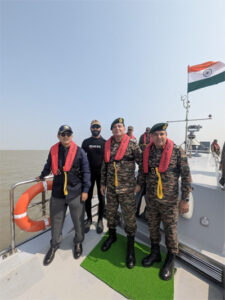
Defence Secretary Shri Rajesh Kumar Singh on February 4–5, 2026, undertook a comprehensive visit to forward areas in the Creek Sector, Bhuj, witnessing first-hand the Indian Armed Forces’ growing jointness, infrastructure development and multi-domain operational capability, alongside their deep-rooted commitment to veterans’ welfare and civilian outreach.
During the visit, the Defence Secretary interacted with Lieutenant General Dhiraj Seth, General Officer Commanding-in-Chief, Southern Command, and senior officers of the Konark Corps, and was briefed on initiatives aligned with the Indian Army’s Decade of Transformation roadmap—aimed at building a technologically advanced, combat-ready and future-resilient force.
Jointness in Action
A key highlight of the visit was the Defence Secretary’s interaction at the Joint Control Centre, jointly manned by the Indian Army, Indian Navy, Indian Air Force, Indian Coast Guard, BSF and other security agencies. The centre integrates multi-source sensor inputs to generate a common operational picture, significantly enhancing situational awareness and decision-making for commanders operating in sensitive coastal and border zones.
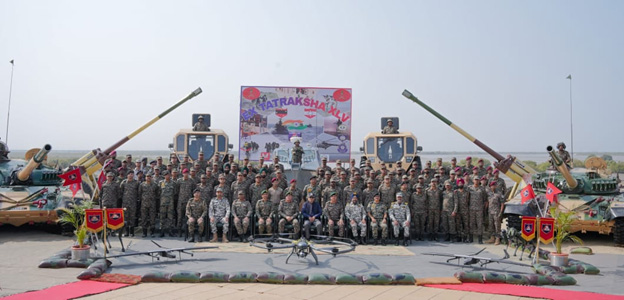
Further validating integrated capability, Shri Rajesh Kumar Singh witnessed Exercise ‘TATRAKSHA’, a high-intensity multi-agency operational demonstration. The exercise showcased real-time surveillance, precision engagement, joint logistics and rapid response, demonstrating the Armed Forces’ readiness to counter emerging maritime and border threats across the full spectrum of operations.
Pride, Power and Preparedness
The Defence Secretary also inaugurated the Monumental Flag in the border region—symbolising national pride, unity and resolve—and witnessed an operational display of new-generation weapon systems, reflecting India’s thrust on capability enhancement and indigenisation.
The visit reaffirmed the Government’s continued focus on strengthening jointness, enhancing border infrastructure, promoting self-reliance and building technologically superior Armed Forces capable of multi-domain warfare.
Healing Beyond the Battlefield
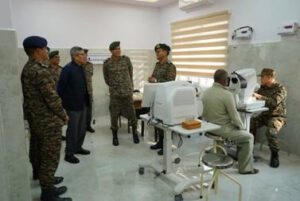
Complementing the oper
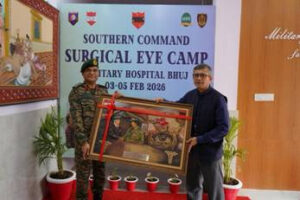
ational review, the Defence Secretary also visited the Surgical Eye Camp at Military Hospital, Bhuj, organised in collaboration with Army Hospital (Research & Referral), New Delhi, under the aegis of Southern Command.
The three-day camp (February 3–5, 2026) successfully restored vision to over 200 veterans, their dependents and civilians, reaching beneficiaries from more than 120 villages across the Kutch district, including remote border areas such as Lakhpat, Narayan Sarovar and Dayapar. The outreach covered a target population of nearly 3,000 people.
Surgeries were conducted using state-of-the-art ophthalmic equipment and premium intraocular lenses, adhering to the highest clinical and safety standards.
Appreciating the initiative, the Defence Secretary described it as “a commendable example of the Indian Army’s commitment to veterans’ welfare and military–civil cooperation,” noting its transformative impact on the quality of life in remote and border regions.
Honouring Service
In recognition of exemplary service, Shri Rajesh Kumar Singh felicitated Brigadier Sanjay Kumar Mishra, Consultant and Head of Department (Ophthalmology), along with the surgical eye care team from Army Hospital (R&R), for delivering high-quality medical care under challenging field conditions.
The Defence Secretary also interacted with patients in post-operative wards, enquired about their recovery, and personally distributed post-operative medicines and spectacles to several beneficiaries—underscoring the human face of military service.