NE SPORTS & HEALTH BUREAU
CHENNAI, FEB 11
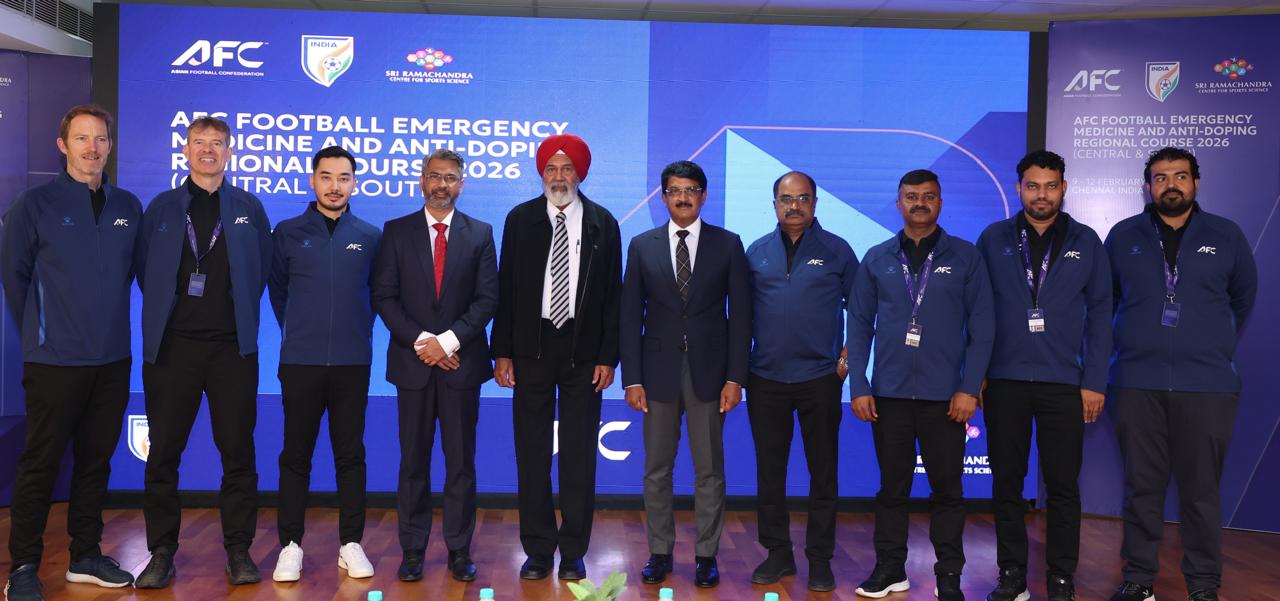
In a decisive move to strengthen Asia’s footballing backbone, the Asian Football Confederation (AFC), in collaboration with the All India Football Federation (AIFF), has rolled out a four-day Emergency Medicine & Anti-Doping Regional Course at the Sri Ramachandra Centre for Sports Science, Chennai.
The high-impact programme brings together 50 medical professionals and physiotherapists from AFC Member Associations across the Central and South Asia region, including the Philippines, Malaysia, Bangladesh, Maldives, Sri Lanka, Kyrgyzstan, Uzbekistan, Turkmenistan, Tajikistan, Bhutan, Nepal and India.
- Four-day Emergency Medicine & Anti-Doping Regional Course hosted at Sri Ramachandra Centre for Sports Science
- AFC–AIFF collaboration trains 50 doctors & physios from Central and South Asia
- Focus on player welfare, injury prevention and on-field cardiac emergency response
- Global best practices aligned with FIFA standards to boost Asia’s World Cup ambitions
- Experts call sports science the ‘silent striker’ behind football excellence
Medicine as the Winning Strategy
Inaugurating the course, Dato Dr. Gurcharan Singh, Chairperson, AFC Medical Committee, underscored that Asia’s long-term vision is clear: to see an Asian nation lift the FIFA World Cup.
“The vision and long-term goal of the AFC is to win the Football World Cup by Asian countries. While technical training and on-field practice are essential, sports medicine and sports science play an equally critical role in achieving this goal,” said Dr. Gurcharan.
Citing research on Europe’s elite football clubs, he pointed out that over 90 per cent of players remain consistently available for training and competition, thanks to heavy investments in medical infrastructure and player welfare.
“Consistent player availability is not accidental. It is the result of sustained investment in sports medicine and scientific support systems. The AFC is committed to increasing its investment in football development across Asia,” he added, calling for administrators and medical professionals to work in tandem to elevate the continent’s global standing.
FIFA Standards, Regional Strength
The AFC continues to work closely with Member Associations to develop and regulate football sports medicine in accordance with FIFA standards, through scientific conferences, knowledge exchange and hands-on training programmes.
The Chennai course blends lectures, simulation drills and practical workshops, focusing on emergency response protocols, concussion management, anti-doping compliance, and sudden cardiac event preparedness.
AIFF Backs Scientific Football
Highlighting the national importance of the initiative, Kalyan Chaubey, President, AIFF, said the programme comes at a crucial time for Indian football.
“Football is extremely popular in India, and this course is highly beneficial for the medical fraternity in safeguarding football players from injuries. Instructors and members of the scientific team from across the country have come together to exchange knowledge, share cutting-edge technologies, and gain hands-on experience to derive maximum benefit,” said Chaubey.
He noted that leading international and national faculty are delivering sessions on the latest developments in football emergency medicine and anti-doping practices, strengthening India’s preparedness both domestically and internationally.
Safeguarding Players, Saving Lives
For host institution Sri Ramachandra Centre for Sports Science, the programme represents a commitment to frontline preparedness.
Dr. S. Arumugam, Director, Sri Ramachandra Centre for Sports Science, stressed that timely intervention can mean the difference between recovery and catastrophe on the field.
“This specialised programme provides updates on the latest advances in football emergency medicine and aims to equip medical professionals to prevent severe injuries and manage on-field medical emergencies, including sudden cardiac events, thereby ensuring player safety at all levels of the game,” said Dr. Arumugam.
With football growing rapidly across Asia, the Chennai course signals a strategic shift: from reactive treatment to proactive prevention—ensuring that medical science remains the unseen defender guarding every goalpost.