- From factory tracks to global climate impact, Gujarat plant scripts sustainability history
- Verra-registered modal shift project unlocks 1.7 lakh carbon credits through rail logistics innovation
- Massive CO₂ reduction, decongested roads and greener dispatch redefine automotive supply chains
NE ENVIRONMENT & BUSINESS BUREAU
AHMEDABAD/NEW DELHI, FEB 25
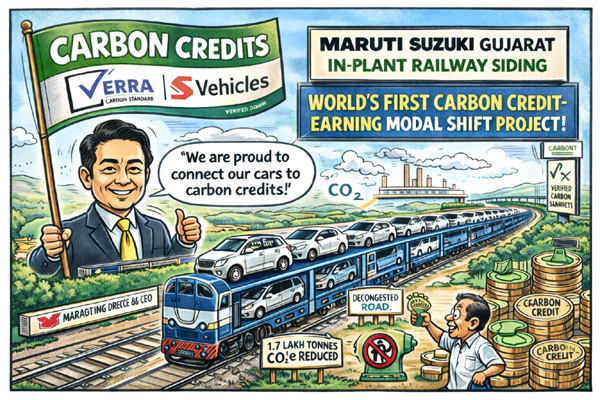
In a breakthrough that places India at the forefront of climate-conscious industrial logistics, Maruti Suzuki India Limited has transformed its Gujarat in-plant railway siding into the world’s first modal shift transportation project to earn carbon credits under global standards, setting a new gold benchmark for sustainable automotive logistics.
Registered under the globally respected Verified Carbon Standard (VCS) programme of Verra, the project marks a historic shift from conventional road transport to rail-based vehicle dispatch, unlocking both environmental and operational gains.
Over a 10-year crediting period from FY2023-24 to FY2032-33, the pioneering initiative is expected to generate approximately 1.7 lakh carbon credits, corresponding to an estimated reduction of 1.7 lakh tonnes of CO₂ equivalent emissions—a decisive step towards India’s net-zero ambitions.
The emission savings have been scientifically measured using the globally recognised AM0090 methodology prescribed under the United Nations Framework Convention on Climate Change Clean Development Mechanism, ensuring credibility, transparency and international validation.
Speaking on the sustainability milestone, Hisashi Takeuchi, Managing Director & CEO, Maruti Suzuki India Limited said, “This is a proud moment for Maruti Suzuki as our Gujarat in-plant railway siding is recognized as the world’s first Verra-registered Modal Shift in Transportation project. By transitioning vehicle movement from road to rail, the project demonstrates how scale, operational efficiency and environmental responsibility can seamlessly go hand in hand.
Leveraging the inherent efficiency of rail transport, the Gujarat in-plant railway siding has significantly reduced the carbon footprint of our logistics operations, while also easing road congestion and lowering overall fossil fuel consumption. We are honoured by the recognition from Verra. This milestone marks a significant step forward in our sustainability journey and reinforces our commitment to setting industry benchmarks that align with India’s strong steps towards net zero emissions.”
Beyond emission reduction, the rail-based logistics model delivers multiple co-benefits—reducing highway congestion, lowering fossil fuel dependency, enhancing transport efficiency, and accelerating India’s transition to climate-smart industrial infrastructure.
The project also aligns with key global sustainability priorities under the United Nations Sustainable Development Goals, particularly advancing climate action, economic growth, and public health outcomes through cleaner transportation systems.
With this achievement, Maruti Suzuki’s Gujarat facility has not only reimagined vehicle dispatch logistics—but also established a replicable global template where industrial growth and climate responsibility move forward on the same track.