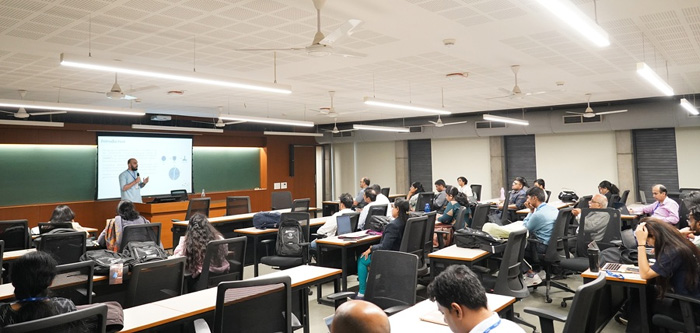

- Scholars, technologists and policy leaders gather at Indian Institute of Management Ahmedabad for InCIS 2026
- Theme focuses on Digital Public Infrastructure (DPI) for a Sustainable and Sovereign Digital Future
- 14 specialised research tracks explore AI, digital governance, security, and future work ecosystems
- Over 250 global participants deliberate on how information systems are shaping digital societies
- Experts highlight India’s DPI success stories including UPI, DigiLocker, DigiYatra and Aadhaar
NE EDUCATION BUREAU
AHMEDABAD, MAR 8
The Indian Institute of Management Ahmedabad (IIMA) hosted the second edition of the India Conference on Information Systems (InCIS 2026) in collaboration with the Association for Information Systems (AIS) India Chapter at its campus from March 5 to 7, 2026. The conference centred on the theme “Digital Public Infrastructure (DPI) for a Sustainable and Sovereign Digital Future.”
The three-day gathering brought together over 250 national and international scholars, policy researchers, developers, industry practitioners, community leaders, doctoral students and early-career researchers to deliberate on the rapidly evolving role of information systems in shaping digital societies.
The conference was inaugurated by Bharat Bhasker, Director of IIMA, along with Pankaj Setia, Conference Chair, Sujeet Sharma, President of AIS India Chapter, and Alok Gupta, Curtis L. Carlson Chair in Information Management at the University of Minnesota.
The conference featured 14 research tracks spanning a wide spectrum of digital technologies and information systems, including Digital Public Infrastructure for a Sustainable and Sovereign Digital Future, Digital Business and Commerce, Collaborative and Social Technologies, Technological Innovation and the Future of Work, Information Systems Research for Social Good, Governance in Smart and Connected Environments, Security and Privacy, Information Systems Design and Project Management, Inclusion and Sustainability through IS, AI and Analytics, Human-Technology Interaction, Practitioners’ Track, Next Generation IS, and General IS Topics.
Delivering the inaugural keynote, Prof. Bharat Bhasker emphasised the importance of bringing together academia and industry on a common platform to shape the future of digital ecosystems. Reflecting on the evolution of the discipline, he noted that information systems have progressed far beyond operational efficiency.
Talking about the opportunities created by Artificial Intelligence for IS professionals, he said, “Today AI has pushed Information Systems into a new frontier, requiring professionals to focus on applying technology to real-world problems and driving innovation. At the same time, it has also provided IS professionals with the opportunity to be at the forefront. Information Systems professionals are now positioned to lead in areas like process automation, predictive maintenance, and addressing biases in AI systems.”
In his keynote address, Prof. Pankaj Setia highlighted the transformative power of India’s digital infrastructure ecosystem.
He said, “Digital public infrastructures such as UPI, DigiLocker, and DigiYatra are laying the foundations of a new digital age in India. The real impact will happen when there is a deep transformation in how organisations function and how individuals interact with digital technologies. Purpose-driven thinking is the core which interconnects individuals, organisations, as well as technology, and is essential to ensure that digital transformation creates a meaningful impact.”
The academic keynote was delivered by Prof. Alok Gupta from the University of Minnesota, who encouraged participants to view Artificial Intelligence as both a reflection and an enabler of human knowledge.
He explained, “The strength of human beings has always been our mental ability to think and create with our minds. AI does not emphasise compatibility with human decision-making. It can be used to extract human knowledge and understand our strengths and weaknesses. If we use AI as a mirror to reflect on how we think and make decisions, we can develop a more explicit understanding of our own processes. That understanding can help us improve ourselves and build on our capabilities with the support of AI.”
Across three days, the conference hosted discussions on platform ecosystems, data governance, digital identities, responsible AI adoption, risk assessment in digital public infrastructures, building trust in digital systems, and leveraging information systems to bridge digital divides and advance sustainable development.
The concluding day featured an industry keynote by R. S. Sharma, Distinguished Visiting Professor at Indian Institute of Technology Kanpur and former Director-General and Mission Director of Unique Identification Authority of India.
Highlighting India’s pioneering role in building digital public infrastructure, he said, “Any digital solution built for India must take into consideration the country’s unique diversity. We have great social, cultural, geographical, infrastructural, ethnic, religious, and educational diversity, and therefore, a different approach is needed to develop inclusive solutions.”
He further explained the principles behind the success of India’s DPI ecosystem, noting, “Our DPIs are succeeding because their design is tailored to India’s needs. They are frugal and low-cost, scalable by design, inclusive and encourage diversity, have minimal public-sector intervention, contain robust and cutting-edge technology, and are interoperable. We are now on our way to build more DPIs in diverse sectors.”
The conference also hosted a panel discussion on “Digital Public Infrastructure (DPI) and India’s Digital Transformation,” moderated by Samrat Gupta, Programme Co-Chair of InCIS 2026.
Panellists included Pankaj Dikshit, Executive Director and Chief AI & Digital Officer at Cygnet.One; Sanjay Moralwar, Chief Information Officer at Senores Pharmaceuticals Limited; and Tarun Vijh, Chief Information Officer at HyFun Foods.
The discussion explored scalability and interoperability of digital platforms such as the Government e-Marketplace (GeM) and Aadhaar, the role of artificial intelligence in digital ecosystems, and the importance of balancing innovation with data security and multi-stakeholder collaboration. The panellists also observed that several countries are increasingly looking to India’s digital public infrastructure as a model for building inclusive digital economies.
The conference received over 190 research paper submissions from researchers across the world, reinforcing its growing stature as a global platform for dialogue on information systems and digital governance.