- Record-weight portal beam installed over active railway lines at Maninagar
- Execution window shrinks from months of planning to just 3.5 hours
- High-precision lift achieved amid tight space, live tracks and overhead systems
- Mumbai–Ahmedabad Bullet Train Project marks another milestone in complex urban engineering
NE INFRASTRUCTURE BUREAU
AHMEDABAD, APR 8
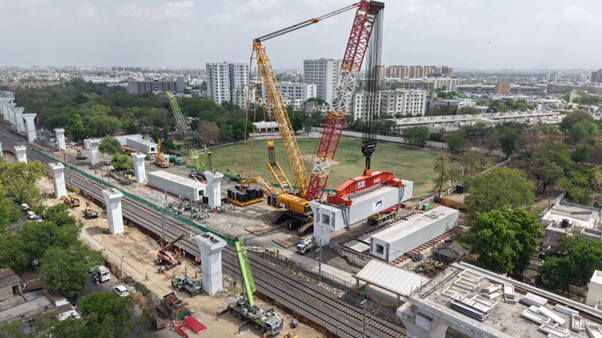
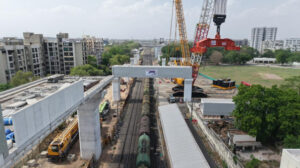
In a landmark engineering operation, one of the heaviest precast-prestressed portal beams—weighing approximately 1,360 metric tonnes—has been successfully launched over the Amdavad–Vadodara railway line at Maninagar, marking a major milestone in the Mumbai-Ahmedabad Bullet Train Project.
Described as a first-of-its-kind execution, the massive concrete structure—34 metres long with a cross-section of 5.5 metres by 4.5 metres—was installed with remarkable precision over active railway tracks. A total of five such beams are planned in the Maninagar railway station zone, each being precast on-site and erected as integrated heavy units.
Precision meets pace
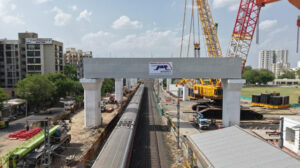
The entire launching operation was completed in an exceptionally short duration of approximately 3.5 hours under a full traffic and power block coordinated with Indian Railways.
Notably, earlier plans had envisaged prolonged caution orders extending up to six months and requiring nearly nine-hour operational blocks. Through meticulous planning and engineering optimisation, the execution time was drastically reduced, enabling swift installation across both lines of the Amdavad–Vadodara section.
Heavy machinery, heavier responsibility
The lifting operation deployed a 2,200 MT crawler crane as the primary equipment, supported by a 260-ton standby crane, an 80-ton crane, man lifters, and a specialised lifter beam system with anchoring frames.
The rigging system incorporated prestressed macalloy bars of 75 mm diameter, along with lifting beams and heavy-duty slings to safely manage the enormous load—making it one of the heaviest lifts ever executed over operational railway infrastructure in India.
Engineering under constraints
The operation posed multiple challenges, including executing an ultra-heavy lift within a narrow time window, working in restricted urban spaces, and navigating overhead electrical equipment and multiple active railway lines.
Engineers had to ensure high-precision placement at an approximate pier height of 15 metres, while maintaining real-time coordination with railway authorities. The process involved redundant lifting systems, rigorous safety checks, continuous wind monitoring due to the beam’s large surface area, and precise survey alignment to guarantee accuracy and safety.
A defining moment in high-speed rail construction
The successful launch not only underscores the technical prowess behind the bullet train corridor but also highlights India’s growing capability in executing complex infrastructure projects within challenging urban environments.