- NHRC steps in after alleged custodial brutality by Rajkot Crime Branch
- Suo motu notice to Gujarat DGP seeks report on victim’s health and probe status
- Media fraternity raises alarm over growing risks to independent journalism
- Call for accountability, safeguards as press freedom concerns deepen in Gujarat
NE LEGAL BUREAU
NEW DELHI, AHMEDABAD, APR 8
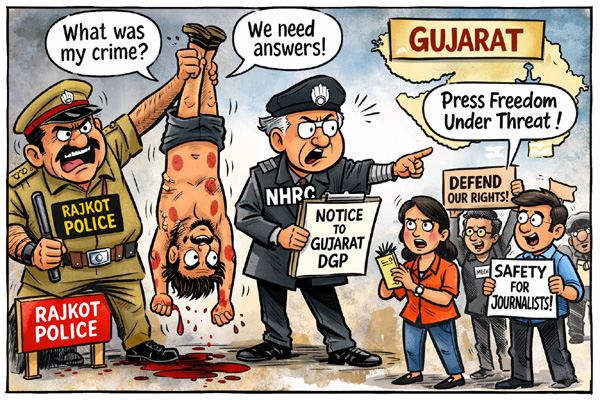
The National Human Rights Commission (NHRC), India has taken suo motu cognizance of a media report that on 22nd March, 2026, a journalist was apprehended in an unlawful manner by the Rajkot Crime Branch police in Gujarat. The journalist was stripped naked, suspended upside down and subjected to physical torture resulting in serious injuries to him. Reportedly, the police tried to threaten the Rajkot Civil Hospital staff against admitting the victim. He was also threatened that false criminal cases would be registered against him and his house would be demolished.
The Commission has observed that the contents of the media report, if true, raise a serious issue of human rights violations of the victim. Therefore, it has issued a notice to the Director General of Police, Gujarat, calling for a detailed report on the matter within two weeks, including the present status of the investigation and the health of the victim.
According to the media report, carried on 29th March, 2026, the journalist operates an online media outlet. The report has also revealed extensive details of the injuries caused to him in police torture. He was admitted to the Rajkot Civil Hospital the next day on 23rd March, 2026.
Journalists under strain: A Disturbing signal
The incident has once again brought into sharp focus the vulnerabilities faced by journalists at the grassroots level, particularly those running independent or digital platforms, often without institutional backing or protection.
Media circles in Gujarat have expressed deep concern, calling the episode not just an isolated incident but a reflection of the growing risks faced by journalists while carrying out their professional duties.
Strong reaction from media body
B R Prajapati, President of the Gujarat Journalist Association, strongly condemned the alleged police highhandedness and welcomed the NHRC’s intervention.
“The reported treatment meted out to the journalist is shocking and unacceptable in a democratic society. Such acts of police excess not only violate human rights but also strike at the very foundation of press freedom,” he said.
Welcoming the Commission’s action, he added: “We appreciate the NHRC for taking swift suo motu cognizance of the matter. It is a crucial step towards ensuring accountability.”
He also urged systemic safeguards: “There is an urgent need to put in place strict mechanisms to prevent such incidents in Gujarat. Journalists must be able to perform their duties without fear, intimidation, or violence. It is need of the hour to enact the Journalists Protection Act in Gujarat and the Centre”
Accountability in focus
The NHRC’s notice to the state police chief signals a critical moment of scrutiny, with expectations that the forthcoming report will shed light on both the circumstances of the incident and the condition of the victim.
As the case unfolds, it is likely to test institutional responses to alleged custodial violence and reinforce calls for stronger protections for journalists across the state.