- RRU–BCAS Pact to Build Indigenous Testing Hub for Airport Security Systems
- Full Body Scanners & Screening Tech to Be Evaluated on Indian Soil
- MoU Sets Framework for Certification, Research & Global Benchmarking
- Atmanirbhar Push Gains Momentum in Aviation Security Ecosystem
- Training, Innovation & Global Collaboration to Shape Future Readiness
NE EDUCATION BUREAU
NEW DELHI, APR 9
In a significant stride towards technological self-reliance, Rashtriya Raksha University (RRU) and Bureau of Civil Aviation Security (BCAS) have signed a landmark Memorandum of Understanding (MoU) to establish India’s first indigenous aviation security equipment testing centre.
The agreement aims to create a robust ecosystem for testing, performance evaluation, and certification of Full Body Scanners (FBS) and other critical screening technologies deployed at airports across the country.
A National Framework for Security Assurance
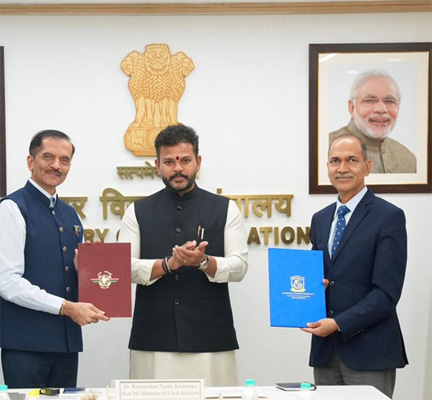
The MoU was formalised in the presence of Union Civil Aviation Minister Rammohan Naidu Kinjarapu, senior ministry officials, and security leadership, marking a coordinated push to strengthen aviation infrastructure.
The partnership establishes a formal institutional framework for collaboration between BCAS and RRU across:
- Testing & certification
- Research & innovation
- Training & capacity building
- Standards development
Testing Centre to Drive Scientific Validation
Under the agreement, RRU will set up and operate a dedicated Testing Centre to conduct trials of Full Body Scanners and other aviation security equipment as per BCAS directives.
The centre will:
- Perform independent evaluation and verification
- Certify equipment from Original Equipment Manufacturers (OEMs)
- Submit scientifically rigorous and impartial reports for regulatory decisions
This ensures only technically compliant and high-performing systems are deployed in sensitive aviation environments.
Global Standards, Local Capability
The initiative includes the creation of state-of-the-art laboratories aligned with international benchmarks, enabling:
- Performance and safety assessments
- Interoperability testing
- Development of an accreditation framework
This will help India match—and potentially lead—global standards in aviation security testing.
Beyond Testing—Building Talent & Knowledge
The MoU goes beyond infrastructure, focusing on academic collaboration and skill development through:
- Workshops and specialised training programmes
- Knowledge-sharing platforms
- Research in emerging aviation security technologies
It also opens doors for national and international collaborations, ensuring India stays ahead of evolving threat landscapes.
Atmanirbhar Vision Takes Flight
Highlighting the broader significance, RRU Vice-Chancellor Bimal N. Patel said: “The establishment of the Testing Centre reflects the spirit of Atmanirbhar Bharat in the field of aviation security.”
He added: “Developing indigenous testing, certification and research capabilities marks a critical step toward reducing dependence on foreign technologies, ensuring technology sovereignty, and fostering innovation within India’s security ecosystem.”
Further emphasising the institutional role, he noted: “The collaboration between RRU and BCAS exemplifies the University’s commitment to translating national policy visions into institutional mechanisms that strengthen India’s self-reliance and preparedness in emerging domains of national security.”
With this initiative, India is not just securing its skies—it is building the scientific backbone to test, trust, and deploy its own security technologies, reinforcing both safety and sovereignty.