NE POLITICAL BUREAU
NEW DELHI, APR 17
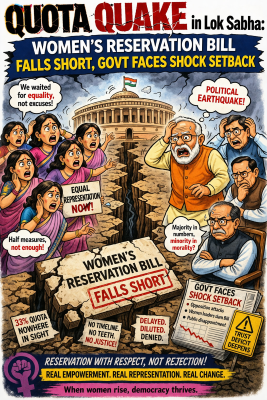
In a dramatic legislative setback, the 131st Constitution Amendment Bill—aimed at implementing women’s reservation alongside delimitation of Lok Sabha seats—failed to pass in the Lok Sabha, despite strong backing from Narendra Modi and Amit Shah.
The bill could not muster the constitutionally mandated two-thirds majority, with only 278 votes in favour out of 489 members present, halting the government’s ambitious push to reshape political representation.
- 131st Constitution Amendment Bill Fails to Secure Two-Thirds Majority in Crucial Floor Test
- PM Modi, Amit Shah’s Push Stalls as Opposition Unites Against Delimitation Linkage
- 278 Votes Fall Short of Required Threshold, Speaker Confirms Defeat in House
- Opposition Claims ‘Victory for Constitution’, Govt Vows to Rework Strategy
- What Next: Fresh Bill, Political Consensus or Phased Reform on Women’s Reservation?
Announcing the outcome, Om Birla said,
“The Constitution (131st Amendment) Amendment Bill did not pass as it did not achieve a 2/3 majority during voting in the House.”
The House was subsequently adjourned till 11 am on Saturday.
Opposition Strikes Back
Opposition leaders swiftly framed the defeat as a defence of constitutional balance rather than opposition to women’s empowerment.
Rahul Gandhi said,
यह महिला आरक्षण बिल नहीं है – इसका महिलाओं से कोई संबंध नहीं।
यह बिल OBC विरोधी है,
यह बिल SC-ST विरोधी है,
यह बिल Anti National है – दक्षिण, उत्तर-पूर्व, उत्तर-पश्चिम और छोटे राज्यों के खिलाफ है।हम भारत जोड़ने वाले न किसी का हक़ छिनने देंगे, न देश को बंटने देंगे। pic.twitter.com/9tAUMZOI9g
— Rahul Gandhi (@RahulGandhi) April 17, 2026
“We have defeated this attack on the Constitution. We have clearly said that this is not a women’s reservation bill, but it is a way to change India’s political structure.”
Echoing similar concerns, Priyanka Gandhi Vadra remarked,
Smt. Priyanka Gandhi Vadra, MP (Lok Sabha) and General Secretary, AICC, addressed the public at Nazira, Assam, today. pic.twitter.com/408LmS3XJS
— AICC Communications (@AICCMedia) April 1, 2026
“The bill was defeated because of the way the govt linked women’s reservation to delimitation and earlier census.”
Senior Congress leader Shashi Tharoor clarified the party’s stance, stating,
“This was not a vote against women’s reservation, but against delimitation and the mischief that delimitation and the dramatic expansion of Parliament would do to our democracy, so we voted to save our democracy…”
He added,
“We have said even in our speeches, that we will vote for women’s reservation if you will delink it from delimitation. It is against their refusal to delink this that we have voted…”
Government Hits Back, Signals Resolve
We'll keep working for India's women!
महिलाओं को सम्मान देने वाले इस ऐतिहासिक विधेयक पर विपक्ष ने साथ नहीं दिया।
प्रधानमंत्री @narendramodi जी के नेतृत्व में हमारी सरकार महिलाओं के सम्मान के लिए कार्य करती रहेगी।#AntiWomenAlliance #महिला_विरोधी_कांग्रेस #MahilaVirodhiCongress pic.twitter.com/uguqLkFrrM— Kiren Rijiju (@KirenRijiju) April 17, 2026
Reacting strongly, Union Minister Kiren Rijiju criticised the opposition and asserted that the government remains committed to women’s reservation, indicating that the reform is far from shelved.
While the government has not officially detailed its next move, political and policy signals suggest multiple possible pathways:
What Next: Possible Course Correction
Reworked Bill Without Delimitation Clause
The government may introduce a revised version of the bill, separating women’s reservation from delimitation to build broader consensus—an option even opposition leaders have indicated willingness to support.
Joint Parliamentary Committee (JPC) Route
A consultative mechanism involving all parties could be set up to address concerns around delimitation, federal balance, and representation—aligning with demands raised during the debate.
Phased Implementation Strategy
The Centre may explore implementing women’s reservation using the current seat structure, postponing delimitation-linked expansion to a later stage.
Political Outreach & Consensus Building
Expect intensified backchannel negotiations with regional parties, especially from southern and northeastern states, where concerns over representation remain sensitive.
Renewed Push Post Census Clarity
With delimitation tied to census data, the government could revisit the reform after updated demographic data is available, strengthening its legislative case.
High-Stakes Political Signal
The defeat underscores the complexities of balancing gender justice with federal and demographic sensitivities. While the government pitched the bill as a historic step toward empowering women, the opposition successfully reframed it as a structural overhaul of India’s political map.
The coming weeks are likely to witness intense political manoeuvring, as both sides attempt to shape the narrative—and the next version—of one of the most consequential reforms in India’s parliamentary history.