


NE HEALTH BUREAU
CHENNAI, APR 17
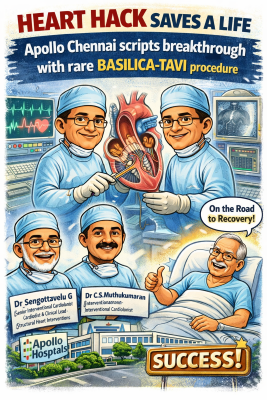
In a pioneering medical breakthrough, Apollo Hospitals Chennai has successfully performed a rare and highly advanced BASILICA-assisted Transcatheter Aortic Valve Implantation (TAVI) procedure on a 67-year-old high-risk cardiac patient—preventing a potentially fatal complication during valve replacement and marking a significant leap in India’s cardiac care landscape.
The complex, minimally invasive procedure was led by Dr Sengottuvelu G, Senior Interventional Cardiologist and Clinical Lead – Structural Heart Interventions, Apollo Hospitals, Chennai, along with a multidisciplinary cardiac team. The technique is especially suited for patients who are not eligible for repeat open-heart surgery, offering a safer and less invasive alternative for complex valve conditions.
- Landmark First for Apollo Group: Advanced Technique Prevents Fatal Coronary Blockage
- High-Risk 67-Year-Old Patient Successfully Treated Without Open-Heart Surgery
- Precision Meets Innovation: Minimally Invasive Valve Replacement Redefines Cardiac Care
- BASILICA Technique Emerges as Lifesaving Shield in Complex Valve Procedures
- Global-Standard Success Achieved with Over 90% Efficacy Technique
The patient had a complicated medical history, including diabetes, coronary artery disease treated with stents, and a prior aortic valve replacement surgery in 2017. Over time, the artificial valve had deteriorated, leading to severe aortic stenosis and moderate regurgitation, necessitating urgent intervention.
Pre-procedure imaging revealed a critical risk: the coronary arteries were positioned extremely close to the previously implanted valve. In such cases, inserting a new valve could push the old valve leaflets into the coronary openings, blocking blood flow and causing life-threatening complications.
To overcome this, doctors performed TAVI, where a new valve is delivered to the heart through a blood vessel in the leg. Given the high risk of coronary obstruction, they combined it with the advanced BASILICA technique, designed specifically to prevent such blockages.
Dr Sengottuvelu G said, “This case demonstrates how far transcatheter-based therapies have advanced in managing complex structural heart diseases. BASILICA is a highly precise and technically demanding procedure, and its successful execution reflects the expertise and coordination of our team.”
During the procedure, a fine guidewire was carefully positioned across the risky valve leaflet. Using controlled electrosurgical energy, the leaflet was split into two, ensuring that once the new valve was deployed, the split sections would move aside—keeping coronary blood flow unobstructed.
As an added safety measure, guidewires were pre-positioned in both coronary arteries, with stents kept ready for immediate use if required—ensuring rapid restoration of blood flow in case of emergency.
Dr C. S. Muthukumaran, Interventional Cardiologist, Apollo Hospitals Chennai said, “Performing the BASILICA procedure for the first time within the Apollo group is a proud milestone. It reinforces our commitment to bringing cutting-edge, lifesaving technologies to patients in India.”
The procedure concluded successfully, with excellent clinical outcomes. Blood flow through the new valve was optimal, no coronary obstruction occurred, and the patient maintained stable heart rhythm before being safely discharged.
Though coronary obstruction during TAVI is rare—occurring in less than 1% of cases—it carries a high mortality risk of 40–50% if it happens. Techniques like BASILICA, which boast a success rate of over 90% globally, are therefore critical in managing such high-risk scenarios. However, due to the expertise required, its use remains limited, especially in India.
This landmark case underscores the growing role of advanced structural heart interventions in reducing the need for open-heart surgeries while ensuring faster recovery and improved patient outcomes.