


R ARIVANANTHAM
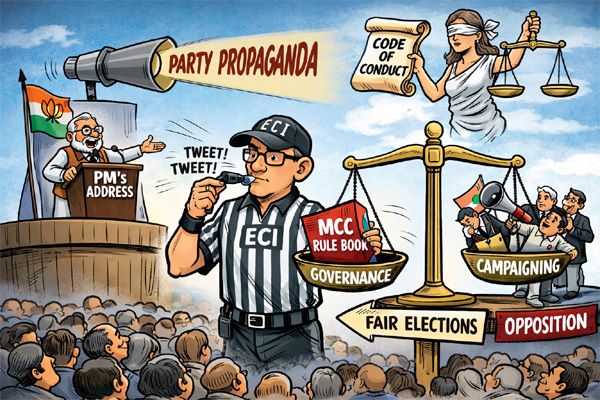
In what could become a defining test of India’s electoral norms, a complaint by over 700 citizens against Prime Minister Narendra Modi has triggered a wider debate on whether executive communication during elections disturbs the democratic balance.
The petition, submitted to the Election Commission of India (ECI), alleges that the Prime Minister’s nationwide address on April 18—delivered after the setback to the women’s reservation bill—amounted to a “clear and blatant violation” of the Model Code of Conduct (MCC).
- Citizens’ complaint puts Election Commission scrutiny on Prime Minister’s national address
- Allegations of Model Code breach over use of official platforms for political messaging
- Debate intensifies on fairness, neutrality and equal electoral opportunity
- Ruling party defends address as governance communication, Opposition calls it misuse of power
- Experts flag grey areas between state duty and campaign advantage
- Women’s reservation bill deadlock adds political and emotional weight to the issue
- ECI’s response may redefine boundaries of election-time communication
- Alleged violation of MCC Clauses 1(a), 1(b) and Section VII provisions
At its core lies a critical constitutional question: Can a Prime Minister, speaking in an official capacity, comment on politically contested legislative developments during an election period without influencing the electoral field?
The complaint: ‘Undue Advantage’ and MCC provisions
The complainants contend that the use of “official government machinery and mass media” to present a politically charged narrative—blaming the Opposition for blocking the Constitution (131st Amendment) Bill—gave the ruling party an unfair advantage.
“Such action provides an undue advantage to the party in power and undermines the level playing field essential for free and fair elections,” the complaint states.
Invoking Clauses 1(a), 1(b) and Section VII of the MCC, the petition urges the ECI to initiate an inquiry and consider deterrent action, including removal of the speech from official platforms if found in violation.
Government’s stand: ‘Duty to inform’
Leaders of the Bharatiya Janata Party (BJP) have defended the address, describing it as a legitimate act of governance.
A senior BJP leader said: “The Prime Minister has a responsibility to inform citizens about important legislative developments. This was not campaign rhetoric but governance communication.”
The party maintains that the MCC does not explicitly prohibit such addresses and cautions against restrictive interpretations that could impede administrative transparency.
Opposition’s charge: ‘Misuse of state power’
Opposition parties, including the Indian National Congress, have sharply criticised the address.
A Congress leader remarked: “This is a clear misuse of official machinery for political messaging. One cannot separate the office from the political intent during an election period.”
Opposition leaders have also reiterated their demand that the women’s reservation bill be introduced independently, without being linked to delimitation.
ECI’s crucial role
The Election Commission of India has so far maintained restraint, but former election commissioners suggest the issue could set a significant precedent.
A former Election Commissioner observed: “The Model Code is not statutory law but carries moral authority. The challenge lies in distinguishing governance communication from political messaging in a highly mediated environment.”
Experts’ view: A Constitutional grey zone
Legal scholars and political analysts broadly agree that the controversy sits in a grey area.
A constitutional expert noted: “The interpretation of the MCC depends on context, intent and impact. This case tests the thin line between state responsibility and electoral influence.”
Political communication specialists point to the role of amplification: “In the digital age, even an official address can function as political messaging once amplified across platforms, raising new regulatory questions.”
Women’s Reservation Bill: Policy meets politics
The backdrop to the controversy is the stalled Constitution (131st Amendment) Bill aimed at introducing reservation for women in Parliament and state assemblies.
While the bill secured support from 298 MPs, it fell short of the required two-thirds majority, with 230 MPs opposing it.
The government has accused the Opposition of blocking a transformative reform, while critics argue that linking it to delimitation complicates implementation and delays benefits.
The larger democratic question
Beyond the immediate dispute, the episode raises deeper concerns:
- Where does governance end and campaigning begin?
- Should incumbents face stricter communication norms during elections?
- Can true parity exist in access to mass communication platforms?
As one policy analyst put it: “The perception of fairness is as vital as fairness itself. Any imbalance—real or perceived—can influence voter trust.”
Classical wisdom, contemporary relevance
The ethical dimensions of governance and restraint find resonance in classical thought.
From Arthashastra by Chanakya: “The king shall consider as good, not what pleases himself, but what pleases his subjects.”
From Thirukkural by Thiruvalluvar: “The world clings to the feet of the just ruler who governs with fairness and impartiality.”
These enduring insights underline the principle that power must be exercised with visible neutrality, especially in moments that shape democratic choice.
What lies ahead
The ECI’s eventual response—whether advisory, censure, or dismissal—will be closely watched as a benchmark for future conduct.
With political communication evolving rapidly and elections becoming increasingly media-driven, this episode may well redefine how the Model Code of Conduct is interpreted in the years ahead.
For now, the controversy stands as a reminder that in a democracy, not just actions, but their context and consequences, are subject to public judgment.
(Author of this article is R Arivanantham, Executive Editor (Former Senior Correspondent, THE HINDU), navjeevanexpress.com He can be contacted – Mails: hindukgi@gmail.com, navjeevanexpress@gmail.com Mobile: 9444671601)