- Century-old minority-language schools shut across Ahmedabad, Surat, Kalol amid falling enrolment
- NEP mandate vs ground reality: constitutional promise of mother-tongue education under strain
- Industrial migration fuels diversity, but civic infrastructure lags behind
- Debate sharpens as Delhi model, global practices, and cultural initiatives come under spotlight
- When a golden jubilee turns into a goodbye — the closure of Maninagar’s only Tamil school becomes a symbol of a larger question: can a state grow globally while its languages fade locally?
R MANICKAVASAGAM
AHMEDABAD, APR 22
A simmering discontent is gaining voice in Gujarat as linguistic minorities allege that the gradual closure of mother-tongue schools in civic systems amounts to a denial of a fundamental educational and cultural right.
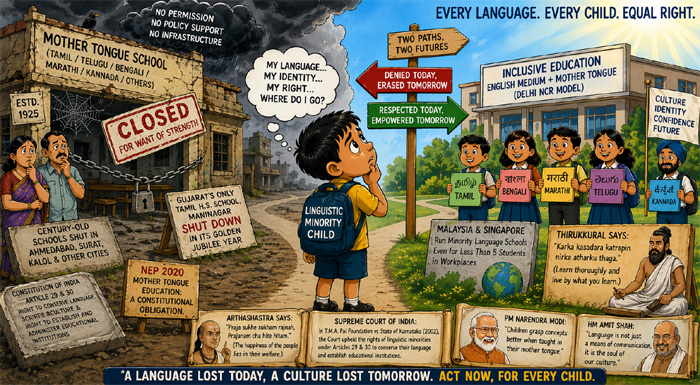
In cities such as Ahmedabad, Surat and Kalol, several minority-language schools—some with a legacy spanning over a century—have shut down, citing inadequate student strength. The closures come at a time when rapid industrialisation continues to draw workers from across India, making Gujarat one of the most linguistically diverse states.
A striking example often cited by community leaders is the shutdown of Gujarat’s only Tamil Higher Secondary School in the Tamil-dominated Maninagar area—ironically during its golden jubilee year—due to lack of adequate enrolment. Stakeholders point out that the school trust had been persistently seeking state government permission to convert it into an English-medium institution on the lines of the NCR model, while retaining mother-tongue instruction, but the proposal remained unaddressed.
Stakeholders argue that this contradiction exposes a deeper policy gap. “Denying a child the right to learn in their mother tongue is nothing but denying breastmilk to an infant,” said an education activist, underlining the emotional and cognitive importance of early learning in one’s native language.
The National Education Policy (NEP) 2020 clearly advocates mother-tongue instruction at the foundational level, placing a constitutional and moral obligation on state governments and local bodies to facilitate such access. However, parents and community leaders say implementation remains inconsistent.
A senior civic school official, requesting anonymity, admitted the challenge: “We are bound by minimum enrolment norms. Running schools with very low strength becomes administratively and financially difficult.”
Yet, global education experts point out that such constraints can be overcome with innovative policy design. According to UNESCO-aligned research on multilingual education, “mother-tongue-based learning improves comprehension, retention, and cognitive development, especially in early years.” Countries like Malaysia and Singapore, they note, run minority-language classes even for very small groups, often within workplace-linked or community-supported schooling systems.
The contrast within India is also stark. In the National Capital Region, governed by the BJP, linguistic minorities are permitted to run English-medium schools with mandatory teaching of their mother tongue—an approach many see as a pragmatic balance between global aspirations and cultural preservation.
This has sparked political questions in Gujarat. If initiatives like Kashi Tamil Sangamam and Saurashtra Tamil Sangamam aim to celebrate and preserve classical languages, why can’t similar commitment reflect in school education? ask community representatives.
Political observers note that despite the emotive resonance of the issue, it has not found prominence in local body election campaigns across parties—be it BJP, Congress, or AAP.
Prime Minister Narendra Modi has repeatedly emphasised the importance of mother tongue in education. “Children grasp concepts better when taught in their mother tongue,” he has said in multiple public forums, advocating culturally rooted learning. Union Home Minister Amit Shah too has stressed linguistic pride, stating, “Language is not just a means of communication, it is the soul of our culture.”
Scholars also invoke ancient Indian wisdom to strengthen the argument. The Arthashastra underscores the role of education aligned with societal needs, while the Thirukkural proclaims: “Learning is excellence of wealth that none destroy.” Experts interpret this as a call for inclusive, accessible education—rooted in one’s linguistic identity.
From a legal standpoint, the Supreme Court of India has upheld the rights of linguistic minorities under Article 29 and Article 30 of the Constitution, recognising their right to conserve language and establish educational institutions. In landmark rulings such as T.M.A. Pai Foundation vs State of Karnataka (2002), the Court affirmed that minority communities have the right to administer institutions of their choice, though reasonable regulations may apply.
Education policy analysts argue that while the legal framework exists, execution at the grassroots remains uneven. “The challenge is not constitutional validity but administrative will and policy innovation,” said a policy researcher.
Meanwhile, the steady conversion of Gujarati-medium civic schools into English-medium institutions—driven by globalisation and parental aspirations—has added another layer to the debate. While English opens economic doors, experts caution against it coming at the cost of linguistic diversity.
As Gujarat positions itself as an economic powerhouse, linguistic minorities say the time has come to ensure that development does not sideline cultural and educational rights. The demand is clear: a balanced, inclusive schooling model that respects both global ambitions and local identities.
Read also