
R ARIVANANTHAM
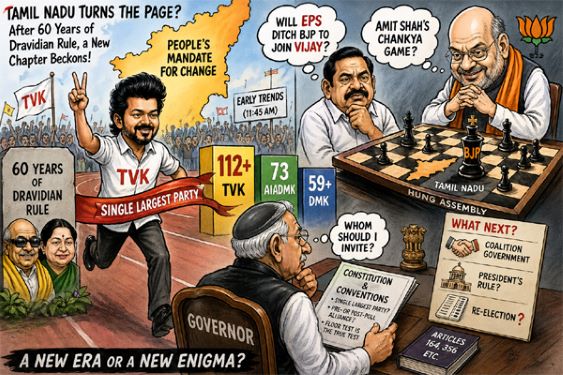
Tamil Nadu woke up to what can only be described as a political earthquake. For the first time in over six decades, the Dravidian duopoly appears shaken at its core, with Tamilaga Vettri Kazhagam (TVK) — led by actor-turned-politician Vijay — emerging as the single largest party in its very first electoral outing.
Early counting trends suggest TVK leading in over 112 seats, ahead of the All India Anna Dravida Munnetra Kazhagam (AIADMK) and pushing the ruling Dravida Munnetra Kazhagam into an unthinkable third position. If these numbers hold, it marks a tectonic shift away from the political binaries that have defined the State since the late 1960s.
- Vijay’s TVK surges as single-largest party in debut, upending six decades of Dravidian dominance
- Hung House arithmetic raises questions: Will Edappadi K. Palaniswami pivot away from BJP to back a new axis?
- Backroom chess begins as Amit Shah weighs coalition calculus in a fractured mandate
- Governor’s discretion, constitutional guardrails, and spectre of President’s Rule come into sharp focus
The symbolism is hard to miss. From M. Karunanidhi to MGR-J. Jayalalithaa, and now M. K. Stalin, Tamil Nadu’s political imagination has long been anchored in Dravidian ideology. Today, that continuum faces its most serious rupture.
A mandate for change—or a moment of flux?
The scale of TVK’s surge — leading across Chennai’s 16 constituencies, including in Kolathur and Chepauk — suggests not merely anti-incumbency but a deeper churn. Even heavyweights like Udhayanidhi Stalin and senior ministers are reportedly trailing.
Yet, this is not a decisive verdict—at least not yet. The magic number of 118 remains uncertain, and Tamil Nadu could well be staring at its first hung Assembly in decades.
Constitutional experts point out that “being the single largest party does not automatically translate into a right to govern; the test is majority on the floor of the House.” This principle, reiterated by the Supreme Court in multiple judgments, places the spotlight firmly on post-poll alliances.
EPS at the crossroads: Kingmaker or spectator?
The spotlight now shifts to Edappadi K. Palaniswami. With AIADMK in second place, EPS holds the pivot.
Will he continue the party’s uneasy alignment with the Bharatiya Janata Party, or seize the moment to back Vijay and reclaim political centrality?
Political observers note that “AIADMK’s ideological flexibility has historically allowed it to recalibrate alliances swiftly.” A tie-up with TVK, while unconventional, could offer both parties a path to power—TVK gets numbers, AIADMK regains relevance.
Delhi’s chessboard: Will Amit Shah play Chanakya?
In a fractured mandate, New Delhi inevitably becomes a silent stakeholder. Amit Shah, often described as the BJP’s master strategist, faces a delicate balancing act.
With BJP trailing in most constituencies, its leverage lies not in numbers but in negotiation. “In hung Assemblies, smaller players can punch above their weight,” a senior political analyst observed, hinting at the possibility of backchannel manoeuvres.
The question is whether the BJP will attempt to stitch together an alternative coalition or play a longer game, allowing regional contradictions to surface.
Raj Bhavan’s moment: Constitutional morality under lens
At the heart of the unfolding drama is the role of the Governor. Under Article 164, the Governor invites a leader to form the government—but convention, not codified law, guides that choice.
Should the Governor first invite the single largest party, or a post-poll alliance claiming majority? Past precedents—from Karnataka (2018) to Maharashtra (2019)—offer conflicting templates.
As one constitutional scholar puts it: “The Governor must act not merely legally, but constitutionally—ensuring that the floor test, not subjective satisfaction, determines legitimacy.”
President’s Rule: Remote possibility or real threat?
If no party or alliance is able to demonstrate a majority, the State could briefly slip into President’s Rule under Article 356. However, experts caution that “courts have repeatedly held that floor tests must be exhausted before invoking central rule.”
Re-election, while constitutionally permissible, is politically costly and administratively disruptive—making it the least preferred outcome.
Beyond numbers: A political reset in motion
What makes this moment historic is not just the numbers, but the narrative shift. Vijay’s rise reflects a generational churn—urban discontent, aspirational politics, and the blurring of cinema and political charisma.
But the road ahead is fraught. Governance demands more than momentum; it requires coalition management, administrative depth, and ideological clarity.
As counting trends evolve, Tamil Nadu stands at a crossroads—between continuity and change, stability and experimentation.
The Dravidian era may not be over. But for the first time in 60 years, it is undeniably under question.