
R ARIVANANTHAM
CHENNAI, MAY 4
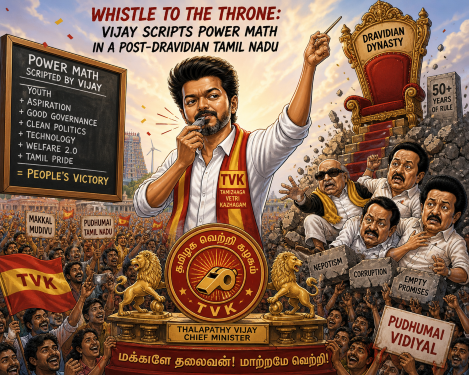
Actor-turned-politician C. Joseph Vijay’s Tamilaga Vettri Kazhagam (TVK) has upended Tamil Nadu’s entrenched Dravidian duopoly, emerging as the single largest party and redrawing the State’s political map. With TVK leading in 107 of 234 constituencies—short of the 118 majority—the spotlight has swiftly shifted from celebration to coalition craft.
- Hung House, Clear Signal: TVK emerges single largest with 38% vote share, leads in 107; majority mark at 118 keeps coalition arithmetic centre-stage
- Delhi to Chennai Axis: Congress, Left and VCK signal support; backchannel talks point to a stitched majority within a week
- EPS at the crossroads: Will AIADMK’s Edappadi K. Palaniswami rethink BJP ties to stay politically relevant?
- Coalition Dharma 2.0: Power-sharing formula likely with Deputy CM slots, rotational portfolios and a Common Minimum Programme
- Populism vs purse: Vijay’s welfare-heavy manifesto to test fiscal headroom; phased rollout and reprioritisation on the cards
- From Reel to real: Governance challenge begins as novices in Assembly face delivery deadlines amid high public expectations
Vijay’s own early signal on alliances—articulated at Vikravandi in 2024—now appears prescient. “We are open to a coalition government,” he had said then. Party insiders say the contours of that coalition are already taking shape.
The power-sharing template
Multiple sources in the Congress, VCK and Left parties indicate readiness to back a TVK-led government. The likely blueprint resembles a Common Minimum Programme (CMP) with calibrated power-sharing:
- Deputy Chief Minister(s): One berth likely for Congress or a consensus ally to stabilise the coalition.
- Key portfolios by formula: Finance or Industries to a senior ally; Health/Education retained by TVK for flagship delivery; Agriculture to a partner with rural footprint.
- Coordination committee: A cabinet-level mechanism to resolve disputes and track CMP milestones.
- Legislative agenda pact: Time-bound passage of priority welfare bills and governance reforms.
A senior Congress functionary, requesting anonymity, said, “The mandate is for change; we will support a stable, secular government led by TVK.” Leaders in the VCK and Left echoed the sentiment, emphasising social justice planks within the CMP.
Political historian Dr. K. Sriram notes that “coalition dharma is a balancing act well managed by Dr Manmohan Singh,” adding that a rules-based CMP “can minimise friction and keep partners invested.”
EPS dilemma: Break or brace?
For the AIADMK, the verdict poses an existential question. Edappadi K. Palaniswami (EPS), whose party trails with 54 leads, must decide whether to persist with the BJP alliance or recalibrate to retain relevance in a rapidly shifting landscape.
A senior Chennai-based psephologist observes, “If EPS stays tethered to the BJP, he risks further erosion in a State where the mandate has clearly tilted to a new axis. A tactical distancing—or issue-based support to a TVK coalition—could be a survival play.”
However, AIADMK insiders remain divided. One faction favours rebuilding independently, while another is open to “conditional engagement” to retain legislative leverage.
Locking the numbers, preventing drift
Amid a fractured mandate, TVK is moving to secure its flock. Sources say newly elected MLAs may be housed together near Chennai to pre-empt defections. Closed-door meetings at Vijay’s Panaiyur office are focused on finalising alliance terms and portfolio mapping. Swearing-in, insiders suggest, could follow within a week.
The fiscal test: Can promises be paid for?
If coalition arithmetic is one challenge, fiscal arithmetic is the bigger one. TVK’s manifesto is expansive—monthly assistance of ₹2,500 for women, gold for marriage assistance, free LPG cylinders, higher education loans, MSP enhancements, job creation, and a ₹25 lakh family health insurance scheme, among others.
Economist Dr. Meera Krishnan cautions,
“The cumulative outlay could significantly widen the revenue deficit unless sequenced carefully. A phased rollout with strict targeting is essential.”
Public finance expert R. Venkataraman adds,
“Tamil Nadu has fiscal strengths, but not limitless space. Reprioritising subsidies, improving tax compliance, and leveraging public-private partnerships will be key.”
A possible roadmap to deliver
Policy advisers around TVK are understood to be weighing a three-stage implementation:
- First 100 days (high-visibility, low-friction):
- 200 units free power, free health check-ups, time-bound service delivery law, doorstep ration pilots.
- Launch of AI Ministry and groundwork for AI University/City to signal growth orientation.
- Year 1 (targeted welfare + jobs):
- Women’s cash transfer rolled out in phases with income/age filters.
- Five lakh government jobs + internships via departmental audits and staggered recruitment.
- MSP enhancements backed by procurement efficiency and logistics upgrades.
- Years 2–3 (capital-heavy promises):
- Health insurance scale-up, hospital modernisation.
- Education investments—Kamaraj residential schools, higher education credit lines.
- Agrarian relief—calibrated loan waivers tied to landholding thresholds.
Industry bodies have welcomed the emphasis on ease of doing business, particularly the promise of licence clearances within 21 days. “If implemented, this could offset welfare pressures by accelerating investment and jobs,” said a senior executive from a Chennai manufacturing association.
The verdict beneath the numbers
Beyond arithmetic, the election reflects a demographic surge—women and youth rallying behind a “change” narrative. As TVK leader Aadhava Arjuna put it, “Women saw Vijay as their son, brother, and family… they trusted him as an emotional and reliable leader.” He called the outcome a “revolution” that has disrupted decades of bipolar politics.
Congress MP Karthi Chidambaram acknowledged the shift, noting the “scale of the mandate and the changing aspirations” of the electorate.
From mandate to management
Vijay’s ascent has been swift; governance will be exacting. A cabinet with many first-time legislators will need institutional support, technocratic depth, and coalition discipline. The immediate task is to convert a moral mandate into a stable majority—and then into measurable outcomes.
If the numbers align and the CMP holds, Tamil Nadu could see a new coalition template—one that blends welfare with growth, and political novelty with administrative continuity. The next week will decide the government; the next year will decide the experiment.