R ARIVANANTHAM
TIRUCHIRAPPALLI, JUNE 14
For thousands of farmers who travelled from villages across Tamil Nadu and neighbouring states to Tiruchirappalli on Sunday, the event was more than just an agricultural conference. It was a glimpse into a greener future—one where farms resemble forests, soils regain their vitality and farmers earn sustainable incomes while nurturing nature.
- Over 6,000 farmers gather in Tiruchirappalli to explore food forests and sustainable tree-based farming
- Scientists warn of declining soil health and advocate nature-based agriculture for long-term prosperity
- Farmers share inspiring stories of transforming barren lands into thriving multi-crop ecosystems
- New fruit varieties, innovative cultivation techniques and value-addition opportunities showcased
- Subsidised saplings and rare fruit exhibitions spark enthusiasm among farmers and families alike
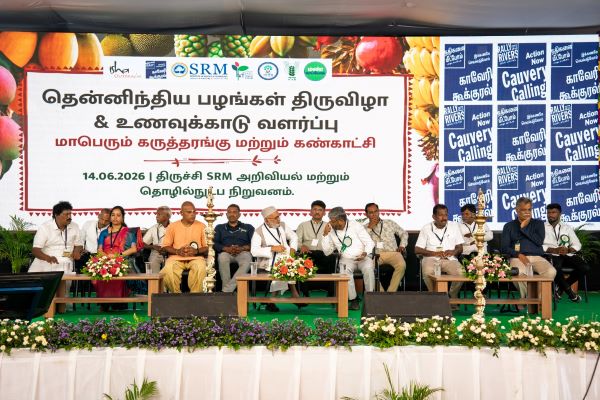
More than 6,000 farmers and members of the public attended the “Food Forest Cultivation and South Indian Fruits Festival”, organised by Sadhguru’s Save Soil–Cauvery Calling movement at the SRM University campus here.
The sprawling venue was abuzz with conversations on mangoes, bananas, avocados and jackfruit, but the central message resonated far beyond fruits: restoring the land through tree-based agriculture may hold the key to safeguarding both farmers’ livelihoods and the environment.
Farming with Trees, Growing wCaith Nature
Scientists, agricultural experts and progressive farmers at the conference highlighted food forests and tree-based agriculture as practical and sustainable alternatives to conventional farming.
Tamilmaran, Coordinator of Cauvery Calling, said awareness about tree-based farming has increased dramatically among farmers following the movement’s campaigns.
“Demand for saplings from our nurseries has risen sharply. Tree-based agriculture improves soil fertility, enhances water retention, strengthens river ecosystems and significantly boosts farmers’ incomes,” he said.
He added that the growing acceptance of the concept was reflected in a recent decision by Union Agriculture Minister Shivraj Singh Chouhan to rename “Agroforestry” as “Tree-Based Agriculture” following representations from farmers and experts.
“The change in terminology reflects a larger shift in mindset. Farmers increasingly see trees not as obstacles but as long-term assets,” he said.
A Warning from the Soil
The conference also sounded an alarm over declining soil health caused by decades of excessive chemical fertiliser use.
Dr Selvarajan, Director of the National Research Centre for Banana, illustrated the challenge with a striking comparison.
“In the 1970s, one kilogram of urea could produce about 30 kilograms of wheat. Today, the same amount yields only around five kilograms,” he said.
“The reason is simple—our soils have lost organic matter and biological activity. Once soil fertility declines, fertilisers alone cannot restore productivity. That is why tree-based agriculture has become essential.”
He also introduced a newly developed banana variety named “Cauvery,” which contains no sucrose and can be consumed by diabetic patients. He noted that farmers could increase their earnings by producing more than 40 value-added products from bananas.
A Farmer’s Journey to the United Nations
Among the many inspiring stories shared at the conference, few drew as much attention as that of Valluvan, a farmer from Coimbatore and a United Nations award recipient.
There was a time, he recalled, when his farm consisted solely of coconut trees and he was sceptical about integrating other crops.
“When Sadhguru’s Save Soil movement first introduced tree-based agriculture to me, I did not believe it would work,” he admitted.
“But they taught me about soil organic matter and how to improve it. Today, I cultivate 14 crops in the same farm—including mango, jackfruit, banana, sapota, nutmeg and pepper.”
His transformation from a conventional farmer to an internationally recognised practitioner of sustainable agriculture drew loud applause.
“I thank Isha and Sadhguru for helping me evolve from an ordinary farmer to someone recognised at the United Nations,” he said.
Creating Forests Inside Farms
Agriculture expert Bala Mohan explained how even traditional coconut farms could be transformed into vibrant food forests.
“A significant portion of land in a coconut farm remains unused,” he said.
“By introducing multi-layer and multi-crop systems, farmers can utilise sunlight more efficiently, conserve soil moisture through natural mulching and increase soil organic carbon.”
The result, he said, is a farm that behaves like a forest—supporting biodiversity, improving soil health and providing multiple streams of income.
Festival of Fruits Draws Crowds
The conference was as much a celebration of nature’s bounty as it was an academic gathering.
Visitors marvelled at exhibitions featuring more than 60 varieties of bananas and over 100 varieties each of mangoes and jackfruits.
One of the star attractions was Padma Shri awardee and legendary horticulturist Kaleem Ullah Khan, popularly known as India’s “Mango Man,” who has successfully grafted 300 mango varieties onto a single tree.
Farmers queued up to hear his experiences and learn the secrets behind his extraordinary achievement.
Scientists from premier institutions, including ICAR’s horticultural research centres and NIFTEM, Thanjavur, also offered guidance on fruit cultivation, value addition and market opportunities.
As the day drew to a close, farmers left not only with knowledge but also with saplings of mango, jackfruit, avocado, apple and other fruit trees offered at subsidised prices.
For many, those saplings represented more than plants. They symbolised hope—hope that the future of farming could be greener, more profitable and in harmony with nature.