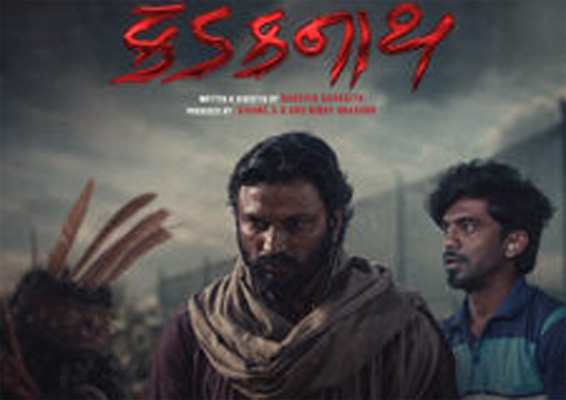
- Kaushik Garasiya’s folk-noir thriller breaks away from formulaic Gujarati cinema to deliver a haunting tale rooted in Adivasi identity, Bhili dialect and psychological suspense
- A slow-burning mystery where atmosphere triumphs over jump scares, proving restraint can be more terrifying than excess
- Abhinay Banker and an ensemble comprising seasoned and first-time performers breathe startling authenticity into a world rarely seen on the Gujarati screen
- Harshit Saini’s evocative cinematography, Kedar & Bhargav’s haunting score, Vihang Rathod’s measured editing and Jikku Joshi’s immersive sound design emerge as silent protagonists
- Workshops, dialect coaching and community participation lend the film an honesty that cannot be manufactured inside studios
- Produced by Lensqueen Films, ‘Kadaknath’ deserves applause for daring to expand the grammar of Gujarati cinema instead of merely entertaining its audience.
GOWRI MANICKAVASAGAM
Gujarati cinema has often been identified with family entertainers, broad comedies, urban-centric and socially driven dramas. Every once in a while, however, a film arrives not merely to tell a story but to redraw the boundaries of what the industry can attempt. “Kadaknath” belongs firmly in that category.
Writer-director Kaushik Garasiya does not simply make a thriller; he constructs an atmosphere. His film refuses to spoon-feed audiences, preferring instead to leave them wandering through dense forests, unsettling silences and lingering doubts. The result is one of the most ambitious genre experiments Gujarati cinema has witnessed in recent years.
Story: Where folklore meets fractured psychology
The narrative unfolds in a remote tribal village where unexplained murders on full moon and no moon days have shattered everyday life. Fear spreads faster than facts, superstition competes with logic, and every character appears to conceal more than they reveal.
Rather than relying on conventional police-procedural tropes, Garasiya allows the mystery to evolve through folklore, inherited beliefs and psychological trauma. The screenplay understands that the greatest horror often lies not in what is seen, but in what remains unexplained.
Even when the film occasionally slows its pace, the emotional investment never weakens because every revelation feels organically earned rather than artificially engineered.
Direction: Kaushik Garasiya announces a fearless new voice
The greatest triumph of Kadaknath lies in its direction.
Garasiya demonstrates remarkable confidence in resisting commercial temptations. There are no unnecessary comic diversions, forced romance or exaggerated heroism. Instead, he trusts silence, atmosphere and character psychology.
His biggest achievement is treating the tribal community with dignity instead of reducing it to cinematic exoticism. The people inhabiting the film are neither victims nor stereotypes; they possess agency, wisdom and emotional complexity.
That creative decision alone distinguishes Kadaknath from numerous mainstream thrillers.
Narrative: Patient, layered and immersive
The storytelling follows the rhythm of the forest itself—measured, unpredictable and quietly dangerous.
Rather than racing from one twist to another, the narrative steadily tightens its grip. Viewers are encouraged to observe details, absorb visual cues and question every assumption.
The screenplay constantly blurs the line between reality, hallucination and inherited memory, ensuring that the audience experiences uncertainty alongside the protagonist.
The Bhili dialect: The film’s greatest act of courage
Perhaps the boldest creative decision is Garasiya’s insistence on retaining the Bhili dialect instead of diluting it for wider commercial appeal.
That choice transforms Kadaknath from a thriller into an important cultural document.
Language here is not decorative—it defines identity.
Garasiya has publicly stated that changing the dialect would have compromised the authenticity of the world he wished to portray, and the decision pays rich dividends. The film becomes less about translation and more about immersion.
Workshops: Authenticity over artificiality
One of the film’s lesser-known strengths lies behind the camera.
The extensive workshops conducted before shooting are visible in almost every frame.
Several performers belong to the Adivasi community and speak Bhili naturally. Rather than merely memorising dialogues, they appear to inhabit their characters completely. Director Kaushik Garasiya has acknowledged that community members contributed not only performances but also cultural accuracy and production support, giving the film unusual authenticity.
Performances: Not stars, but believable human beings
Abhinay Banker delivers one of the finest performances of his career.
His portrayal is deliberately understated. Instead of theatrical expressions, he communicates fear, vulnerability and determination through subtle body language and restrained dialogue delivery.
Denisha Ghumra complements the emotional texture beautifully, while Chetan Daiya, Nirav Bhabhor, Parmeshwar Sirsikar, Het Panchal, Suryanshi Shah, Nisarg Trivedi and the supporting cast contribute performances that never appear manufactured.
What impresses most is the absence of weak links. Every character belongs naturally to the cinematic universe.
Cinematography: The forest becomes a character
Cinematographer Harshit Saini deserves enormous credit.
Instead of merely photographing landscapes, he transforms forests into emotional spaces.
Moonlit trees, dense shadows, smoky village pathways and haunting close-ups create a visual language that constantly sustains suspense.
Darkness is never used to conceal technical shortcomings; it becomes part of the storytelling.
Music, Sound & Lyrics: Fear often arrives through silence
The music by Kedar & Bhargav avoids loud orchestration.
Its greatest strength lies in knowing when not to play.
The background score quietly amplifies tension without manipulating emotions, while the folk influences strengthen the film’s cultural roots. The sound design by Jikku Joshi deserves equal appreciation, using ambient forest sounds, echoes and silence to heighten psychological unease.
The lyrics remain rooted in the soil from which the story emerges, resisting commercial flamboyance in favour of emotional sincerity.
Editing: Controlled rather than flashy
Editor Vihang Rathod understands that thrillers breathe through rhythm.
The editing neither rushes nor overstays.
Transitions remain fluid, allowing suspense to accumulate naturally instead of relying on abrupt shocks.
The measured pacing may demand patience from audiences accustomed to rapid-fire thrillers, but it rewards those willing to surrender to the film’s mood.
Technical excellence
From production design to costumes, make-up and location selection, the film displays unusual consistency.
Nothing appears artificially polished.
Everything feels lived-in.
That realism significantly enhances the psychological impact.
What could have been better?
The first act occasionally takes longer than necessary to establish its world, and a few narrative threads could have benefited from greater emotional closure.
Some viewers expecting a conventional commercial thriller filled with constant twists may find the deliberate pacing demanding.
Yet these are relatively minor observations in an otherwise confident work.
Kudos to the makers
Special appreciation is due to writer-director Kaushik Garasiya, whose conviction never wavers. Instead of chasing formulas, he has attempted something culturally rooted, aesthetically bold and emotionally unsettling.
Equal credit belongs to producers Vihang Rathod and Nirav Bhabhor under Lensqueen Films for backing a project that prioritises originality over predictability. The film’s festival journey—including screenings at the Pune International Film Festival and the NFDC Film Bazaar Viewing Room—underscores its ambition beyond the commercial circuit.
Verdict
Kadaknath is not merely another Gujarati release—it is a statement.
It demonstrates that regional cinema can embrace folklore, psychological horror, indigenous identity and artistic restraint without sacrificing audience engagement.
Long after the mystery is solved, it is the sounds of the forest, the haunting silences, the Bhili voices and the emotional scars of its characters that continue to linger.
That is the mark of cinema which aspires not simply to entertain, but to endure.
A haunting, culturally rooted folk thriller that opens an exciting new chapter for Gujarati cinema.