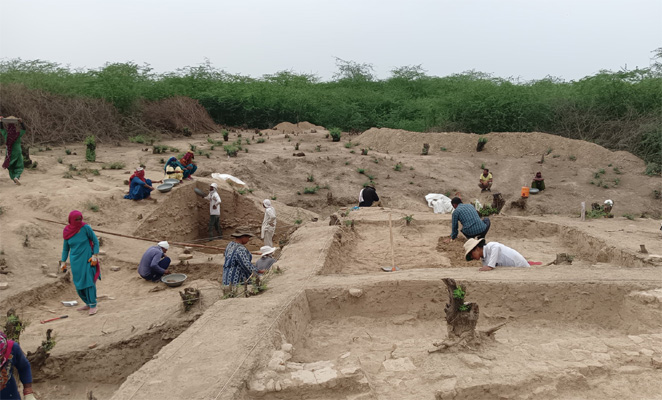

- A defining month in 2026 has thrust archaeology from exploration of river beds and excavation trenches into the heart of law, governance, science and national identity
- Historic developments have elevated the discipline’s public relevance, but the institutions that shaped India’s archaeological scholarship remain under-resourced
- Without sustained investment, academic autonomy and discipline-led leadership, civilisational research risks losing its strongest foundations
- From Deccan College to the Institute of Archaeology, India’s oldest centres of learning deserve a future worthy of their legacy
- Global academic excellence has always been built over generations—not through episodic reforms but through unwavering institutional commitment
- If India truly seeks to become a civilisational knowledge superpower, strengthening archaeology’s historic institutions must become a national priority

ALOK KUMAR KANUNGO
May 2026 may well be remembered as the month when Indian archaeology stepped decisively into the national spotlight—not merely as a discipline concerned with excavating the past, but as an indispensable pillar of jurisprudence, scientific inquiry, cultural diplomacy and public policy.
Within just three weeks, four landmark developments collectively signalled a profound shift in the way archaeology is perceived and valued across India.
On May 7, the Government of Maharashtra appointed a distinguished academic-administrator as Chancellor of the Deccan College Post-Graduate & Research Institute (DCPGRI), Pune. On May 15, the Madhya Pradesh High Court delivered its landmark judgment on the Bhojshala-Kamal Maula complex at Dhar, relying substantially on archaeological and scientific evidence. On May 20, the Anusandhan National Research Foundation (ANRF) announced the establishment of three Convergence Research Centres of Excellence for Archaeology and Traditional Knowledge Systems. Finally, on May 29, the Ministry of Culture appointed the first-ever administrator to the Pandit Deendayal Upadhyaya Institute of Archaeology (PDUIA) at Greater Noida.
Viewed together, these developments represent far more than administrative decisions or isolated institutional milestones. They affirm that archaeology has moved beyond excavation reports, museum galleries and academic conferences to occupy a central place in debates surrounding heritage, identity, law, science and governance.
Yet this historic momentum also compels us to confront an uncomfortable question.
Are we strengthening the very institutions that built Indian archaeology?
That question is as urgent as it is consequential.
For decades, India’s archaeological scholarship has been rooted in universities, shaped by multidisciplinary inquiry and enriched by scientific research. Institutions such as DCPGRI and PDUIA have done far more than train archaeologists; they have defined intellectual traditions, nurtured generations of scholars and influenced archaeological thinking across Asia.
Ironically, even as archaeology enjoys unprecedented public visibility, many postgraduate departments across the country continue to function with an alarmingly small number of permanent faculty members. Visiting and guest faculty—once intended to supplement academic expertise—have increasingly become structural necessities. The consequence is a revolving ecosystem in which the same limited pool of scholars serves multiple institutions, gradually weakening academic diversity, institutional continuity and intellectual independence.
Such a trajectory should concern anyone invested in India’s knowledge future.
Unlike many disciplines, archaeology cannot be taught through lectures alone. Its knowledge emerges through an intricate dialogue between excavation, laboratory science, museum collections, archives and interpretation. Every excavation is unique and irreversible. Because excavation permanently removes the original archaeological context, every intervention must be undertaken with the utmost care, precision, and scientific discipline. At the same time scientific analysis derives meaning only when understood within the archaeological context from which artefacts emerge.
Laboratories, museums, archives and field schools are therefore not supporting infrastructure.
They are the discipline.
The world’s greatest universities recognised this truth centuries ago. Institutions including Bologna, Oxford, Cambridge, Paris, Heidelberg, Stanford and University College London have retained global leadership not merely because they innovate, but because they have consistently invested in intellectual traditions, institutional ecosystems and scholarly continuity.
India may not possess universities with uninterrupted institutional histories stretching back nearly a millennium, yet it possesses institutions whose century-long legacies deserve similar conviction and investment if the country genuinely aspires to global leadership in civilisational studies.
Few comparisons illustrate this more vividly than the parallel journeys of two institutions envisioned by Sir Mortimer Wheeler.
The Institute of Archaeology at University College London, established in 1937, evolved into one of the world’s foremost archaeological centres, supported by outstanding faculty strength, advanced laboratories and sustained research infrastructure.
Its Indian counterpart tells a more complicated story.
The School of Archaeology, established in 1959—today’s PDUIA—grew out of the Training School of Archaeology, founded in 1944. Despite operating within one of the richest and most complex archaeological landscapes anywhere in the world, it has struggled to realise the institutional vision originally imagined for it. It is important to mention that it has only run Post-Graduate Diplomas and in-service training.
Yet PDUIA’s intellectual legacy remains extraordinary.
Its originality of research, the quality of scholars who led the institution and its enduring contributions to Indian archaeology remain the envy of many comparable institutions worldwide.
The issue, therefore, has never been one of scholarly capability.
Indian archaeologists have consistently produced globally respected research despite institutional limitations.
The real deficit lies elsewhere—in sustained investment, institutional autonomy and academic leadership.
Excellence cannot be legislated, managed or bureaucratically manufactured.
It must be cultivated patiently through scholarship, continuity, intellectual freedom and visionary leadership. DCPGRI of 20th century is the best example of this.
India today proudly speaks of the twin aspirations of Vikas and Virasat.
Archaeology occupies precisely that intersection.
It informs judicial decisions.
It advances scientific knowledge.
It strengthens cultural diplomacy.
It deepens national identity.
If India genuinely seeks global leadership in heritage studies and civilisational research, the journey must begin by empowering the institutions that have preserved and generated this knowledge for generations.
The story of the 205-year-old Deccan College Post-Graduate & Research Institute demonstrates what is truly at stake.
Its contributions have earned extraordinary national recognition, including 15 Padma awards, four Sahitya Akademi honours and four Tagore National Fellowships.
It carries the legacy of Dakshina Fund and houses one of South Asia’s richest contextual archaeological collections. Its pioneering Science-in-Archaeology laboratories, museum as a learning centre, and the DCPGRI Bulletin—among the oldest archaeological journals in the discipline—have been exchanged with 165 institutions worldwide since 1940. Its library represents one of India’s most valuable repositories of archaeological knowledge.
Such institutions are far more than educational campuses.
They are repositories of civilisational memory.
They are laboratories of national identity.
They are engines of future scholarship.
Until the beginning of the twenty-first century, DCPGRI stood among Asia’s foremost centres of archaeological excellence, helping establish academic departments and research traditions extending well beyond India’s borders.
Today, despite its unparalleled legacy, it finds itself at a crossroads, seeking contemporary support equal to its historic stature.
The lesson is unmistakable.

No great future can emerge without strong institutional roots.
India must therefore begin imagining an autonomous, globally competitive Institute of Eminence in Archaeology, built not from scratch but upon the proven strengths of its historic institutions. Meeting contemporary global standards does not require reinventing excellence; it requires empowering institutions and individuals with demonstrated records of scholarly achievement.
Equally important, Indian philanthropy must broaden its vision.
The generosity that transformed science, technology, medicine, business administrations, and software engineering must now embrace cultural and knowledge institutions with equal ambition. Supporting archaeology is not an act of nostalgia—it is an investment in India’s intellectual sovereignty.
If May 2026 indeed marks the beginning of India’s archaeological renaissance, then the nation’s next responsibility is unmistakably clear.
The challenge is no longer simply to celebrate India’s extraordinary heritage.
It is to invest—in a sustained, visionary and globally competitive manner—in the institutions that make that heritage meaningful, scientifically credible and intelligible to the world.
For nations become great not merely because they inherit a remarkable past, but because they build institutions capable of interpreting, protecting and advancing that inheritance for generations yet to come.
Alok Kumar Kanungo (kanungo.co.in), author/editor of 19 books on Indian culture, is an HSS faculty in IIT Gandhinagar and an alumnus of Deccan College. He can be contacted at kanungo71@gmail.com
Readers’ Invitation
“Navjeevan Express warmly welcomes original articles from our readers, providing a vibrant platform to showcase their creativity, ideas and unique perspectives in the ever-evolving digital world. We look forward to amplifying voices that inspire, inform and engage.”
— R ARIVANANTHAM, Executive Editor, Navjeevan Express