NE NEWS SERVICE
NEW DELHI/JAKARTA, JULY 6
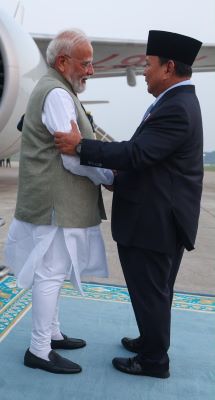
Prime Minister Narendra Modi on Monday launched one of India’s most consequential Indo-Pacific diplomatic engagements by arriving in Jakarta on a two-day bilateral visit, where he was accorded an exceptional welcome by Indonesian President Prabowo Subianto, who personally received him at the airport in a rare diplomatic gesture underscoring the growing strategic convergence between the two nations.
#WATCH | PM @narendramodi arrives in Jakarta, Indonesia, where he was received at the airport by Indonesian President Prabowo Subianto.
Upon his arrival, PM Modi was accorded a traditional ceremonial welcome and a Guard of Honour.@MEAIndia @IndianEmbJkt #PMModiIndonesiaVisit pic.twitter.com/5yTo7MMbWn
— DD News (@DDNewslive) July 6, 2026
Adding military symbolism to the visit, fighter aircraft of the Indonesian Air Force escorted the Prime Minister’s aircraft soon after it entered Indonesian airspace, while traditional Indonesian cultural performances greeted the Indian leader on his arrival, reflecting the warmth and civilisational depth of bilateral ties.
- Prime Minister receives rare airport welcome from Indonesian President Prabowo Subianto as fighter jets escort his aircraft into Jakarta
- Strategic talks to focus on defence, maritime security, trade, connectivity, civilisational ties and the shared vision of Viksit Bharat 2047 and Golden Indonesia 2045
- Visit marks first bilateral engagement since India and Indonesia elevated ties to a Comprehensive Strategic Partnership
- BrahMos cooperation, Indo-Pacific maritime collaboration and expanding economic engagement expected to dominate bilateral agenda
- Indonesia leg launches PM Modi’s three-nation diplomatic mission covering Australia and New Zealand to reinforce India’s Act East Policy and MAHASAGAR Vision
The visit marks Prime Minister Modi’s first bilateral visit to Indonesia since the elevation of India-Indonesia relations to a Comprehensive Strategic Partnership, and comes barely eighteen months after President Prabowo’s landmark visit to India as the Chief Guest at the Republic Day celebrations on January 26, 2025.
Setting the tone for the visit in his departure statement, Prime Minister Modi said:
“India and Indonesia share strong civilisational and people-to-people ties and my visit will further deepen all aspects of our multifaceted partnership.”
During his discussions with President Prabowo, the two leaders are expected to review the entire spectrum of bilateral cooperation encompassing defence and security, maritime collaboration, trade, investment, connectivity, cultural exchanges and emerging technologies.
The visit assumes added geopolitical significance as India and Indonesia continue to emerge as two of the Indo-Pacific’s most influential maritime democracies.
Defence cooperation between the two countries has witnessed remarkable momentum in recent years through regular military exchanges, bilateral and multilateral exercises, defence industrial collaboration and strategic initiatives, including the proposed supply of the BrahMos supersonic cruise missile to Indonesia.
Maritime cooperation is also expected to receive fresh impetus.
Since adopting the Shared Vision of India-Indonesia Maritime Cooperation in the Indo-Pacific in 2018, both countries have intensified collaboration in maritime domain awareness and regional security.
The stationing of an Indonesian Liaison Officer at India’s Information Fusion Centre–Indian Ocean Region (IFC-IOR), along with New Delhi’s decision to earmark training slots for Indonesian cadets and officers at the National Defence Academy (NDA) and the Defence Services Staff College (DSSC), is expected to further strengthen defence capacity-building.
Economic engagement remains another major pillar of the partnership.
Indonesia has emerged as India’s second-largest trading partner in the ASEAN region, with bilateral trade touching US$24.78 billion during 2025-26. More than 130 Indian companies currently have investments spanning multiple sectors across Indonesia, reflecting expanding commercial confidence.
Both governments also see strong complementarities between India’s long-term development vision of Viksit Bharat 2047 and Indonesia’s ambitious Golden Indonesia 2045 (Emas 2045) roadmap, creating opportunities for collaboration in infrastructure, manufacturing, clean energy, digital transformation and human capital development.
Beyond strategic and economic engagement, the Prime Minister’s itinerary highlights the enduring cultural bonds linking the two ancient civilisations.
During the visit, Prime Minister Modi will interact with members of the Indian diaspora and accompany President Prabowo to the Prambanan Temple Complex at Yogyakarta, one of Southeast Asia’s most celebrated Hindu heritage monuments.
Speaking about the cultural significance of the visit, the Prime Minister said: “During this visit, I will also interact with the Indian diaspora in Indonesia and visit the Prambanan Temple complex at Yogyakarta with President Prabowo, which is another remarkable testament to our close cultural ties.”
Indonesia serves as the opening chapter of Prime Minister Modi’s three-nation diplomatic tour from July 6 to 11, after which he will travel to Melbourne for talks with Australian Prime Minister Anthony Albanese before concluding the tour in Auckland, where discussions with New Zealand Prime Minister Christopher Luxon will focus on trade, economic cooperation and implementation of the recently concluded India-New Zealand Free Trade Agreement.
Summarising the strategic significance of the broader visit, Prime Minister Modi said:
“My visit to Indonesia and Australia in the Eastern and Southern Indian Ocean respectively, followed by New Zealand will further strengthen India’s Act East Policy, MAHASAGAR Vision as well as our outlook towards a free and open Indo-Pacific.”
With Indo-Pacific geopolitics undergoing rapid transformation, Prime Minister Modi’s three-nation outreach is widely viewed as a decisive effort to reinforce India’s strategic partnerships across the region while advancing shared prosperity, maritime security, economic resilience and civilisational connectivity.