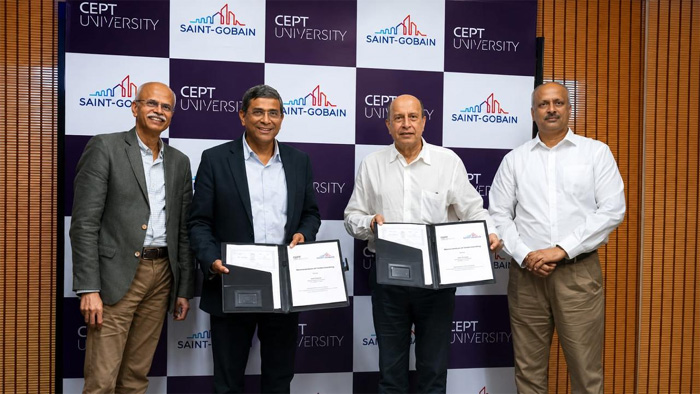
- Climate-resilient Tech Commons Centre to become a living laboratory for sustainable construction, building science, prototyping and industry-led innovation
- Strategic partnership bridges Saint-Gobain’s expertise in light and sustainable construction with CEPT University’s academic and research leadership
- Collaboration to focus on energy efficiency, circularity, climate resilience, digital twins, computational design and wellbeing in the built environment
- Tech Commons Centre to bring students, faculty, industry and researchers together to solve real-world challenges facing India’s rapidly urbanising landscape
- Partnership aims to accelerate adoption of Made-in-India sustainable building solutions and support India’s Net Zero ambitions
R MANICKAVASAGAM
AHMEDABAD, JULY 23
India’s buildings are consuming more energy, cities are growing hotter and climate shocks are becoming more frequent. The question is no longer whether India can afford sustainable construction—it is whether the country can afford to build anything else.
In a significant industry-academia partnership aimed at addressing this defining challenge, Saint-Gobain India and CEPT University have joined hands to accelerate the adoption of sustainable building solutions, strengthen research and create a new generation of professionals capable of designing a climate-resilient built environment.
The partnership will establish a climate-resilient Tech Commons Centre (TCC) at CEPT University and foster collaboration in sustainability, energy efficiency, building science, climate resilience and wellbeing.
The initiative brings together Saint-Gobain’s expertise in light and sustainable construction and CEPT University’s leadership in architecture, design, education and research, creating a powerful bridge between academic knowledge and real-world industry challenges.
The proposed centre is envisioned as a first-of-its-kind platform for building science, research, prototyping, skill development and industry-led knowledge exchange in sustainable construction.
A living laboratory for the buildings India needs
The Tech Commons Centre will provide students, faculty, researchers and industry professionals with a platform to experiment, test and develop solutions for the rapidly evolving challenges of the built environment.
It will enable hands-on learning and real-world problem-solving across architecture, design, construction and urban development.
The partnership is particularly significant at a time when India is witnessing rapid urbanisation and rising demand for buildings, infrastructure and energy.
The challenge is to ensure that this growth does not translate into a proportionate rise in energy consumption and carbon emissions.
‘Sustainability must begin in the classroom’
Speaking on the occasion, Sreedhar N., Senior Vice-President and CEO – Asia Pacific and India Region, said: “Saint-Gobain’s sustainable solutions create climate-resilient building spaces that consume up to 40% less energy, reduce embodied carbon, improve circularity, enhance durability, deliver healthier and comfortable living spaces. Our aim is to advance sustainable and energy-efficient construction while placing well-being at the center. This shared vision is at the heart of our partnership with CEPT. Together, we will provide architecture students with a living lab for sustainable construction relevant to India’s unique needs and create awareness in the next generation of talent that will shape the future of India’s built environment for decades to come.”
The partnership seeks to ensure that sustainability is not treated as an afterthought in construction.
Instead, it aims to embed sustainable thinking into the education, research and professional development of those who will design and build India’s future cities.
CEPT’s four-hub approach to a sustainable future
Highlighting the importance of the partnership, Prof. Barjor Mehta, President, CEPT University, said: “Universities have a vital role in creating knowledge that addresses real-world challenges. Through the Tech Commons Centre (TCC) and our collaboration with Saint-Gobain, we’re giving our students and faculty the chance to engage directly with building performance, sustainability and innovation. The TCC’s four hubs — Building Science and Climate Resilience, Urban Intelligence and Digital Twins, Computational Design and Visualisation, and Communications and Media — along with shared facilities, will bring academic inquiry closer to professional practice and push the sustainable built environment.”
The four hubs will bring together multiple disciplines and create an ecosystem where research can move from the laboratory to the construction site and eventually into everyday life.
The focus will include:
- Building Science and Climate Resilience
- Urban Intelligence and Digital Twins
- Computational Design and Visualisation
- Communications and Media
Together with shared facilities, the hubs are expected to strengthen collaboration between academic inquiry and professional practice.
Why India needs light and sustainable construction
As India advances towards Viksit Bharat, the role of buildings is undergoing a fundamental transformation.
A building can no longer be viewed merely as a structure that provides shelter.
It must also contribute to energy security, lower carbon emissions, climate resilience and human wellbeing.
Sustainable construction can help reduce energy consumption, improve thermal comfort and enhance the performance of buildings.
Solutions that improve natural daylighting, acoustics, indoor air quality, fire safety and durability can significantly improve the quality of life of occupants.
The impact extends across sectors.
Energy-efficient buildings can help reduce operating costs and dependence on imported fuels.
Better-designed workplaces can enhance productivity.
Sustainable schools can improve learning environments.
Energy-efficient healthcare facilities can support patient recovery.
Climate-resilient homes can provide greater safety and comfort in an era of increasingly extreme weather.
From global expertise to Indian solutions
Saint-Gobain’s sustainable solutions and CEPT’s academic and research ecosystem will together create an opportunity to develop solutions that respond to India’s unique climatic, economic and urban challenges.
The collaboration will focus on translating global expertise into Made-in-India solutions that can be adapted to the country’s diverse geographies and climatic zones.
The proposed Tech Commons Centre is expected to become a platform for innovation in:
- Energy-efficient building design;
- Climate-resilient construction;
- Sustainable materials;
- Circularity and resource efficiency;
- Building performance;
- Digital twins;
- Computational design;
- Urban intelligence;
- Skill development; and
- Industry-academia research.
The real test: Can India build more with less?
India’s construction sector stands at a decisive crossroads.
The country needs millions of new homes, offices, schools, hospitals and infrastructure assets.
But the future cannot be built by simply repeating the energy-intensive construction models of the past.
The challenge is to build more, faster and better—while consuming less energy, generating less carbon and creating healthier spaces for people.
That is the larger significance of the Saint-Gobain–CEPT partnership.
By placing industry expertise inside an academic and research ecosystem, the collaboration seeks to turn sustainability from a policy aspiration into a practical discipline.
By combining global expertise with local innovation and manufacturing, Saint-Gobain remains committed to supporting India’s journey towards its Net Zero ambitions and creating lasting value for future generations.
And through the Tech Commons Centre, CEPT University aims to give the next generation of architects, designers, researchers and professionals something more valuable than a textbook:
A living laboratory where the buildings of tomorrow can be imagined, tested and built today.