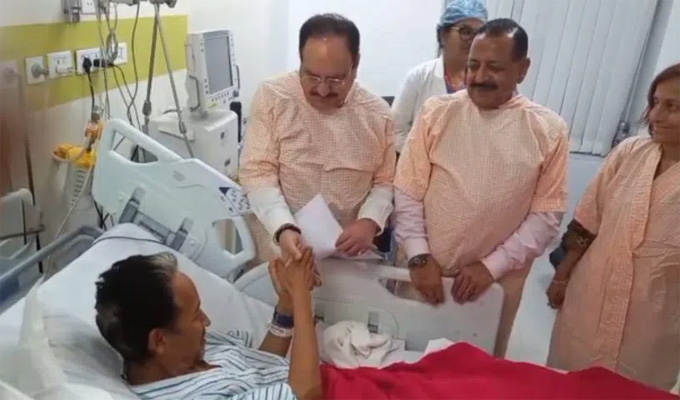
- Sonam Wangchuk breaks hunger strike after Union Ministers JP Nadda and Jitendra Singh convey government assurances at Medanta Hospital
- PM Modi announces ‘more strict actions’ against paper leaks; proposed measures to be taken up by Union Cabinet
- Centre assures peaceful protesters of a positive approach on cases arising from Jantar Mantar agitation and July 20 Parliament march
- Parliament likely to discuss accountability over NEET paper leaks, examination reforms and compensation for families of suicide victims
- Protest movement continues as CJP says its Jantar Mantar agitation will go on until Union Education Minister Dharmendra Pradhan resigns
NE NATIONAL BUREAU
NEW DELHI, JULY 24
Twenty-six days of hunger, a rapidly widening student movement and a late-night government assurance have brought Sonam Wangchuk’s fast to an end—but not the larger battle over examination integrity, NEET paper leaks and accountability.
Activist and education reform campaigner Sonam Wangchuk ended his indefinite hunger strike early Friday at Medanta Hospital in Gurugram, after Union Ministers JP Nadda and Jitendra Singh met him and conveyed assurances on key demands raised by the student-led movement.
The breakthrough came amid mounting public pressure and growing protests over alleged irregularities in competitive examinations, including the NEET-UG paper leak controversy, demands for stronger examination reforms and calls for accountability.
“Just now in the presence of Union Ministers JP Nadda, Dr Jitendra Singh and the senior leaders of Apex Body of Leh Ladakh, I finally broke my fast after 26 days,” Wangchuk said in a post on X.
He said the decision followed “long negotiations on various conditions and in view of possible violence in the country” and urged supporters to remain vigilant and ensure that the movement did not turn violent.
“Meanwhile, I urge you all to stay very vigilant and not allow violence of any kind anywhere,” Wangchuk said.
PM’s message: ‘More strict actions’ against paper leaks
As the fast ended, Prime Minister Narendra Modi announced that the government would bring forward tougher measures against examination paper leaks.
“More strict actions against paper leaks to come in tomorrow’s Cabinet!” the Prime Minister posted on X.
In another message after Wangchuk ended his fast, Modi urged him to follow medical advice and regain his lost weight.
“I urge Sonam ji to follow his daily routine as advised by the doctors and regain his weight as soon as possible,” the Prime Minister said.
“I pray to the Almighty that Sonam ji remains healthy,” he added.
The Prime Minister’s announcement has put examination security and paper-leak accountability at the centre of the government’s immediate legislative and policy agenda.
Nadda reads out assurances
Union Health Minister JP Nadda, speaking in the presence of Wangchuk’s wife Gitanjali Angmo and others at the hospital, said the government had adopted a positive approach towards peaceful protesters.
“The government is positive about not registering cases against those protesting peacefully at Jantar Mantar in Delhi and those who participated in the march to Parliament on July 20, 2026,” Nadda said.
He also said the government had already assured discussions in Parliament on paper leaks and examination reforms.
“Besides, the government is also positively considering suitable compensation for the families of students who died by suicide following the recent NEET paper leaks,” Nadda added.
The assurances represent a significant response to the movement’s central demands: accountability in the examination system, stronger safeguards against paper leaks, reforms in competitive examinations and relief for families who lost students amid the continuing examination crisis.
Wangchuk: ‘End of hunger, beginning of accountability’
After ending his fast, Wangchuk said the assurances had been secured after negotiations and intervention by parliamentarians.
He said 65 Members of Parliament from different political parties had either visited him or signed letters urging him to end the fast.
Wangchuk had begun his indefinite fast on June 28 in support of students demanding accountability over alleged irregularities in competitive examinations, reforms in the education system and action over the NEET paper-leak controversy.
During the 26-day protest, he reportedly lost around 11 kg. He had repeatedly appealed to supporters to remain peaceful even as tensions rose around the July 20 ‘Sansad Chalo’ march.
Wangchuk was later shifted from the protest site for medical attention and, following legal proceedings, continued his fast at Medanta Hospital in Gurugram.
His decision to end the fast came after he said he had been seeking safeguards for young protesters and assurances on the core demands before withdrawing from the agitation.
Protest movement not over, says CJP
While Wangchuk’s hunger strike has ended, the broader protest movement is set to continue.
The Cockroach Janta Party (CJP) said it was “relieved and grateful” that Wangchuk had ended his 26-day fast but announced that its peaceful protest at Jantar Mantar would continue until Union Education Minister Dharmendra Pradhan resigns.
CJP founder Abhijeet Dipke thanked Wangchuk for his “extraordinary courage and sacrifice”.
“By putting your own life on the line, you awakened the conscience of an entire nation. Your life is far too precious to this country,” Dipke said.
However, the CJP added: “The Cockroach Janta Party’s peaceful protest at Jantar Mantar will continue until Dharmendra Pradhan resigns.”
The outfit is also demanding accountability over alleged irregularities in competitive examinations, reforms in the education system, compensation for families of students who died by suicide following alleged NEET paper leaks and withdrawal of FIRs and legal action against peaceful protesters.
The protest movement has spread beyond Delhi, with demonstrations and support reported from several cities, while the government has signalled that tougher legal and institutional action against paper leaks is now under consideration.
The big question: Assurance or accountability?
The end of Wangchuk’s fast has opened a possible window for dialogue between the government and protesters—but the credibility of the next phase will depend on implementation.
For students and parents, the immediate questions remain stark: Will the promised tougher action against paper leaks become law? Will examination reforms address the vulnerabilities that allow leaks and irregularities? Will families of affected students receive compensation? And will peaceful protesters avoid criminal cases?
The government’s assurances have ended one dramatic chapter of the protest. But the larger demand for a cleaner, more transparent and accountable examination system remains firmly on the national agenda.
The hunger strike may be over. The examination accountability test has just begun.