NE DEFENCE BUREAU
NEW DELHI, JULY 24
India has taken a major step towards building an indigenous long-range air-defence shield capable of hunting down some of the most challenging aerial threats—from high-speed fighter aircraft and missiles to unmanned aerial vehicles and large enemy aircraft.
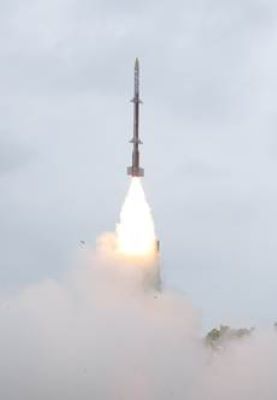
The Defence Research and Development Organisation (DRDO) successfully conducted the maiden flight test of the ‘Kusha’ Long-Range Surface-to-Air Missile (LR-SAM) from APJ Abdul Kalam Island off the Odisha coast on July 23, marking a significant milestone in the country’s quest for strategic autonomy in advanced air-defence technology.
- India’s long-range missile shield clears maiden flight test with successful interception of high-speed, high-altitude electronic target
- Home-grown system designed to neutralise fighter aircraft, missiles, UAVs and large enemy aircraft across a wide threat envelope
- DRDO-developed missile, radars and command-and-control architecture underline India’s growing strategic autonomy
- Defence Minister Rajnath Singh hails breakthrough as a giant leap towards ending import dependence in long-range air defence
During the test, the Kusha weapon system successfully intercepted an electronic target simulating a high-speed, high-altitude aerial threat, demonstrating the system’s capability against demanding operational scenarios.
Kusha: India’s answer to the long-range air threat
The Kusha missile system has been designed to neutralise a wide variety of aerial threats across a broad range and altitude envelope.
Its intended targets include:
- Fighter aircraft
- Missiles
- Unmanned aerial vehicles
- Large enemy aircraft
The system is being developed as an integrated weapon architecture, with its missiles, radars and command-and-control centre being developed by various DRDO laboratories and Indian industry partners.
The maiden flight test is therefore significant not merely as a missile launch, but as a demonstration of the capabilities of a wider indigenous air-defence ecosystem.
‘A giant leap’ towards strategic air-defence autonomy
Defence Minister Rajnath Singh described the successful flight test as an important milestone in Indian defence research and development.
He said the test highlighted India’s capability to develop a long-range surface-to-air missile system—a capability possessed by only a handful of nations.
Singh said the development would also help eliminate import dependence for such systems and described the achievement as a “giant leap in the air defence capability of the nation.”
The successful test comes at a time when the ability to detect and neutralise threats at extended ranges has become a critical component of modern warfare. The expanding use of missiles, drones, high-speed aircraft and other aerial platforms has made layered and networked air defence an essential element of national security.
From missile to network: The technology behind Kusha
The Kusha programme represents a broader shift in India’s defence technology journey—from developing individual weapons to building integrated combat systems.
The system’s architecture includes:
- Indigenous long-range surface-to-air missiles
- Advanced surveillance and engagement radars
- A command-and-control centre
- Integrated weapon-system elements developed by DRDO laboratories and industry partners
Such integration is critical to modern air defence, where the effectiveness of a missile system depends not only on the missile itself but also on the speed and accuracy with which threats are detected, tracked, assessed and engaged.
The maiden test of Kusha thus marks a major step towards strengthening India’s ability to develop a comprehensive, long-range and indigenous air-defence network.
DRDO team congratulated for breakthrough
Defence Secretary, Secretary, Department of Defence R&D and Chairman, DRDO Rajesh Kumar Singh monitored the activities during the launch and congratulated the teams involved in the successful flight test.
The successful maiden test adds another significant capability to India’s growing portfolio of indigenous missile and air-defence technologies.
With Kusha, India is seeking to move decisively from dependence on imported long-range air-defence systems to the development of a powerful home-grown capability—one that can form a crucial layer in the country’s future air-defence architecture.