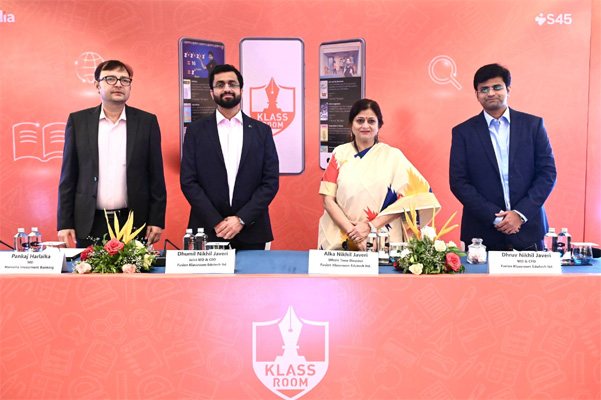
- Fusion Klassroom Edutech’s ₹39.04-crore SME IPO opens July 31; price band fixed at ₹151–159
- Fresh issue of 19,89,400 shares and OFS of 4,65,800 shares; anchor bidding on July 30
- QIBs get 49.81% of net offer, retail investors 35.06% and NIIs 15.13%; market makers reserved 1,23,200 shares
- IPO proceeds to fund debt repayment, AI/ML model development, cloud infrastructure, content, new AI/ML labs and marketing
- Company reports FY26 income of ₹23.10 crore and PAT of ₹7.60 crore; shares proposed to list on BSE SME on August 7
- Suniel Shetty among the strategic/angel investors associated with the company’s growth journey
R MANICKAVASAGAM
AHMEDABAD, JULY 24
In an edtech landscape where the post-pandemic boom has given way to sharper scrutiny of profitability, customer acquisition costs and sustainable learning outcomes, Fusion Klassroom Edutech Limited is attempting to make a different pitch to investors: not just another online education platform, but a hybrid learning ecosystem where classrooms, content, technology, AI and institutional partnerships work as interconnected growth engines.
The company’s maiden IPO, opening on Friday, July 31, 2026, therefore arrives at an interesting inflection point for the sector. Fusion Klassroom is seeking to raise ₹39.04 crore through an issue of 24,55,200 equity shares at a price band of ₹151–159 per share, implying a valuation of around ₹148.1 crore at the upper end of the price band. The issue will close on Tuesday, August 4, while the Anchor Investor bidding period will open on Thursday, July 30.
The issue comprises a fresh issue of up to 19,89,400 equity shares and an Offer for Sale of up to 4,65,800 shares. The minimum bid lot is 1,600 shares, with bids thereafter in multiples of 800 shares. The company’s shares are proposed to be listed on the BSE SME platform, with a tentative listing date of August 7, 2026.
The IPO allocation map: QIB muscle, retail participation and anchor confidence
The IPO’s net public offer comprises 23,32,000 shares after the firm reservation of 1,23,200 shares for market makers. Of the net offer, 11,61,600 shares, or 49.81%, are earmarked for Qualified Institutional Buyers, 3,52,800 shares, or 15.13%, for Non-Institutional Investors, and 8,17,600 shares, or 35.06%, for Retail Individual Investors.
Within the QIB portion, 6,96,800 shares, or 28.38% of the total issue, are reserved for Anchor Investors, while 4,64,800 shares are available to QIBs other than anchors. Market makers have been allotted 1,23,200 shares, or 5.02% of the total issue.
The minimum retail application at the upper price band works out to ₹2,54,400 for 1,600 shares, making the issue one that investors will examine closely for its earnings growth, technology deployment and scalability rather than merely its edtech label.
“We are not building only another app” — Dhumil Javeri on the Fusion advantage
Dhumil Nikhil Javeri, Joint Managing Director and CEO, has positioned Fusion Klassroom’s model around the combination of digital reach and physical learning, rather than an either-or choice between online platforms and conventional coaching centres.
The company’s journey began with offline academic coaching and technology integration and has since expanded into a hybrid ecosystem comprising offline partner centres, an AI-powered education platform, professional examination preparation and institutional and government-linked programmes. The company says its platform now offers more than 100 courses and over 3,300 hours of proprietary learning content, while its user base has expanded substantially across digital and physical learning channels.
“The fundamental difference is that technology is not replacing the classroom in our model; it is making the classroom more measurable, accessible and scalable,” Dhumil has said in explaining the company’s hybrid approach.
According to the management, the model is designed to address the limitations of both extremes. Pure-play online platforms offer scale but can face challenges in engagement, accountability and retention, while traditional coaching models can be constrained by geography and physical capacity. Fusion’s strategy is to combine classroom interaction with digital content, technology-led learning support and institutional delivery.
The company is also expected to pursue a calibrated physical expansion strategy, with a combination of offline centres, partner-led expansion and asset-light opportunities, rather than relying exclusively on a capital-heavy company-owned network.
From IPO proceeds to AI labs: where the ₹39.04 crore could change the growth equation
The central investor question is how the IPO capital will translate into measurable business outcomes.
The company has identified several deployment priorities: repayment or prepayment of outstanding borrowings; technology and AI/ML model development; servers and cloud infrastructure; content development; procurement of desktops and laptops for AI/ML laboratories at new offline centres; marketing initiatives; inorganic growth through unidentified acquisitions; and general corporate purposes.
Dhruv Nikhil Javeri, Managing Director and CFO, has indicated that the company’s capital-allocation strategy is intended to strengthen both its balance sheet and its growth infrastructure.
“The objective is not to deploy the IPO proceeds simply to increase expenditure. Debt reduction can improve financial flexibility, while investment in technology, AI/ML, cloud capacity and content is aimed at expanding the platform’s ability to serve more learners and institutions. The AI/ML labs and new offline infrastructure are intended to create tangible delivery capacity, while marketing investment is expected to support customer acquisition and brand expansion,” the management has said.
For investors, the measurable outcomes to watch will include growth in paid subscribers, revenue from institutional and enterprise programmes, utilisation of new centres and AI/ML labs, improvement in digital engagement, expansion of content monetisation and the company’s ability to maintain profitability while scaling.
Fusion Klassroom reported total income of ₹23.10 crore and PAT of ₹7.60 crore in FY26, compared with total income of ₹10.11 crore and PAT of ₹2.90 crore in FY25, according to Dhruv Nikhil Javri, MD & CFO.
The post-pandemic edtech correction: Fusion bets on multiple revenue engines
The sharp correction in the edtech sector after the pandemic boom has made one lesson clear: user numbers alone do not create a sustainable education business.
Fusion Klassroom’s answer is diversification.
The company operates across K-12 education, competitive examination preparation, professional upskilling and AI/ML learning, while also working with educational institutions, universities, enterprises and government-linked bodies. Its revenue architecture therefore extends beyond individual subscriptions to include offline coaching, institutional subscriptions, content, training and technology-enabled learning infrastructure.
“The sustainability of the business comes from having more than one route to the learner and more than one customer segment,” Dhumil has said, emphasising the company’s focus on individual learners as well as institutions and organisations.
The company’s official journey describes its evolution from offline academic coaching to a broader hybrid platform, with expansion into AI-powered learning, government and institutional programmes and AI/ML labs.
This diversification could help reduce dependence on any single student-acquisition channel. But the challenge for investors will be execution: managing a business that simultaneously operates digital platforms, offline centres, institutional programmes and government-linked projects requires disciplined capital allocation and operational control.
AI, adaptive learning and data: the next Fusion layer
The company is placing AI/ML at the centre of its next phase of expansion.
Its IPO objects specifically include AI/ML model development, servers, cloud infrastructure and AI/ML laboratories, suggesting that artificial intelligence is being treated not merely as a marketing feature but as a strategic technology and learning capability.
“AI will increasingly help us understand how learners learn, where they struggle and what kind of intervention is required,” Dhumil has said, outlining the potential role of adaptive learning, analytics and personalised education.
The company’s stated direction is to build on its own education content and technology ecosystem while using the broader AI/ML infrastructure available in the market where appropriate. The critical investment question will be whether Fusion can develop meaningful proprietary data and learning intelligence rather than merely placing AI features on top of third-party technology.
The proposed AI/ML labs at new offline centres could provide a physical dimension to this strategy, linking digital learning with hands-on training and practical exposure.
CAC, retention and LTV: the metrics investors will watch beyond enrolments
For any edtech company, the real test is not how many students sign up, but how efficiently those students are acquired, retained and monetised.
Fusion Klassroom’s management has therefore highlighted the importance of looking beyond headline enrolment numbers to metrics such as customer acquisition cost, retention, conversion from registered users to paid subscribers, lifetime value and the contribution of institutional contracts.
“Our objective is to ensure that growth is not bought at any cost. The focus is on improving the quality of acquisition, increasing engagement and retention, and using technology and content across multiple programmes so that the lifetime value of a learner improves,” Dhruv has said.
The company’s hybrid structure could provide opportunities for cross-selling: a learner entering through digital content may later access a classroom programme, professional course or skills programme, while institutional relationships can create larger and potentially recurring contracts.
The key margin question will be whether revenue growth outpaces the incremental cost of content creation, faculty, technology infrastructure, marketing and centre expansion.
The talent battle: faculty, students and parents are the real moat
The competitive battlefield now includes established coaching brands, online education platforms, creator-led learning channels and AI-powered learning tools.
Fusion Klassroom’s response is to position itself around faculty quality, personalised support, trusted parent relationships, technology-enabled learning and the flexibility of a hybrid model.
“Technology can improve the learning experience, but education remains a people-driven business. The quality of faculty, the trust of parents and the outcomes delivered to students remain central to retention,” Dhumil has said.
The company’s strategic challenge will be to attract high-quality faculty while ensuring that its content and technology do not become dependent on a small number of individual educators. AI can improve personalisation and analytics, but the credibility of the learning experience will continue to depend on teaching quality and measurable outcomes.
The company’s investor ecosystem has also included prominent strategic and angel investors, including Suniel Shetty, whose association has added visibility to the company’s growth journey. Dealroom data lists Shetty among the investors associated with Klassroom’s funding history.
A profitable hybrid bet — with execution now under the microscope
Founded in 2016, Fusion Klassroom Edutech has built a business spanning competitive examination coaching, K-12 education, professional upskilling, AI/ML learning, digital subscriptions, offline learning and institutional programmes.
The IPO represents the next stage of that evolution.
The company’s FY26 financial performance provides the profitability narrative, while the proposed use of IPO funds offers the growth narrative. The investment case, however, will ultimately turn on whether Fusion can convert its hybrid model into higher student lifetime value, stronger institutional revenues, scalable technology and sustainable margins.
The IPO will be managed by Narnolia Financial Services Limited, with Maashitla Securities Private Limited as registrar to the issue.
For investors, Fusion’s proposition can be summed up in one question: Can a company born in the classroom use technology, AI and capital-market access to build a durable education ecosystem — without repeating the excesses that triggered the edtech correction?
The IPO will provide the market with its first public answer.