R ARIVANANTHAM
NEW DELHI/CHENNAI, JULY 25
“My young friends…”
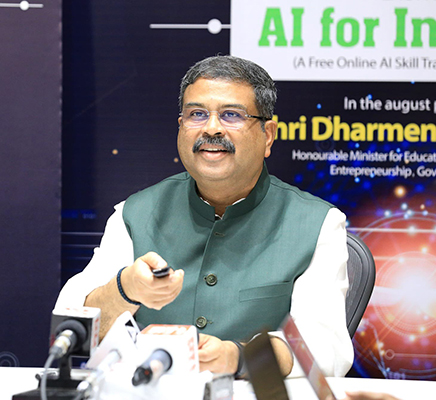
With those words, Union Education Minister Dharmendra Pradhan addressed the country’s students as he announced that he had submitted his resignation to Prime Minister Narendra Modi — bringing the most dramatic political chapter yet in the NEET-UG 2026 controversy to a close.
— Dharmendra Pradhan (@dpradhanbjp) July 25, 2026
Pradhan said he had taken the decision after being deeply pained by developments of the past 10 days and to ensure that students’ futures did not get trapped in prolonged political and legal complications.
“Considering the situation at Jantar Mantar and across the country—with the aim of preventing anti-national forces from exploiting it, preserving national unity, ensuring that not a single Indian student’s future gets entangled in legal complexities, and allowing our children to devote their time to studies and focus on building their careers—I have submitted my resignation to the Honorable Prime Minister,” Pradhan said in his letter.
He also expressed gratitude to Prime Minister Modi for his “guidance, trust, and constant support.” The resignation was submitted to the Prime Minister; the public statements available at the time of writing did not establish a separate formal announcement of its acceptance.
The development came as a nationwide student agitation over alleged irregularities in NEET-UG 2026 reached its 36th day, with the Cockroach Janata Party (CJP) protest at Jantar Mantar becoming the focal point of a movement that spread beyond Delhi and drew support from student groups and activists across the country.
“We have won”: CJP calls resignation its first victory
Loud cheers erupted at the CJP protest site at Jantar Mantar after founder Abhijeet Dipke announced Pradhan’s resignation.
“Dharmendra Pradhan has resigned and this is proof that if you don’t get scared, you can win,” Dipke told protesters.
“You should not be scared to speak in a democracy. Only if you raise your voice will they stay in line because they are sitting in power because of us,” he said.
The CJP, however, made it clear that the agitation would not end with the resignation.
“We have two more demands. We will not go like that. We are cockroaches. Once it enters, it does not leave. Only one resignation has happened for now. Don’t mess with the cockroach,” Dipke said.
The group continues to seek compensation for families of students who allegedly died by suicide in connection with the controversy, action against those responsible for the alleged leak and action against police personnel accused of excessive force against protesters.
The celebrations were followed by a sombre two-minute silence in memory of students who allegedly died by suicide. Dipke read out their names before protesters observed the silence.
Wangchuk: “Victory of democracy”; Kharge sees youth power in resignation
Environmentalist and education reform activist Sonam Wangchuk, who had undertaken a prolonged hunger strike in support of the agitation before his health deteriorated, described the development as a victory for democratic protest.
“IT’S A VICTORY OF DEMOCRACY. Direct democracy… straight from the streets. It’s a victory of peace, patience & perseverance. Congratulations CJP, Gen Z of the nation, and thank you all citizens for shedding fear and the fear of fear and rising up from every corner of the nation,” Wangchuk said.
He later framed the next stage as a transition “from accountability, now to reforms.”
Congress president Mallikarjun Kharge said the resignation represented the victory of young people, families who had lost their children and the united Opposition.
“India’s ‘Chatro ki Goonj’ has finally reached the threshold of arrogant power. This is the victory of our millions of youth who raised their voices on the streets across the country to fix the education system,” Kharge said.
“This is the victory of all those families who lost their blood, their children,” he said, while demanding further action against those responsible for the alleged irregularities and against police personnel accused of using force against protesters.
South India’s student anxiety: from Chennai to Hyderabad, faith in merit under scrutiny
The reverberations of the controversy have been particularly strong in South India, where NEET has remained a politically and emotionally charged issue.
Tamil Nadu has for years been at the forefront of opposition to the high-stakes medical entrance examination, with the State’s political parties and student groups repeatedly arguing that a single national examination places enormous pressure on aspirants and intensifies dependence on costly coaching.
In Hyderabad, the controversy also triggered public demonstrations, candlelight vigils and student and citizen protests demanding accountability and systemic reform in the medical entrance examination process.
For students and parents across Tamil Nadu, Kerala, Karnataka, Telangana and Andhra Pradesh, the immediate concern is not simply who occupies the Education Ministry but whether a student who studies honestly can trust the examination system.
That is the emotional core of the crisis.
A student who spends years preparing for NEET does not seek political victory. The student seeks one assurance: that the question paper will remain secret, the examination will be conducted fairly, the answer sheet will be evaluated accurately and merit will not be defeated by malpractice.
Government response: CBI probe, cancellation and re-examination
The Government had already taken several measures after allegations emerged regarding the NEET-UG 2026 examination conducted on May 3.
The CBI registered a case based on a complaint from the Department of Higher Education, Ministry of Education, relating to alleged irregularities and paper leakage. The investigation covers alleged criminal conspiracy, cheating, criminal breach of trust, theft and destruction of evidence, besides provisions under the Prevention of Corruption Act and the Public Examinations (Prevention of Unfair Means) Act, 2024.
The NEET-UG 2026 examination was subsequently cancelled and a re-examination was conducted on June 21.
The Government also announced that NEET would move to a computer-based test format from next year, a major structural change intended to reduce vulnerabilities associated with physical question-paper handling.
The National Testing Agency has also introduced or announced measures including biometric verification and exception protocols, a dedicated platform for reporting suspicious claims, WhatsApp updates for candidates and capacity-building for examination officials through the ‘Pariksha Karmayogi’ programme.
Tighter security, inter-agency coordination to plug loopholes
The Centre also moved to strengthen security and logistical arrangements for the re-examination.
The Union Home Secretary reviewed preparedness with State Governments and central agencies, with specific emphasis on student convenience, security arrangements and examination integrity.
The Railway Board, Department of Posts, CRPF, CISF, BCAS, NTA and other agencies were involved in the preparedness process, while States and Union Territories were asked to facilitate the smooth travel of students and ensure strict adherence to security protocols.
Cabinet Secretary T. V. Somanathan warned that “the full might and weight of the law will fall on any person trying in any manner to distort, disrupt or tamper with the integrity or smooth conduct of the re-examination.”
The government’s response has therefore included three broad pillars: investigation and prosecution, cancellation and re-examination where necessary, and systemic redesign of the examination process.
The unresolved questions: compensation, police action and accountability
For the protesters, however, the minister’s resignation is only one part of the larger demand for accountability.
The CJP continues to press for compensation for families of students who allegedly died by suicide, action against those responsible for the alleged paper leak and action against police personnel accused of excessive force during the agitation.
The government and protesters have held multiple rounds of talks, but the resignation demand remained a major point of contention before Pradhan submitted his resignation.
The political debate is likely to continue, but the larger national challenge is more fundamental: how to rebuild the confidence of students who have invested years of preparation, money, emotional energy and family sacrifice in a system they expect to be fair.
After the resignation, the real test begins
Pradhan, in his message, said that his commitment to students and education remained unwavering.
“Serving the nation is the highest priority of my life; I will always remain dedicated to this cause,” he said.
For the government, the resignation may close one political chapter. For students, however, the examination crisis will truly end only when the system becomes demonstrably secure.
The next Education Minister will inherit a task far larger than administering an examination: to restore faith in merit.
That means plugging every loophole — from question-paper generation and printing to transportation, storage, centre-level security, digital transmission, biometric verification, invigilation, answer-sheet handling, result processing and rapid redressal of complaints.
For the aspirant in a small town, a coaching hub in Kota, a village in Tamil Nadu, a city in Karnataka, a district in Kerala or a bustling centre in Hyderabad, the message must be unmistakable:
Your hard work will not be allowed to become collateral damage in an examination system that fails to protect its own sanctity.
The resignation may be the first political consequence of the NEET storm.
But the true measure of accountability will be whether India can now build an examination system in which every student — regardless of wealth, region, language or coaching background — can sit for the test without fear that someone else’s malpractice will decide their future.