
R ARIVANANTHAM
CHENNAI, JULY 25
Can a city solve its water crisis by destroying the very wetlands that absorb its floods, sustain its biodiversity and support communities that have lived in rhythm with the coast for generations?
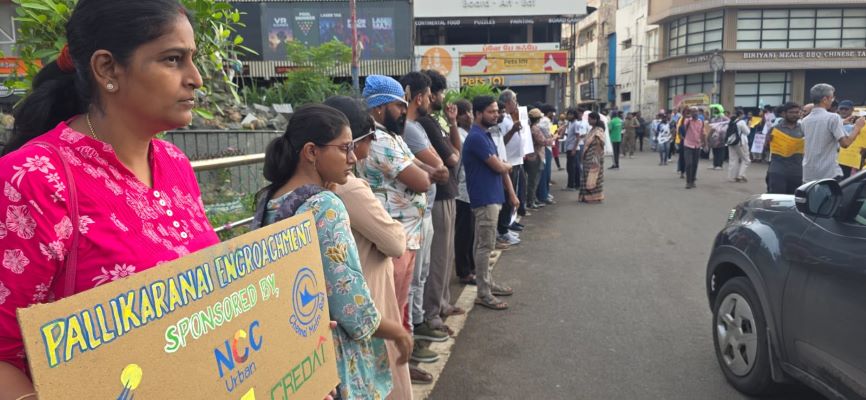
That question reverberated along Besant Nagar beach on Saturday as representatives of fishing villages, Irula families and more than 30 environmental organisations marched against the proposed Mamallan Reservoir project near Kovalam, warning that the proposed intervention could threaten both a fragile coastal ecosystem and the livelihoods of thousands of people dependent on it.
- 16 fishing villages and Irula families fear losing their traditional livelihoods as opposition mounts to the proposed Mamallan Reservoir near Kovalam
- Environmentalists warn that converting a brackish wetland system into a freshwater reservoir could disrupt coastal ecology, fisheries and natural flood protection
- Fisherfolk, Irula communities and more than 30 environmental organisations march at Besant Nagar demanding that the project be scrapped
- From shrimp and crab catchers to traditional snake-trackers, communities say a wetland is not vacant land but a living economy
- Pallikaranai’s Ramsar status and Chennai’s shrinking wetlands intensify calls for cumulative ecological impact assessment before irreversible intervention
- The larger question: Can Chennai secure its future water without sacrificing the ecosystems and communities that already protect the city?
The protesters demanded that the project be abandoned and raised slogans including:
“Do not auction the dreams of students and the livelihoods of fishermen.”
The campaign has brought together two communities whose lives are deeply linked to the landscape — fishing families dependent on the coastal waters and wetlands, and Irula families whose traditional ecological knowledge includes snake tracking and conservation-related work.
Their message was unequivocal: a wetland is not empty land waiting to be converted into infrastructure. It is a living ecosystem, a livelihood base and a natural defence against climate extremes.
A reservoir for Chennai — but at what ecological cost?
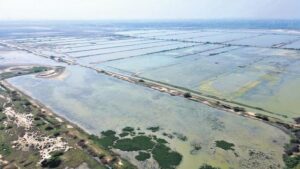
The Tamil Nadu Government had proposed the Mamallan Reservoir, incorporating the Nemmeli wetland area near Kovalam, to meet the drinking water needs of Chennai and its expanding metropolitan region.
The project, announced during the previous DMK regime, was proposed with a storage capacity of approximately 1.6 TMC and an estimated cost of ₹342 crore, according to the campaigners.
The project has faced opposition from environmentalists, who argue that the proposed conversion of a brackish-water wetland system into a freshwater storage reservoir could alter the area’s natural hydrology and ecological balance.
Two school students explain why the Mamallan reservoir project in Chennai's Kovalam backwaters is a disastrous idea. It destroys thousands of livelihoods, migratory bird habitat and increases flood risk for the city. @CMOTamilnadu @actorvijay @thirumaofficial pic.twitter.com/GlgQpIY5ib
— M.Yuvan (@Yuvan_aves) July 5, 2026
The protesters contend that the wetland’s vegetation and saline-brackish characteristics play an important role in moderating coastal processes and supporting a wide range of species.
They fear that changes to the wetland could affect shrimp and crab habitats, fish resources, bird populations, aquatic life and native vegetation.
The concerns acquire added significance in a city where wetland loss has already reduced natural flood-storage capacity.
Read Also:
The Tamil Nadu State Wetlands Authority describes the Pallikaranai Marsh, connected to the wider South Chennai hydrological system through the Kovalam Creek, as a biodiversity-rich coastal wetland with important ecological functions including freshwater provision, maintenance of hydrological regimes, erosion protection, hazard reduction, biological control and biodiversity support.
‘The wetland is our livelihood’
Representatives of fishing villages including Ennore, Kovalam, Kanathur, Rettikuppam, Mylapore Nochikuppam and Nemmeli, among others, participated in the march.
The protesters said people from 16 fishing villages depend on the surrounding coastal and wetland ecosystems for fishing and the collection of shrimp and crabs.
For these families, the question is not simply about land acquisition or a change in water use.
It is about the future of an entire livelihood chain.
A wetland supports nursery grounds, aquatic organisms and food webs that ultimately sustain fishing communities. Any change in salinity, water circulation, tidal connectivity or habitat structure can have consequences far beyond the project footprint.
The campaigners therefore demanded a comprehensive assessment of the project’s impact on fisheries, biodiversity, groundwater, flood management and community livelihoods before any irreversible construction activity.
Irula families fear the loss of a living knowledge system
The protest also brought the livelihood concerns of Irula families into the centre of the environmental debate.
Women from Irula families who participated in the march reportedly broke down while speaking about the project.
“If the Mamallan Reservoir project is implemented, there will be no livelihood left for us,” they said.
The Irulas possess generations of knowledge of snakes, habitats and landscapes. Their expertise is particularly significant in Tamil Nadu, where conservation and public-safety initiatives have increasingly recognised the importance of trained snake rescuers and community knowledge.
Tamil Nadu has also taken steps to promote ethical snake rescue and documentation through initiatives such as the NAAGAM platform, which connects the public with trained rescuers and supports species documentation, conservation awareness and safer rescue practices.
For Irula families, therefore, the loss of a familiar ecological landscape can mean more than the disappearance of a physical habitat.
It can erode traditional knowledge, livelihood opportunities and a community’s relationship with the natural environment.
The protesters’ argument is that conservation cannot be separated from the people who have historically understood and worked within these ecosystems.
Chennai’s wetlands: The city’s natural flood and climate shield
Environmentalists at the rally also urged the Government to protect Chennai’s remaining wetlands and water bodies.
Among their demands were:
- Relocating the proposed Sports City from the low-lying Semmancheri area to an alternative site;
- Preventing further encroachment of the Pallikaranai Marsh, described as the city’s ecological ‘lung’;
- Recovering encroached water bodies, including wetlands affected by urban expansion;
- Restoring degraded water bodies and strengthening their flood-management functions.
The Pallikaranai Marsh is a designated Ramsar site covering 1,247.54 hectares. The Tamil Nadu State Wetlands Authority identifies it as a natural coastal wetland with major biodiversity and hydrological values, including water storage, flood-risk reduction, erosion protection and habitat support.
The Authority also records that the marsh historically drained a large portion of South Chennai through a network of wetlands and channels towards the Kovalam Creek and the Bay of Bengal.
That hydrological connectivity is central to the debate over any major intervention in the broader coastal-wetland landscape.
When wetlands disappear, water does not disappear. It often moves elsewhere — into streets, homes, low-lying neighbourhoods and already stressed drainage systems.
‘Do not destroy a natural system to build a man-made solution’
Environmental activists at the march argued that Chennai’s water security must be built through a diversified strategy rather than placing excessive pressure on a single wetland system.
They called for:
- Rainwater harvesting and aquifer recharge;
- Restoration of existing lakes and tanks;
- Protection of catchment areas;
- Prevention of wetland encroachment;
- Scientific reuse of treated wastewater;
- Improved water-demand management;
- Sustainable desalination and water recycling;
- Independent cumulative environmental impact assessments.
The demand is not necessarily against urban water security.
It is a demand that water security and ecological security should not be treated as competing objectives.
The State’s own wetland conservation framework recognises that wetlands provide multiple services — from freshwater and food to hydrological regulation, erosion protection, hazard reduction, climate regulation and biodiversity.
The challenge, therefore, is to ensure that a project designed to provide water does not weaken the natural systems that help Chennai manage floods, recharge groundwater and withstand climate shocks.
A coastal wetland is also a community economy
The debate over the Mamallan Reservoir has exposed a larger gap in infrastructure planning.
Project reports often measure capacity in TMC, MLD, hectares and rupees.
Communities measure the same landscape in daily catch, family income, access to water, seasonal cycles, traditional knowledge and the survival of future generations.
Both measurements matter.
The fishing communities say the wetland is an economic asset. The Irula families say it is part of their livelihood and knowledge system. Environmentalists say it is a natural ecological infrastructure that cannot be recreated once destroyed.
The Tamil Nadu Government, meanwhile, faces the legitimate challenge of securing drinking water for a rapidly growing Chennai metropolitan region.
That is precisely why the protesters are demanding a transparent, independent and participatory evaluation before the project proceeds.
The ‘green’ question Chennai cannot avoid
The march, featuring traditional parai music and silambattam, was not merely a protest against one reservoir.
It was a public warning about the direction of urban development.
- Can Chennai build new infrastructure without sacrificing its last natural buffers?
- Can water security be achieved without destroying fishing livelihoods?
- Can traditional communities such as the Irulas be treated as stakeholders and custodians of ecological knowledge rather than as collateral casualties of development?
And perhaps the most important question:
If a wetland is already performing the functions of flood control, biodiversity conservation, groundwater regulation and livelihood support, should its value be measured only by the amount of water that can be stored after it is altered?
The protesters say the answer must be no.
The Government’s stated objective of ensuring water security for Chennai must be balanced with rigorous environmental scrutiny, community consultation and a credible assessment of alternatives.
Because the future of Chennai cannot be secured by creating a new water source while destroying the natural systems that have protected the city for centuries.
The Mamallan Reservoir debate has thus become a defining test of Tamil Nadu’s environmental governance: whether development will simply make room for people — or whether it will make room for people, nature and traditional communities to survive together.
(Author of this article is R ARIVANANTHAM is Executive Editor (Former Senior Correspondent, THE HINDU) navjeevanexpress.com He can be contacted at – hindukgi@gmail.com, navjeevanexpress@gmail.com – Mobile: 9444671601)