- Indian Army concludes three-day HADR mission after rescuing more than 790 stranded civilians across Gujarat and Dadra & Nagar Haveli
- Southern Command deploys Relief, Rescue, Engineer and Medical Columns across Navsari, Valsad, Vapi, Ahmedabad and Silvassa
- Operation showcases ‘Military-Civil Fusion’ as Army, NDRF, SDRF, SEOC and civil administration unite against monsoon fury
- From flooded villages to inaccessible zones, troops deliver rescue, medical care, food, drinking water and essential relief
- Indian Army reaffirms unwavering commitment to the nation and its people as Coast Guard and other agencies reinforce flood response
NE DEFENCE BUREAU
AHMEDABAD, JULY 26
When floodwaters erased roads, isolated communities and turned familiar landscapes into dangerous stretches of water, the Indian Army stepped in—not as an institution standing apart from disaster response, but as a force moving shoulder-to-shoulder with civil authorities and fellow responders. Over three days of relentless humanitarian operations, Army personnel rescued more than 790 stranded civilians, delivered medical assistance and essential supplies, and helped restore a measure of hope and normalcy across flood-hit parts of Gujarat and Dadra & Nagar Haveli.
The operation offered a powerful answer to a question every disaster poses: when nature overwhelms infrastructure, can preparedness, coordination and courage bridge the gap between danger and safety?
The Indian Army, under the aegis of Southern Command, concluded its major Humanitarian Assistance and Disaster Relief (HADR) operations across flood-affected areas of Gujarat and the Union Territory of Dadra & Nagar Haveli on Sunday, after a three-day mission launched on the evening of July 23, 2026.
The operation was mounted in response to incessant rainfall and widespread flooding, with Army Relief and Rescue Columns, including Engineer and Medical teams, working closely with the NDRF, SDRF, State Emergency Operations Centre (SEOC), civil administration and other agencies.
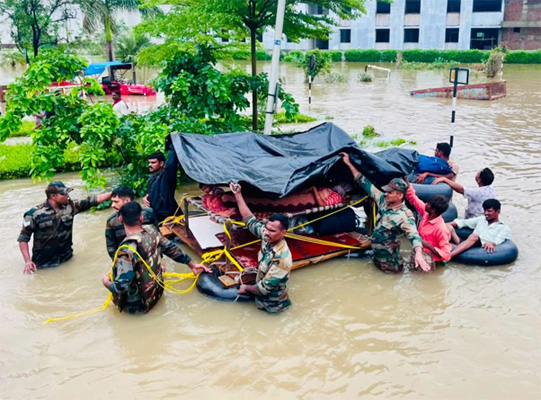
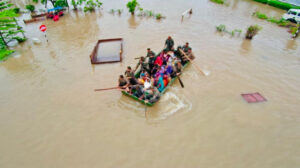
During the mission, Army personnel safely evacuated more than 790 stranded civilians from inundated and inaccessible areas. Medical teams provided immediate healthcare, while relief teams distributed food, drinking water and other essential supplies to affected residents.
The Army also assisted the civil administration in efforts to restore normalcy in the affected areas.
From Navsari to Silvassa, the rescue grid moved where roads could not
The Army deployed multiple Relief and Rescue Columns across Navsari, Valsad, Vapi, Silvassa and flood-affected areas of Ahmedabad, including Dholka and Rajoda, while additional columns remained on standby to respond to emerging contingencies.
Earlier, the Army had deployed seven Relief and Rescue Columns, including Engineer and Medical teams, across the affected areas. The deployment included two columns in Navsari, one in the Valsad–Vapi region, three in Ahmedabad covering Ahmedabad Town, Ahmedabad Rural and the Ahmedabad–Rajkot Highway, and one in Silvassa.
In Silvassa, an Army Flood Relief Column also evacuated 23 civilians, including seven women and four small children, from Sanduri village in the Madhuban Dam area to a safe shelter at Khanvel after rising water levels triggered an emergency response.
‘Military-civil fusion’ turns preparedness into lifesaving action
Beyond the numbers, the operation produced countless stories of courage, resilience and selfless service.
Army personnel worked in extremely challenging conditions alongside disaster-response agencies, civil authorities and civilian volunteers to reach people stranded by rising waters.
The operation demonstrated the power of ‘Military-Civil Fusion’—years of joint planning, coordination and preparedness translating into decisive action when communities needed help most.
The Army’s role was not limited to evacuation. Its teams provided medical assistance, essential supplies and logistical support, while working with the civil administration to help affected communities move towards normalcy.
ARMY, NDRF, SDRF and civil administration join hands
The flood response across Gujarat was reinforced by a broad multi-agency mobilisation.
The State Government, NDRF, SDRF, Army, Coast Guard, police and local administration worked across multiple affected regions to evacuate stranded residents and deliver relief.
The Indian Coast Guard separately rescued 170 stranded persons through 11 rescue operations across Daman, Dadra & Nagar Haveli and South Gujarat amid severe flooding and challenging weather conditions.
The scale of the response underlined a central lesson of modern disaster management: no single agency can confront a large-scale natural disaster alone; lives are saved when every capability works as one.
‘Ever prepared to respond in times of crisis’
The successful conclusion of the HADR operations once again underscored the Indian Army’s unwavering commitment to the nation and its people.
The Army said it remains “ever prepared to respond in times of crisis” and steadfast in extending humanitarian assistance whenever called upon.
The mission also reaffirmed the armed forces’ expanding role in disaster response, where combat readiness, engineering expertise, medical capability, logistics and disciplined execution can be rapidly transformed into lifesaving humanitarian action.
When the Uniform becomes a symbol of hope
For those rescued from flooded homes, stranded workplaces and inaccessible areas, the Army’s arrival meant far more than a tactical operation.
It meant a boat, a helping hand, medical attention, food, drinking water—and the reassurance that help could reach them even when roads, bridges and communication networks were disrupted.
The Gujarat flood-relief mission thus became a powerful portrait of service under pressure.
The rains may have tested the state’s resilience. The floods may have swallowed roads and isolated communities. But in the hour of greatest uncertainty, the rescue columns moved forward—proving once again that when the nation calls, the Indian Army does not merely arrive. It brings a lifeline.