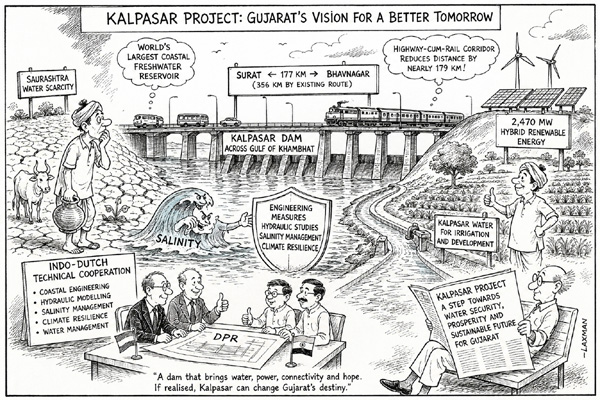
- World’s largest coastal freshwater reservoir proposed across the Gulf of Khambhat promises a lifeline for drought-prone Saurashtra and a new era of water security
- Bhavnagar-Surat journey could shrink by nearly 180 km through a highway-cum-rail corridor, unlocking faster trade, tourism and regional growth
- Indo-Dutch collaboration strengthens DPR with cutting-edge expertise in coastal engineering, climate resilience, salinity control and water management
- Project also envisions 2,470 MW of hybrid renewable energy to power irrigation, making Kalpasar a unique blend of infrastructure, sustainability and economic transformation
NE ENVIRONMENT BUREAU
NEW DELHI, JULY 27
Imagine a Gujarat where recurring water shortages in Saurashtra become history, where one of the world’s largest freshwater reservoirs transforms the State’s economy, and where travelling between Bhavnagar and Surat takes almost half the current distance. That is the ambitious vision behind the Kalpasar Project, a mega water-resources initiative that has once again come into national focus as its Detailed Project Report (DPR) enters the advanced stage of finalisation.
If implemented, the Gulf of Khambhat project could become one of independent India’s most transformative infrastructure ventures—combining water security, renewable energy, climate resilience and regional connectivity into a single engineering landmark.
The update was provided by Minister of State for Jal Shakti Raj Bhushan Choudhary in a written reply in the Rajya Sabha on Monday.
A game-changer for water-starved saurashtra
According to the Gujarat Government, the Kalpasar Project envisages constructing a dam across the Gulf of Khambhat to create one of the world’s largest coastal freshwater reservoirs.
The primary objective is to substantially augment freshwater availability and provide a dependable source of water for irrigation and other identified uses, particularly benefiting the drought-prone Saurashtra region.
For Gujarat, where rainfall is uneven and water scarcity has long constrained agriculture and development in several regions, the project represents the possibility of a long-term structural solution rather than seasonal relief.
A shorter route, a stronger economy
Beyond water, Kalpasar also promises to redefine Gujarat’s transport landscape.
The proposed highway-cum-rail corridor over the dam is expected to reduce the travel distance between Bhavnagar and Surat by nearly 179 kilometres.
Instead of travelling approximately 356 km through the existing land route, commuters and freight traffic could cover the journey in about 177 km via the proposed dyke corridor.
Such a reduction could improve logistics, lower transportation costs, boost industrial connectivity and strengthen commercial links between South Gujarat and the Saurashtra region.
Global expertise for a global-scale project
The Gujarat Government informed the Centre that the Detailed Project Report (DPR) is now at an advanced stage of finalisation.
A significant feature of the project is the ongoing Indo-Dutch technical cooperation, which is expected to strengthen the DPR by incorporating international best practices in:
- Coastal engineering
- Hydraulic modelling
- Salinity management
- Climate resilience
- Integrated water management
The collaboration is intended to enhance the project’s technical robustness and support informed decision-making during implementation.
Renewable energy to power the future
Kalpasar is not merely a water-storage project.
It also proposes the development of around 2,470 MW of hybrid renewable energy capacity on reclaimed land that is presently submerged during high tide.
The renewable power generated is proposed to be utilised, among other purposes, for pumping freshwater to irrigate the coastal regions of Saurashtra.
This integrated approach combines clean energy with sustainable water management, making the project a rare convergence of environmental stewardship and infrastructure development.
Addressing salinity and climate challenges
One of the major engineering challenges in a project of this magnitude is preventing salinity ingress.
According to the Government, the DPR incorporates appropriate engineering measures, detailed hydraulic studies and salinity-management strategies to address this issue.
The inclusion of climate-resilient design features also reflects the growing need to prepare major infrastructure projects for changing weather patterns and rising environmental risks.
A project with far-reaching implications
Beyond engineering, Kalpasar has the potential to reshape Gujarat’s development trajectory.
Greater water availability could strengthen agriculture, improve drinking-water security, support industrial growth and reduce vulnerability to drought.
Enhanced road and rail connectivity could accelerate trade, tourism and investment.
The renewable-energy component could contribute to Gujarat’s clean-energy ambitions while supporting irrigation infrastructure.
Though the project remains under preparation, its scale and integrated vision make it one of the most closely watched infrastructure initiatives in the country.
For millions of Gujaratis, Kalpasar represents more than a dam—it embodies the possibility of transforming water into prosperity, connectivity into competitiveness and sustainability into long-term resilience.