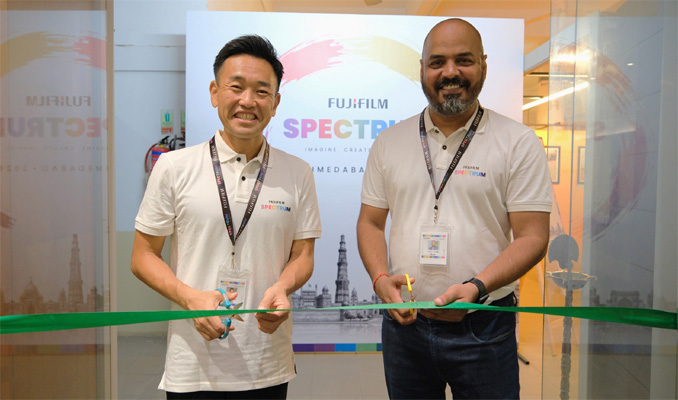

- Three-day Spectrum India Tour lands at Navajivan Trust Campus, turning Ahmedabad into a playground for photographers, filmmakers and visual storytellers
- ‘Click to Print’ philosophy bridges the digital and physical worlds as Fujifilm showcases cameras, lenses, instax™, QuickSnap and photo-printing solutions
- Creator economy gets centre stage with hands-on zones for vlogging, cinema, street, travel, portraiture and premium GFX imaging
- Fujifilm takes its full imaging ecosystem directly to creators, professionals and enthusiasts through Touch & Try experiences, masterclasses and live demonstrations
- Arun Babu says smartphones are creating a new generation of visual storytellers who can graduate to dedicated cameras as their creative ambitions grow
GOWRI MANICKAVASAGAM
AHMEDABAD, JULY 31
From a fleeting click on a smartphone to a photograph held in the hand, Fujifilm is attempting to reconnect India’s fast-growing creator generation with the magic of the image. The company’s trailblazing Spectrum India Tour 2026 arrived in Ahmedabad on Friday, transforming the Navajivan Trust Campus into an immersive imaging playground where clicks become prints, creators become storytellers and technology meets the timeless craft of photography.
Following its successful Gurugram debut, the Ahmedabad edition of Fujifilm Spectrum runs from July 31 to August 2, bringing photography enthusiasts, professional photographers, filmmakers, vloggers, students and emerging creators face-to-face with Fujifilm’s expansive imaging ecosystem.
The tour operates under the theme “Imagine. Create. Inspire.” and is built around the comprehensive “Click to Print” philosophy—an idea that gives physical photographs a renewed place in a world increasingly dominated by screens, feeds and cloud galleries. Fujifilm’s official announcement describes Spectrum as an experiential festival spanning its imaging ecosystem, including cameras, instax™, photo-imaging solutions with live printing, binoculars and optical devices.
Inaugurating the Ahmedabad edition, Koji Wada, Managing Director, FUJIFILM India, said: “The response to the Gurugram edition of Fujifilm Spectrum showed us that Indian creators are looking for experiences that go beyond the product and into the craft itself. Carrying that energy forward to Ahmedabad is a meaningful step in our journey, one that stays true to our Group purpose of ‘Giving our world more smiles.’ We are proud to keep building a platform where creators can experience our rich heritage in imaging solutions, seamlessly fused with cutting edge technology, in every city we visit.”
Print is back—but with a digital twist
The “Click to Print” theme comes at a time when photography has never been more accessible—or more digital. Millions of images are captured every day on smartphones, yet Fujifilm sees an enduring emotional and creative value in giving selected images a physical life.
Arun Babu, Associate Director, Imaging Solutions Division, FUJIFILM India, said the company views print not as a rejection of digital photography but as its natural extension.
“‘Click to Print’ reflects the complete journey of an image—from the moment it is captured to the moment it becomes something tangible. Digital photography has made image-making universal, but the physical print continues to offer an emotional connection that a screen cannot fully replicate. With instax™, QuickSnap and our photo-imaging and printing solutions, we see an opportunity to bring that joy of holding, sharing and preserving an image back into everyday photography. For India, where memories, family occasions and visual storytelling have a strong cultural value, we see significant potential in connecting the digital image with the physical print.”
Fujifilm’s recent product strategy reinforces that convergence. Its hybrid instax mini Evo Cinema™, for instance, combines digital viewing with instant printing, while the X half can transfer images to smartphones and send them to instax™ Link printers.
India’s creator boom opens a new lens
The creator economy is changing the very definition of photography. YouTubers, influencers, filmmakers, travel storytellers and social-media creators are demanding equipment that can handle both stills and video while remaining portable and intuitive.
Fujifilm is responding with an ecosystem extending from its X Series and large-format GFX cameras to instax™, QuickSnap, optical devices and the compact ASK 400 dye-sublimation printer. The company has also positioned the recently launched X-T30 III specifically for India’s growing community of photographers and serious visual creators, combining still photography with 6.2K, 10-bit video in a 378g body.
Babu said: “Indian creators are no longer just taking photos or shooting video; they are crafting comprehensive visual stories. That is why our approach is not about selling a camera in isolation. We are building an ecosystem around the creator—from the X Series and large-format GFX to instax™, QuickSnap, Optical Devices and compact printing solutions. Spectrum allows creators to touch, try and understand how these products can work together, while our X-Mentors and creator-led sessions help them translate technology into stronger storytelling.”
He added: “The smartphone has played an important role in creating this new generation of photographers and visual storytellers. Many creators begin with a phone, build an audience and then, as their ambition grows, look for greater control, interchangeable lenses, stronger low-light performance, more sophisticated video capabilities and a more immersive shooting experience. We want to be part of that journey—from the first click to professional-level creation.”
That strategy has roots in Fujifilm’s earlier observations on smartphones: Babu had previously described smartphones as helping create a “habit” of photography among vloggers and YouTubers, with users subsequently seeking more advanced lightweight mirrorless cameras.
Why a camera when the phone is already in your pocket?
The smartphone remains the most convenient camera in the world. But Fujifilm’s pitch to serious creators is that convenience and creative control are not always the same thing.
Babu said: “A smartphone is extraordinarily capable and we do not see dedicated cameras as simply competing with it. The strongest reason to move to a dedicated Fujifilm camera is creative control. A larger sensor, interchangeable lenses, optical possibilities, tactile controls, depth and perspective, advanced video capability and Fujifilm’s Film Simulation modes give creators a much wider canvas on which to express their individual voice. When photography moves from simply recording a moment to deliberately creating an image, a dedicated camera becomes a very different creative instrument.”
Fujifilm has repeatedly positioned its cameras around that distinction. In its recent X-T30 III launch, Babu described the camera as offering creators the tactile experience of a classic camera alongside advanced cinematic video capabilities.
Growth with India’s imaging community
On Fujifilm India’s current imaging trajectory and its targets for FY27 and the coming three years, Babu said the company is focused on expanding the category by building a wider creator ecosystem rather than chasing a single headline number.
“India is one of the most important growth markets for Fujifilm, and we see substantial headroom for imaging as photography, filmmaking and content creation continue to expand. Our focus is on sustainable growth through the X Series, GFX, instax™ and the wider imaging ecosystem, while strengthening our engagement with creators across metros as well as emerging markets. We do not publicly disclose specific FY27 revenue or market-share targets for the imaging business, but our ambition is clear—to grow the category, expand our creator community and make Fujifilm a stronger part of India’s visual storytelling journey over the next several years.”
Ahmedabad gets its moment in the frame
At the Navajivan Trust Campus, Spectrum brings together dedicated experience zones covering vlogging, cinema, street and travel photography, portraiture, premium imaging and the GFX system.
The three-day experience extends beyond cameras, with visitors able to try instax™, live photo-printing solutions, binoculars and optical devices, alongside accessories and hands-on demonstrations.
The Ahmedabad edition also features a strong line-up of visual storytellers and Fujifilm X-Mentors, including Vivek Desai on the Art of Storytelling; Arvind Patwal on Content Creation: From Idea to Impact; Jatin Kampani’s Phantasmagoria; Aditya Varma on shooting big films with small cameras; and Prashant Godbole on the Art of Observation.
Sessions on portfolio building and Film Simulation Recipes add a practical dimension, enabling photographers to explore Fujifilm’s custom in-camera settings rooted in the company’s colour philosophy.
The much-anticipated Experience Passport Challenge allows visitors to collect stamps as they explore the venue, with completed passports unlocking giveaways featuring Fujifilm merchandise. Treasure hunts and challenges such as “Shoot Your Friend” portraits and “Shoot & Vlog” using the Fujifilm X App further turn the exhibition into an interactive creative laboratory.
As Spectrum moves from Gurugram to Ahmedabad and on to more Indian cities, Fujifilm’s message is increasingly clear: the future of photography may be digital, but the art of creating—and the emotion of holding—a great image is far from disappearing.