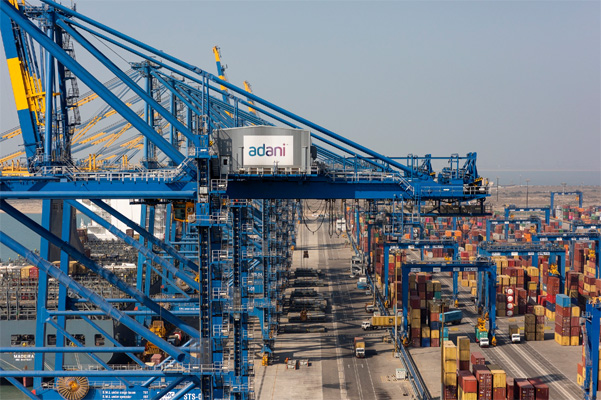
- Mundra Port clocks 32 hours 27 minutes for import cargo release, emerging as the fastest among India’s leading seaports in NTRS 2026
- Average release time plunges 41.6% from 55 hours 34 minutes in 2025, smashing the national 48-hour trade facilitation target
- 39% of Bills of Entry meet NTFAP’s 48-hour clearance benchmark—the highest compliance among leading Indian seaports
- Direct Port Delivery cargo clears in 24 hours 30 minutes, while AEO-DPD consignments race through in just 15 hours 18 minutes
- Mundra outpaces major gateways including Nava Sheva, Chennai and Kolkata, underscoring the power of digitalisation, automation and integrated logistics
- Faster clearance promises lower dwell time, reduced logistics costs and a sharper competitive edge for India’s international trade and manufacturing ambitions
NE BUSINESS BUREAU
MUNDRA, JULY 31
In global trade, time is not merely money—it is competitiveness. And at Mundra, the clock is now moving faster than India’s leading maritime gateways. The country’s largest commercial port has emerged as the fastest-performing leading seaport in India for customs cargo clearance, according to the National Time Release Study (NTRS) 2026 released by the Central Board of Indirect Taxes and Customs (CBIC).
The headline number tells the story: Mundra’s average release time (ART) for import cargo has crashed from 55 hours 34 minutes in 2025 to just 32 hours 27 minutes in 2026—a 41.6% improvement in a single year.
That performance not only places Mundra at the top among leading Indian seaports but also comfortably beats the National Trade Facilitation Action Plan (NTFAP) target of customs clearance within 48 hours.
For importers, exporters and logistics operators, every hour saved at the port can mean lower inventory costs, faster cargo evacuation, improved supply-chain predictability and greater competitiveness.
32 hours vs 65, 85 and 155: Mundra opens a wider gap
Mundra’s performance becomes even more striking when placed alongside other major gateways.
The NTRS 2026 data puts average cargo clearance time at 65 hours 52 minutes at Nava Sheva, 85 hours 59 minutes at Chennai and 155 hours 9 minutes at Kolkata, against Mundra’s 32 hours 27 minutes.
The efficiency story extends beyond seaports.
Ahmedabad Airport recorded an average release time of 35 hours 41 minutes, Bengaluru 42 hours 59 minutes, Chennai 36 hours, Delhi 36 hours 1 minute, Hyderabad 45 hours 8 minutes and Mumbai 43 hours 24 minutes.
In other words, Mundra’s seaport operations have in several comparisons performed at speeds traditionally associated with faster air cargo facilities.
78.39% cargo clears within the 48-hour target
Mundra’s achievement is not simply about its average.
A remarkable 78.39% of Bills of Entry processed at the port achieved the NTFAP target of customs clearance within 48 hours—the highest compliance among India’s leading seaports.
That figure points to a broader transformation in cargo movement, driven by closer coordination between Mundra Customs, terminal operators, logistics partners and other stakeholders.
For businesses, predictability can be as important as speed. Faster and more consistent customs processing enables companies to plan inventory, transportation and production schedules with greater confidence.
Direct port delivery cuts the wait
The NTRS 2026 findings also highlight the impact of Direct Port Delivery (DPD) in accelerating cargo evacuation.
Import consignments handled through DPD at Mundra recorded an average clearance time of 24 hours 30 minutes, compared with 34 hours 52 minutes for cargo routed through Container Freight Stations (CFS).
By enabling eligible cargo to move directly from port terminals, DPD can reduce dwell time, minimise additional handling and lower logistics costs.
The gains become even more dramatic under the AEO-DPD route.
Import consignments moved through the combined Authorized Economic Operator (AEO)-DPD mechanism achieved an exceptional average release time of just 15 hours 18 minutes—the fastest among leading Indian seaports.
The result demonstrates how risk-based customs facilitation and trusted-trader programmes can create a faster and more predictable cargo-clearance ecosystem.
Rakshitbhai Shah: ‘A proud achievement for Mundra’
Reacting to the recognition, Rakshitbhai Shah, Executive Director, Adani Ports, Mundra, said:
“Being recognized as India’s fastest leading seaport for customs cargo clearance is a proud achievement for Mundra Port. This milestone reflects the strong collaboration between Mundra Customs, logistics partners, and the entire trade ecosystem. We sincerely thank the Central Board of Indirect Taxes and Customs (CBIC), the Mundra Customs team led by Customs Commissioner Nitin Saini, and all our stakeholders for their continued partnership.”
The achievement reflects the combined impact of port infrastructure, customs processes, digitalisation, automation, advance filing, risk management and coordinated cargo evacuation.
It also underlines the importance of the people behind the technology.
The performance has been supported by the experienced and trained manpower within the Mundra Customs administration, along with coordinated efforts across Customs, terminal operators and logistics stakeholders. Under the leadership of Nitin Saini, Customs Commissioner, Mundra Customs, the coordinated approach has helped translate operational efficiency into measurable reductions in cargo-release time.
When every saved hour strengthens India’s trade engine
The significance of the NTRS recognition extends beyond Mundra.
For an economy seeking to expand manufacturing, attract global supply chains and strengthen its position in international trade, port efficiency is strategic infrastructure.
A container waiting for clearance is not merely cargo waiting at a terminal. It can represent inventory locked up, trucks waiting, production schedules delayed and additional costs accumulating across the supply chain.
Reducing that waiting time therefore creates benefits that travel far beyond the port gates.
Mundra’s latest performance demonstrates how infrastructure + technology + customs reform + trusted-trader mechanisms + stakeholder coordination can transform cargo clearance.
As India pursues a more competitive logistics ecosystem and greater integration with global supply chains, the NTRS 2026 results offer a powerful message:
The race to become a global trade hub is increasingly a race against time—and Mundra has shown that the fastest route to competitiveness may begin by simply making cargo wait less.