R ARIVANANTHAM
CHENNAI, AUG 2
For a newborn, the journey towards a healthier life can begin with something as natural as a mother’s first feed. Breast milk is not merely food for an infant; it is nourishment, immune protection and an intimate bridge between mother and child. Yet, experts are warning that this powerful first line of protection needs stronger family, community and healthcare support as exclusive breastfeeding rates show worrying signs of decline.
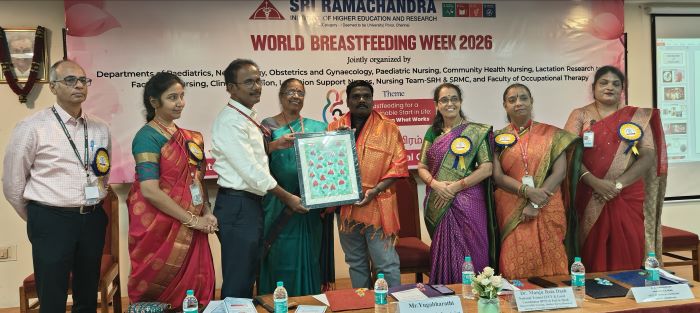
Against this backdrop, the Sri Ramachandra Institute of Higher Education and Research (SRIHER) on Saturday launched its week-long World Breastfeeding Week programme on the theme, ‘Breastfeeding for a Sustainable Start in Life: Strengthen What Works’, bringing together medical, nursing, nutrition and allied-health professionals to reinforce evidence-based breastfeeding practices.
- SRIHER launches World Breastfeeding Week with a call to strengthen what works for healthier beginnings
- Experts flag falling exclusive breastfeeding rate and urge stronger family and community support for mothers
- Breast milk nourishes more than the infant’s body, strengthening immunity, development and the emotional bond between mother and child
- Week-long programme to combine scientific sessions, community outreach and public awareness to promote evidence-based breastfeeding
- Healthcare professionals caution against aggressive promotion of infant formula and supplementary milk products that can undermine exclusive breastfeeding
Acclaimed Tamil film lyricist Yugabharathi, who inaugurated the programme, stressed that breastfeeding extends far beyond nutrition.
“Breast milk not only provides optimal nourishment to an infant but also strengthens the emotional bond between mother and child,” he said, pointing out that breastfeeding helps prevent several health problems during early childhood and contributes to the overall well-being of the baby.
Calling for sustained public awareness, Yugabharathi said universal breastfeeding practices could be achieved only through continuous awareness campaigns reaching both urban and rural communities. He also noted that the theme of motherhood occupies a special place in his film lyrics, reflecting the invaluable role of mothers in society.
The six-month window that matters
Delivering the keynote address, Dr Manju Bala Dash, National Trainer (Infant and Young Child Feeding–IYCF), Local Coordinator, Breastfeeding Promotion Network of India (BPNI), and Head, Department of Obstetrics and Gynaecological Nursing, Mother Theresa Post Graduate & Research Institute of Health Sciences, underlined the wider developmental importance of breast milk.
Recent studies, she said, have shown that breast milk enhances a child’s cognitive development, intelligence and immune function.
However, she expressed concern over the decline in the national exclusive breastfeeding rate, from 63.7 per cent to 55.8 per cent.
She attributed the challenge partly to inadequate family support and the aggressive marketing of infant formula and supplementary milk products, which can discourage mothers from exclusively breastfeeding during the recommended first six months.
The message from the experts was therefore clear: supporting breastfeeding cannot be left to mothers alone; families, communities, workplaces and healthcare systems all have a role to play.
Why breastfeeding matters — for baby and mother
For the infant:
- Provides nutritionally appropriate nourishment during early life.
- Supplies antibodies and other immune-supporting components that help protect against infections.
- Supports healthy growth and development, including cognitive development.
- Strengthens the mother-child emotional bond.
- Is safe, readily available and requires no preparation.
For the mother:
- Helps the uterus contract after childbirth and can reduce postpartum blood loss.
- Supports recovery after delivery.
- Is associated with lower long-term risks of breast and ovarian cancers and Type 2 diabetes.
- Offers a convenient, hygienic and economical way of feeding the baby.
- Provides an opportunity for close skin-to-skin contact and bonding.
From hospital to home, a week of awareness
The week-long SRIHER programme will feature academic sessions, community outreach initiatives and public-awareness activities, bringing faculty, students and healthcare professionals together to promote scientifically sound breastfeeding practices.
The programme seeks to improve awareness among mothers and families while strengthening collaborative healthcare delivery through multidisciplinary engagement.
The initiative has been jointly organised by the Departments of Paediatrics, Neonatology, Obstetrics and Gynaecology, Paediatric Nursing, Community Health Nursing, Lactation Research, Clinical Nutrition, Lactation Support Nurses, Nursing Team-SRH & SRMC, Faculty of Nursing and Faculty of Occupational Therapy.
Vice Chancellor Dr Uma Sekar, Head of Paediatric Medicine Dr Saji James, Assistant Professor of Paediatrics Dr P Anitha, Head of Neonatology Dr B Uma Maheshwari, Head of Clinical Nutrition Dr A J Hemamalini, Nursing Superintendents Kala and Selma Thomas, faculty members and students participated.
The initiative ultimately carries a simple but profound health message: when a mother is adequately informed, supported and empowered, a baby’s first food can become the foundation for a healthier life.