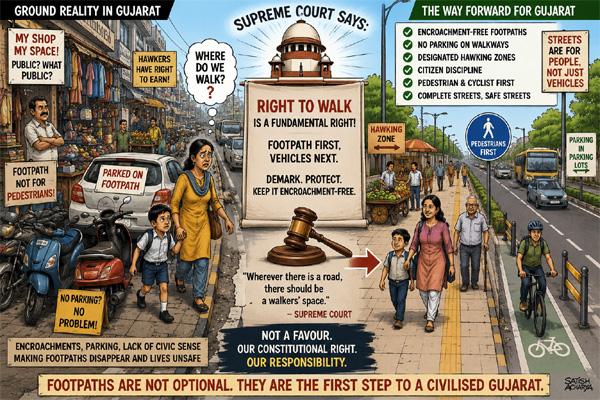
- SC puts pedestrians first; Gujarat’s streets now face a constitutional reality check
- Ahmedabad’s footpaths swallowed by vehicles, shops and hawkers despite years of HC directions
- From police enforcement to civic sense: State needs a pedestrian-cyclist-first mobility reset
GOWRI MANICKAVASAGAM
AHMEDABAD, AUG 4
Where exactly is a Gujarati citizen supposed to walk when the footpath is a parking lot, a shop extension, a hawker zone—or simply does not exist? That question has acquired an altogether different constitutional weight after the Supreme Court declared that the right to walk on a demarcated footpath is a fundamental right, with pedestrian movement taking priority over motorised vehicles.
For Gujarat, the verdict is less a new instruction than a long-overdue reality check. The Gujarat High Court had already directed Ahmedabad authorities years ago to clear encroachments, keep footpaths and service roads free for pedestrians and prevent roads abutting commercial establishments from becoming permanent parking spaces. Yet the familiar scene survives across Ahmedabad and other Gujarat cities: cars and two-wheelers occupying walking space, shopkeepers spilling merchandise into public areas, hawkers narrowing passages, vehicles mounting pavements and pedestrians being forced into live traffic.
The Supreme Court’s latest intervention now makes the question sharper: Can a public authority claim to have provided a footpath if a citizen cannot safely walk on it?
SC’s message: Footpath first, vehicles next
On June 19, the Supreme Court held that the right to walk is a fundamental right under Part III of the Constitution, integral to the freedom of movement under Article 19(1)(d), read with other constitutional freedoms and Article 21. It specifically brought the right to demarcated footpaths within that protection and said such pedestrian rights have priority over motorised vehicles.
The ruling went beyond merely recognising a right. It placed a correlative duty on urban development authorities, municipal corporations, municipalities and panchayats to demarcate, construct, maintain and safeguard footpaths and necessary pedestrian infrastructure wherever roads exist.
On Monday, the Supreme Court reinforced that message, directing the Centre to ensure that every road has a properly demarcated, encroachment-free space for pedestrians, with the bench stressing that this need not begin with expensive construction: the pedestrian space must simply be clearly separated and protected from motor vehicles.
For Gujarat, this puts a constitutional spotlight on an old civic failure.
Gujarat HC had already drawn the line—but streets tell another story
The irony is hard to miss.
In a 2018 PIL concerning Ahmedabad’s roads, traffic and encroachments, the Gujarat High Court explicitly directed the Estate Department and Traffic Police to remove encroachments obstructing vehicular as well as pedestrian movement.
The court also directed authorities to ensure that vehicles belonging to visitors to shopping centres, restaurants, hospitals, educational institutions, malls, religious places, parks and other establishments were parked in designated parking spaces rather than on adjoining public roads and service roads. Such public roads, the court made clear, were not to be converted into permanent parking spaces.
The HC had even urged authorities to “instil a habit of walking among people”—a striking reminder that walkability was already being treated as a public-policy concern years before the Supreme Court’s latest constitutional pronouncement.
But Ahmedabad’s ground reality remains stubbornly different.
The city’s own data tell the story. A CEPT University study found that only about 15% of Ahmedabad’s road network had footpaths, while around 28% of those footpaths were rendered unusable by on-road parking. The study also found that 40% of the 775 accidents examined involved pedestrians or cyclists, while bicycle tracks existed on only about 2% of city roads.
More recent reporting has painted an even more alarming picture: about 72% of Ahmedabad’s 2,634-km road network reportedly lacks footpaths, leaving pedestrians particularly vulnerable in rapidly developing areas such as Bopal, Thaltej and Motera.
Parking, shop extensions, hawkers: The footpath hijack
The problem cannot be pinned on one group alone.
A footpath in Gujarat can disappear in several ways: a car parked across it; two-wheelers lined up outside a commercial establishment; a shopkeeper extending merchandise, display racks or platforms into public space; a hawker occupying the remaining corridor; utility infrastructure narrowing it further; or civic works leaving pedestrians to negotiate broken surfaces and traffic.
The result is the same: the pedestrian is pushed onto the carriageway.
And that is where the distinction between “traffic management” and public safety collapses.
The Gujarat High Court’s earlier directions explicitly contemplated responsibility on both civic and police authorities. The problem, therefore, is not necessarily an absence of rules. It is the inconsistent enforcement of rules against powerful and everyday encroachments alike.
Ahmedabad has recently attempted a tougher response. The AMC has designated 11 roads as Zero Tolerance Roads, authorising stringent action against illegal parking, encroachments and traffic violations, including immediate towing and removal of vehicles. Its stated policy objective is to “protect public streets from encroachment, prioritise pedestrians and public transport, and manage parking demand systematically.”
But a few Zero Tolerance Roads cannot solve a State-wide structural problem.
The question is whether the same enforcement intensity will reach every ordinary street, market road, school frontage, hospital approach and residential lane where pedestrians are routinely squeezed out.
A strange paradox: Narrower footpaths to stop encroachment?
Gujarat’s response to the pedestrian crisis has also produced an uncomfortable policy paradox.
In June, the AMC considered narrowing footpaths “wherever possible to prevent illegal occupation”, arguing that larger pedestrian spaces could facilitate misuse by hawkers. Yet the civic body’s own policy prescribes minimum obstruction-free widths of 2.5 metres in central business/commercial zones, 2 metres on arterial roads, 1.8 metres on sub-arterial and collector roads and 1.5 metres on local/residential roads. It also calls for continuous, protected pedestrian paths.
That raises a fundamental question after the Supreme Court ruling: Should public authorities make pedestrian space smaller because others are misusing it—or make enforcement strong enough to ensure that pedestrian space remains pedestrian space?
Urban planning experts increasingly argue for the latter.
At a recent Ahmedabad mobility exhibition, experts advocated better footpaths, improved public transport, stronger last-mile connectivity and paid parking, along with demand-management measures to reduce excessive dependence on private vehicles. The call was for citizen-centric planning and “complete street” designs rather than infrastructure designed predominantly around vehicle movement.
Gujarat needs a pedestrian-cyclist-first mobility reset
Gujarat’s mobility policy now needs to move beyond the traditional formula of more roads + more lanes + more flyovers = less congestion.
The State needs a clearly measurable Pedestrian and Cycling Priority Policy, with walking and cycling treated as core transport modes rather than leftover spaces after the carriageway has been designed.
That means:
- continuous, obstruction-free and physically protected footpaths on every feasible urban road;
- strict prohibition of parking on pedestrian space, backed by automatic enforcement and towing;
- zero tolerance for permanent shop extensions and commercial encroachments;
- designated, properly planned vending zones rather than allowing hawkers to compete with pedestrians for pavement space;
- protected cycle tracks, especially on major corridors and around educational, employment and transit hubs;
- safe, raised and accessible pedestrian crossings at junctions;
- universal-access design for senior citizens, children and persons with disabilities;
- mandatory pedestrian and cycling audits before approval of major road projects;
- parking pricing and demand management rather than treating public streets as free parking lots; and
- a public mobility scorecard measuring footpath continuity, encroachment removal, pedestrian safety, cycling infrastructure and enforcement—not merely kilometres of roads constructed.
A two-day active-mobility workshop held in Ahmedabad in July, involving AMC, the Union Ministry of Housing and Urban Affairs, GIZ India, the Dutch Cycling Embassy and other experts, specifically focused on complete streets, safe intersections, universal accessibility, cycling infrastructure and pedestrian safety, signalling that the expertise and institutional knowledge already exist. The missing ingredient is consistent execution.
CEPT University’s Maulik Chauhan, whose work focuses on urban design and walkability in Indian cities, has also researched Ahmedabad through the lens of “Walkability as Contested Citizenship”—an apt description of a city where access to street space is constantly negotiated among pedestrians, vehicles, vendors, businesses and civic authorities.
The real test: Will Gujarat reclaim its streets?
The Supreme Court has now changed the vocabulary: walking is not a favour extended by a civic body; safe walking on a demarcated footpath is a constitutionally protected right.
Gujarat already has the judicial blueprint. Its High Court has issued directions on encroachments, parking and pedestrian movement. Ahmedabad has a traffic-management policy and Zero Tolerance Roads. The State has mobility experts, planners and institutions capable of designing people-first streets.
What remains is the hardest part: enforcement and civic discipline.
Citizens cannot demand clean, safe footpaths while parking vehicles on them. Shopkeepers cannot claim a right to trade while appropriating public walking space. Hawkers need dignified and designated spaces—but pedestrians cannot be made to surrender the only strip of pavement available to them. Police and civic authorities cannot conduct episodic drives and declare victory while the same encroachments return weeks later.
The Supreme Court has effectively placed the footpath at the centre of the constitutional map.
Now Gujarat must decide whether its streets will continue to belong primarily to vehicles—or finally become public spaces where the pedestrian, cyclist, child, senior citizen and person with disability are treated as first-class citizens.
Caption: The footpath exists—but does it belong to the pedestrian? With vehicles, shop extensions and other encroachments routinely squeezing walkers onto live traffic lanes, Gujarat faces a constitutional test after the Supreme Court’s landmark right-to-walk ruling.