
- Proposed ‘Bharat Gold Standard’ to bring training, assessment and certification under one indigenous professional framework
- Advanced Security Skills Training Centre to blend technology, simulation, OSINT, drones, K9 and scenario-based learning
- Initiative seeks to transform private security from manpower deployment into a skilled, assessed and technology-enabled profession
- RRU–industry partnership targets first-response capability and professional mobility across a 10-million-strong private security workforce
NE EDUCATION BUREAU
GANDHINAGAR, SEPT 25
A security guard at a gate today may be the first person to spot a threat, raise an alarm, manage an emergency or initiate the first response—yet the skills required for that responsibility are rapidly changing.
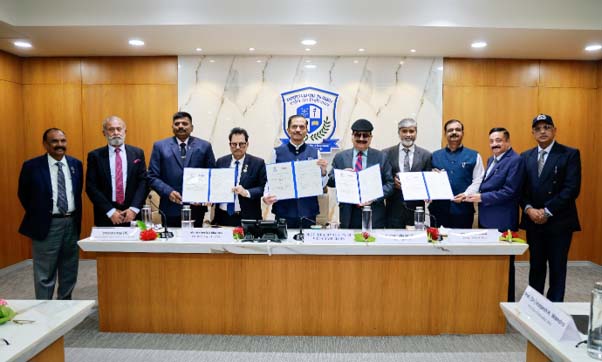
Against this backdrop, Rashtriya Raksha University (RRU) and the Central Association of Private Security Industry (CAPSI) have signed Memoranda of Understanding to develop an indigenous framework for the training, assessment and professional certification of private security professionals, centred on a proposed “Bharat Gold Standard” aligned with India’s regulatory, operational and technological requirements.
The initiative is being pursued in line with the vision of Union Home Minister Amit Shah for a trained, technology-enabled and professionally capable private security sector that can serve as an effective first line of response and complement public security institutions.
The partnership seeks to address a fundamental question facing the rapidly evolving sector: Can India’s private security workforce move from being primarily manpower-driven to becoming a professionally trained, assessed, certified and technology-enabled security force?
Academia meets industry to redefine security standards
The MoU brings together RRU’s academic, training, research, simulation and assessment capabilities with CAPSI’s extensive industry network and understanding of operational requirements.
The signing ceremony was held at the RRU campus in Gandhinagar, where Vice Chancellor Prof. Bimal N. Patel interacted with the CAPSI delegation on the broader objective of professionalising private security in Bharat.
RRU was represented by Nimesh Dave, Director, SICSM, and Lt Col B. S. Rao, Coordinator, along with other University representatives.
The CAPSI delegation was led by Kunwar Vikram Singh, Chairman, CAPSI, and included Mahesh Sharma, Secretary General; Anil Puri, National Vice President; V. V. Katti, President; Col. A. K. Singh, COO, SSSDC; Dr. Sheetal Nair, President, CAPSI Gujarat Chapter; Dr. R. K. Tyagi and R. P. Chauhan, National Vice Presidents; Sanjeev Bhardwaj, National Secretary (Reforms); Anil Rai, Honorary Secretary, SAG; Rajesh Pillai, General Secretary, CAPSI Gujarat; I. P. Singh, Vice President, CAPSI Gujarat; Rajesh Yadav, Deputy General Secretary, CAPSI Gujarat; and R. K. Chaturvedi, Treasurer, SAG.
Where ‘Gold Standard’ meets ground reality
The institutional backbone of the initiative will be RRU’s Advanced Security Skills Training Centre, conceived as an industry-aligned platform catering to a wide spectrum of security professionals.
Its potential beneficiaries include young entrants to the sector, serving security personnel seeking career advancement, ex-servicemen and former police personnel transitioning to civilian security, private security agency owners and managers, and professionals working in risk, compliance and facility management.
The Centre seeks to move beyond conventional classroom-based instruction by combining legal and operational foundations with simulation, laboratory exposure, scenario-based learning and physical preparedness.
Its training ecosystem includes driving and firing simulators, OSINT and technology laboratories, drone training, K9 exposure, maritime-security facilities, a dedicated Private Security Lab, moot-court exposure and human-performance infrastructure.
This combination assumes significance because the modern security environment has moved well beyond the traditional guard at the gate.
A security professional may now have to understand CCTV analytics, electronic access control, alarm systems, drones, digital communications and AI-enabled security platforms, alongside conventional physical-security responsibilities.
The proposed framework therefore places technology literacy alongside operational competence, with training extending across prevention, detection, reporting, escalation and first response.
From a job to a professional career
The initiative’s larger significance lies in its attempt to create a professional architecture around the individual security practitioner.
Instead of treating course attendance as the primary indicator of training, the proposed system seeks to connect training with practical assessment and certification, allowing competence to be demonstrated and recognised.
The pathway could enable personnel to move from entry-level guarding and site duties to supervisory roles and specialised functions involving K9, drones, OSINT and technology-enabled security, and subsequently towards managerial, consulting and entrepreneurial opportunities.
Training of trainers, executive education and continuing professional development could further extend these competencies into private security organisations across India.
The proposed career progression can be summed up as:
Deployment → Skills → Assessment → Certification → Specialisation → Professional Mobility
For personnel, that could mean moving from a job to a career.
For employers, it could provide a more structured basis for matching certified capabilities with responsibilities.
For the wider security ecosystem, it could help create a workforce that is progressively trained, assessed, specialised and technology-enabled.
A 10-million-person security opportunity
The scale of the sector makes the initiative significant beyond the private security industry.
CAPSI describes India’s private security workforce as approximately 10 million personnel, deployed across industrial facilities, financial institutions, corporate establishments, hospitals, educational campuses, residential communities, logistics networks and other public-facing spaces.
At such scale, improvements in professional competence, first-response capability, technological literacy and supervisory standards could have implications well beyond individual security agencies.
The proposed Bharat Gold Standard is therefore envisaged not merely as another certificate, but as an Indian professional ecosystem encompassing defined occupational competencies, structured curricula, qualified trainers, practical learning, credible assessment, professional certification and continuing education.
Its framework can also evolve alongside changing technologies, threats and operating environments.
An Indian benchmark for an evolving security industry
The RRU–CAPSI partnership ultimately seeks to redraw the architecture of private security in India.
From guarding to professional security.
From attendance-based training to assessed competence.
From manpower deployment to technology-enabled capability.
From isolated employment to structured professional mobility.
And, potentially, from dependence on external benchmarks to an Indian standard capable of earning national and eventually global relevance.
If the proposed “Bharat Gold Standard” translates this vision into measurable skills, credible assessment and industry-wide recognition, the initiative could give India’s vast private security workforce something it has long needed alongside employment: a clearly defined professional pathway.