
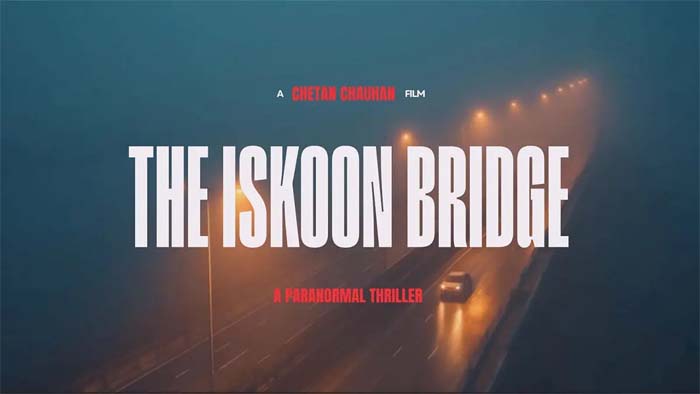
- India’s first AI-generated Gujarati feature film unveils teaser; paranormal thriller set for November 13 theatrical release
- 82 AI-generated characters power an ambitious human-AI cinematic experiment
- White Screen Motion Pictures, GoSkripto & Matrix Studio combine Gujarati storytelling with next-generation AI visuals
- NFDC officially selected the teaser at AI Impact Summit 2026 in New Delhi
- Human story, screenplay, dialogues, music and direction meet AI-generated visual storytelling
NE ENTERTAINMENT BUREAU
The question is no longer whether Artificial Intelligence can write a story. Gujarati cinema is now posing a far more intriguing question: Can AI create the visual world of a feature film and still make audiences laugh, wonder, fear and feel?
That experiment has taken a distinctly Gujarati turn with the teaser launch of The Iskoon Bridge, billed by its makers as India’s first AI-generated Gujarati feature film, and scheduled for a theatrical release on November 13, 2026.
Presented by White Screen Motion Pictures, GoSkripto and Matrix Studio, the film ventures into the paranormal-thriller genre, placing generative AI at the centre of its visual creation while retaining human authorship across the story, screenplay, dialogues, music, editing and direction.
The result is an unusual cinematic proposition: human imagination writes the story; AI builds its visual universe.
82 AI characters, one Gujarati story
One of the project’s most striking claims is the creation of 82 AI-generated characters, making the film an unusually ambitious experiment in AI-driven characterisation.
The makers say AI has been used specifically for creating the visuals and video, while the film’s narrative and core creative elements have retained human involvement.
The film’s story is positioned as a paranormal thriller based on multiple true events across India, adding another layer to its attempt to blend technology with culturally rooted storytelling.
The project has also been placed under observation with the National Forensic Sciences University (NFSU) for an authentic narrative, according to the makers.
Why Gujarati—and why now?
The choice of Gujarati is central to the project’s identity.
Director and writer Chetan Chauhan had earlier explained why the makers chose Gujarati despite having the option of Hindi: “We had an option for Hindi language but we decided to choose Gujarati as being a Gujarati we want to bring a proud moment to our own people in our language.”
That decision turns the project into more than a technology experiment. It attempts to demonstrate that emerging AI filmmaking can be deployed in a regional language without sacrificing linguistic or cultural identity.
Creative Director Kuunal Shah had also indicated that audiences would be surprised to see AI avatars speaking fluent Gujarati, while describing the film as an unconventional paranormal-thriller experience.
Where human storytelling meets machine-generated imagery
The technology may be unconventional, but the creative credits underline the substantial human team behind the film.
Written & Directed: Chetan Chauhan
Creative Director: Kuunal Shah
Music: Vivek Bhardwaj Chhetri
Lyricist: Chirag Tripathi
Editor: Ankit Gadhvi
Colourist: Mihir Chhatbar
Screenplay & Dialogues: Vrunda Buch
Sound Design: Avinash Sonvane
According to the makers, GoSkripto’s Go2V visual-content model has been used as the AI technology platform for the project.
This division of creative responsibilities is important. The film is not being presented simply as a machine-written movie. Instead, its central proposition is that AI can become a visual production tool while human creators retain control of the narrative and filmmaking decisions.
A paranormal thriller becomes the testing ground
The choice of a paranormal thriller could be particularly significant for an AI-generated visual project.
The genre demands atmospheric environments, uncanny imagery, suspense, supernatural situations and visual worlds that can often be difficult or expensive to construct through conventional production methods.
That makes The Iskoon Bridge an interesting test case for generative AI: Can the technology create unsettling environments and believable characters while sustaining suspense over an entire feature film?
The teaser now offers audiences their first substantial glimpse into that visual experiment.
From AI experiment to theatrical gamble
The makers are taking the project beyond the digital space. The Iskoon Bridge is planned as a theatrical release, followed subsequently by an OTT release.
The India release plan includes Gujarat and Mumbai, while the proposed overseas markets include the USA, UK, Australia, New Zealand and Canada.
The film is scheduled to hit theatres on November 13, 2026.
That theatrical ambition raises the stakes considerably. A short AI-generated sequence can create curiosity; sustaining a feature-length cinematic experience is a different challenge altogether.
Can AI-generated visuals maintain continuity? Can AI avatars generate emotional engagement? Can digitally created environments support suspense without making audiences conscious of the technology behind them?
And perhaps the biggest question: Can viewers eventually forget that the images were generated by AI and simply surrender to the story?
A milestone at the AI Impact Summit
The project had already attracted institutional attention before the teaser’s wider release.
According to the makers, The Iskoon Bridge teaser was officially selected by NFDC at the AI Impact Summit in New Delhi in February 2026, an event associated with the Ministry of Information & Broadcasting, Government of India.
That selection places the Gujarati experiment within India’s larger conversation around artificial intelligence and the creative industries.
The film’s journey therefore extends beyond Gujarati cinema. It enters a rapidly developing debate over how AI may alter filmmaking—from visual effects and character creation to production workflows and eventually the economics of regional-language cinema.
Gujarati cinema enters an unfamiliar bridge
The title itself now acquires an intriguing metaphorical resonance.
A bridge connects two worlds. The Iskoon Bridge attempts to connect two creative worlds as well: human storytelling and machine-generated visual imagination.
Whether that bridge can carry audiences across an entire feature film will be tested in theatres this November.
For Gujarati cinema, however, the experiment has already opened a conversation: What happens when a regional-language story is given an AI-generated visual universe without surrendering its human creative core?
The answer will arrive on the big screen on November 13, 2026.
The teaser is out. The real experiment begins in the theatre.
Teaser: The Iskoon Bridge — https://youtu.be/hkaAXj3fjdI