

NE RAILWAY BUREAU
BOGIDOLE, SIBSAGAR DIST, ASSAM, SEPT 24
What if a railway journey that currently ends at Chennai could instead carry passengers all the way to the heart of Tamil Nadu and on to Kanniyakumari? For thousands of Tamil families living in the Northeast, better rail connectivity is not merely about adding a few kilometres to a timetable—it is about creating a dependable transport lifeline linking communities, families, workplaces and places of origin.
- Over 10 lakh Tamil residents across the Northeast and Howrah region seek better rail access beyond Chennai
- Plea to PM Modi, Railway Minister Ashwini Vaishnaw and senior Railway officials for three strategic train extensions
- Howrah–Tiruchchirappalli service sought to be extended to Kanniyakumari and made daily
- Northeast–Tamil Nadu trains proposed to run through Villupuram, Tiruchchirappalli and Madurai
- Doubling of Chennai–Kanniyakumari route and new terminal facilities create an opportunity to strengthen the rail bridge
Against this backdrop, the Northeast Tamilar Association has made an urgent public-interest appeal to Prime Minister Narendra Modi, Railway Minister Ashwini Vaishnaw and senior officials of the Ministry of Railways, Southern Railway and North Eastern Railway, seeking strategic extensions and increased frequency of key trains connecting the Northeast with central and southern Tamil Nadu.
The Northeast—comprising Arunachal Pradesh, Assam, Manipur, Meghalaya, Mizoram, Nagaland, Sikkim and Tripura—accounts for around 8% of India’s geographical area. The Northeast and the Howrah region together are home to more than 10 lakh Tamil residents, with over half reportedly originating from central and southern Tamil Nadu.
Yet, the Association points to a significant connectivity gap.
Major daily trains such as the Coromandel Express and Howrah Mail terminate at Chennai Central, leaving passengers travelling onward to central and southern Tamil Nadu to depend on additional connections. The plea notes that only about 55 km of Tamil Nadu’s approximately 4,500-km railway network is directly covered by these services—highlighting the need for stronger penetration into the State’s southern districts.
Three extensions, one stronger rail bridge
The Association has placed three specific proposals before the Railway authorities.
First, it has sought extension of the 12663/12664 Howrah–Tiruchchirappalli bi-weekly Express up to Kanniyakumari, along with conversion of the service into a daily train.
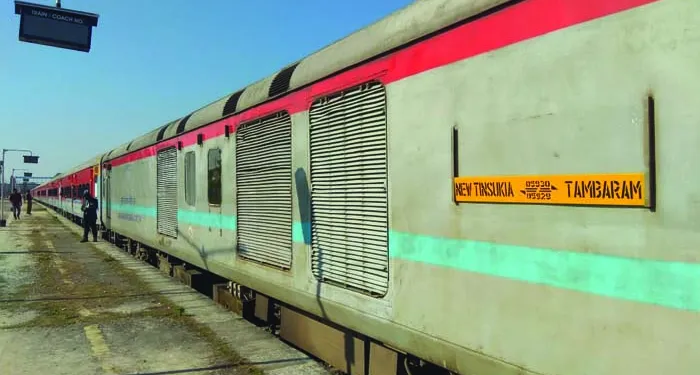
Second, it has requested that the 15930/15929 New Tinsukia–Tambaram Express and 15630/15629 Silghat Town–Tambaram Express be extended to Kanniyakumari via Villupuram, Tiruchchirappalli and Madurai.
Third, the Association has proposed extending the 22611/22612 Chennai Central–New Jalpaiguri weekly Express to Kanniyakumari and further to Agartala, creating a proposed Kanniyakumari–Agartala weekly service via Villupuram, Tiruchchirappalli and Madurai.
Together, the proposals seek to create a more direct rail corridor between India’s Northeast and the southernmost districts of Tamil Nadu.
Why the timing matters
The Association argues that the timing is particularly significant following completion of the Chennai–Tiruchchirappalli–
This, it says, provides an opportunity for the Railways to examine whether existing services can be operationally extended to serve a much larger passenger catchment.
For passengers, such extensions could reduce the need for multiple train changes, make long-distance journeys more predictable and provide a more seamless rail connection between the Northeast and southern Tamil Nadu.
The proposal also places the issue in a wider connectivity context: railways do more than move passengers—they connect communities that live hundreds or thousands of kilometres apart.
An appeal for an operational examination
The Northeast Tamilar Association has urged the Railway Ministry and the concerned railway zones to examine the proposals on operational, technical and passenger-demand parameters and consider suitable action.
“These extensions will greatly enhance connectivity for passengers travelling between Northeast India and southern Tamil Nadu,” the Association said in its appeal, pointing to the infrastructure developments now taking place along the southern Tamil Nadu corridor.
The plea comes from Dr Aaron Gnanadas, Founder and President, Northeast Tamilar Association, whose organisation has sought immediate attention to what it describes as a long-standing connectivity requirement.
The larger question before the Railways is straightforward: can existing rail assets and services be leveraged to build a more direct Northeast–Tamil Nadu connection, particularly for passengers whose destinations lie far beyond Chennai?
For the Tamil communities of the Northeast, the answer could determine whether the railway map becomes not merely a network of stations, but a stronger bridge between the Northeast and the deep south of India.