NE RAILWAY BUREAU
CHENNAI, OCT 3
A railway station may be cleaned in hours, but keeping thousands of stations, trains, tracks, offices and colonies clean is a daily test of systems, behaviour and public participation. Southern Railway is seeking to turn that challenge into a sustained movement, with more than 9,000 Cleanliness Target Units (CTUs) cleaned and 70,650 participants mobilised during its intensive Swachhata campaign.
GM Shri U. Subba Rao, AGM Shri Vipin Kumar and DRM Shri Shailendra Singh lit the traditional lamp to begin the programme at Dr. MGR Chennai Central on the 157th Birth Anniversary of Mahatma Gandhi, culminating Swachhata Hi Seva 2026.#GandhiJayanti #SwachhataHiSeva2026 #SHS pic.twitter.com/idSpo9nMO2
— Southern Railway (@GMSRailway) October 2, 2026
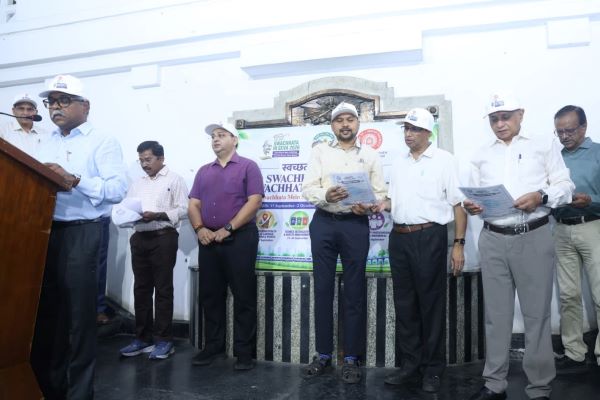
The next phase began on October 1, when U. Subba Rao, General Manager, Southern Railway, launched Swachhata Pakhwada-2026 at Southern Railway Headquarters in Chennai, administering the Swachhata Pledge before joining officers and staff in Shramdaan and tree plantation drives.
- GM U. Subba Rao launches Swachhata Pakhwada-2026 at Southern Railway Headquarters
- Month-long cleanliness drive reaches more than 300 stations with focus on waste management and public participation
- Over 16,000 join ‘Ek Din, Ek Ghanta, Ek Saath’ mass Shramdaan across divisions and units
- 4,500 Safai Mitras and families benefit from 161 safety, health and welfare camps
- 45 tonnes of plastic waste removed as railways push segregation, recycling and sustainable cleanliness practices
He also felicitated Safai Mitras for their contribution and distributed health kits.
More than 300 staff members, along with Additional General Manager Vipin Kumar, Principal Chief Mechanical Engineer R. Mukund, Principal Heads of Departments and other officers, participated in the launch.
From 300-plus stations to 9,000 cleanliness target units
The launch follows Swachhata Hi Seva-2026, conducted across Southern Railway from September 17 to October 1, covering stations, offices, colonies, tracks, trains, workshops, railway hospitals and other establishments.
The campaign combined physical cleanliness with waste management, environmental awareness, public participation, youth engagement and Safai Mitra welfare.
More than 300 stations came under the campaign, while over 9,000 CTUs were cleaned with the active participation of 70,650 people.
The scale of participation is significant because Indian Railways has increasingly sought to move from periodic cleaning exercises towards institutionalised waste management and sustainable cleanliness practices.
Youth, communities join the clean railway mission
Under “Swachh Paathsaala – Yuva for Swachhata”, Southern Railway conducted 181 events, involving 4,211 students and 92 stakeholders, including schools, educational institutions and NGOs.
The campaign also placed strong emphasis on Jan Bhagidari, with more than 650 advocacy campaigns on themes including Say No to Plastic, Green Festivals and Zero-Waste Sports.
Another 98 campaigns focused on Solid Waste Management Rules, while four-way source segregation was promoted to encourage waste to be separated at the point of generation.
The objective is to make cleanliness less of a one-time activity and more of a daily behavioural practice.
Safai Mitras at the heart of the drive
The campaign’s social dimension extended to those who work every day to keep railway premises clean.
As many as 161 Safai Mitra Suraksha evam Samman Shivir and Health Camps were organised, benefiting around 4,500 Safai Mitras and their families.
The focus on health, safety, dignity and welfare of sanitation workers adds an important human dimension to the cleanliness campaign. It recognises that a clean railway system depends not only on infrastructure and technology, but also on the people who maintain it.
Under “Swachhata Se Samriddhi”, Southern Railway organised 94 events and exhibitions promoting reuse, recycling and productive utilisation of waste.
Heritage-site cleanliness programmes were also conducted to underline the need to preserve both the cleanliness and heritage value of iconic railway locations.
The campaign additionally resulted in the removal of 45 tonnes of plastic waste.
‘One day, one hour, together’ mobilises 16,000
One of the major public-participation initiatives was “Ek Din, Ek Ghanta, Ek Saath”, a mass Shramdaan conducted simultaneously across Southern Railway’s divisions and units.
More than 16,000 participants joined the initiative, reinforcing the message that cleanliness of public infrastructure cannot be left solely to the agencies responsible for maintaining it.
Next Stop: Deep cleaning, segregation and waste processing
Southern Railway’s Swachhata Pakhwada-2026, running from October 1 to 15, will carry the campaign into a more intensive phase covering stations, offices, colonies, yards and other railway establishments.
The programme will include:
- Mass Shramdaan and Swachh Bharat Diwas activities
- Deep cleaning of major stations
- Track-side and legacy-waste removal
- Removal of unwanted posters and gutka stains
- Intensive cleaning of passenger areas, kitchens and toilets
- Four-way waste segregation
- Identification of Bulk Waste Generators
- Strengthening of waste-processing facilities
- Preparation of unit-wise Solid Waste Management Action Plans
The larger challenge now is to prevent the cleaned spaces from returning to their previous condition.
For Southern Railway, the stated objective is therefore not simply to create cleaner premises during a fortnight, but to sustain the gains, prevent re-accumulation of waste and embed scientific waste management and public participation into everyday railway operations.