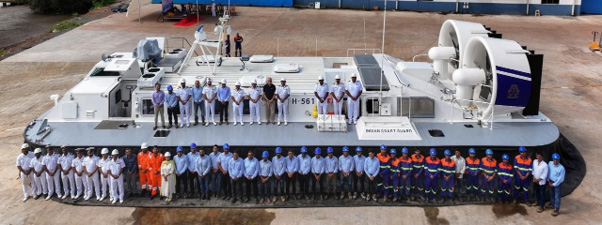
- Indian Coast Guard commissions first Made-in-India Air Cushion Vehicle to strengthen maritime security and rapid response capabilities
- Defence Minister Rajnath Singh to lay foundation for 10,000-ton aluminium extrusion press set to transform aerospace and defence manufacturing
- Twin milestones reinforce India’s self-reliance mission by boosting indigenous technology, reducing imports and expanding the nation’s strategic industrial ecosystem
NE DEFENCE BUREAU
NEW DELHI, JUNE 18
India’s march towards defence self-reliance received a significant boost with two landmark developments that strengthen both its maritime security architecture and strategic manufacturing capabilities. While the Indian Coast Guard (ICG) inducted its first indigenous Air Cushion Vehicle (ACV) into service in Goa, Defence Minister Rajnath Singh is set to lay the foundation stone for a state-of-the-art 10,000-ton Aluminium Extrusion Press at Yantra India Limited’s Ordnance Factory in Nagpur on June 19.
Together, the initiatives underscore the Centre’s commitment to Aatmanirbhar Bharat, enhancing indigenous defence production while reducing dependence on imported critical technologies.
Indigenous hovercraft enhances Coast Guard’s maritime muscle
The first of six indigenous Air Cushion Vehicles, being built by Chowgule & Company Private Limited for the Indian Coast Guard, was formally inducted into service in Goa on June 18.
Designed to operate seamlessly across coastal waters, marshlands and shallow regions inaccessible to conventional vessels, the advanced hovercraft will significantly enhance the Coast Guard’s operational effectiveness across a broad spectrum of maritime missions, including coastal surveillance, search and rescue, anti-smuggling operations, disaster response and rapid deployment.
The induction ceremony, attended by senior Coast Guard officials and representatives from the shipbuilding industry, reflected the organisation’s sustained emphasis on modernisation and capability enhancement to safeguard India’s vast maritime interests.
The indigenous platform is expected to strengthen India’s maritime security architecture while showcasing the growing maturity of the country’s domestic shipbuilding and defence manufacturing ecosystem.
Officials noted that the induction advances the vision of Aatmanirbhar Bharat and stands as a testament to the expanding strength of India’s maritime industrial base.
The contract for six indigenous Air Cushion Vehicles was signed between the Ministry of Defence and Chowgule & Company Private Limited, marking a major step towards indigenisation of specialised maritime assets.
Mega aluminium extrusion facility to power future defence and aerospace projects
Further accelerating India’s self-reliance agenda, Defence Minister Rajnath Singh will perform the Bhoomi Pujan for a cutting-edge 10,000-ton Aluminium Extrusion Press at Yantra India Limited (YIL), Ordnance Factory, Ambajhari, Nagpur, on June 19.
The ceremony will be attended by Maharashtra Chief Minister Devendra Fadnavis, Secretary (Defence Production) Sanjeev Kumar, senior officials from the Department of Defence Production and leadership of Yantra India Limited.
The proposed facility is expected to emerge as a strategic national asset capable of producing large, high-strength and precision aluminium alloy extrusions required for next-generation defence platforms and aerospace applications.
The project will significantly reduce India’s reliance on imported critical aluminium extruded components while strengthening domestic manufacturing capabilities for missiles, aircraft, armoured systems and other advanced defence equipment.
The upcoming extrusion press is poised to become a key pillar in India’s expanding defence industrial ecosystem, supporting indigenous innovation, supply-chain resilience and technological advancement under the Aatmanirbhar Bharat vision.
Twin milestones reflect India’s evolving defence ecosystem
The simultaneous induction of an indigenous hovercraft and the establishment of a world-class aluminium extrusion facility signal India’s transition from an import-dependent defence buyer to an increasingly self-reliant manufacturing power.
By integrating advanced maritime platforms with indigenous industrial infrastructure, the country is building long-term strategic capabilities that will not only strengthen national security but also position India as a competitive global hub for defence and aerospace manufacturing.