NE SCIENCE & TECH BUREAU
MUMBAI, JULY 19
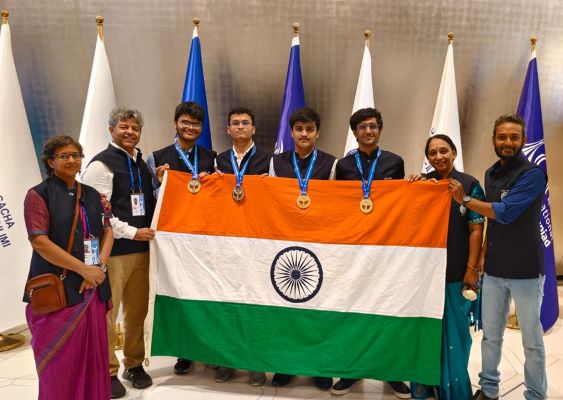
Four students. Four gold medals. One unforgettable chapter in India’s scientific journey. At a time when the nation is striving to emerge as a global leader in innovation, deep technology and scientific research, Team India’s unprecedented clean sweep at the 58th International Chemistry Olympiad (IChO) 2026 sends a powerful message to millions of young minds: the future belongs to those who dare to explore science. Their spectacular achievement is far more than a medal tally—it is a celebration of curiosity, perseverance and intellectual excellence that can inspire an entire generation to embrace Science, Technology, Engineering and Mathematics (STEM) as the pathway to transforming both their lives and the nation’s future.
- India scripts history with its first-ever clean sweep of four Gold Medals at the 58th International Chemistry Olympiad in Uzbekistan
- Outstanding performance propels India to joint No. 1 globally, showcasing the country’s growing scientific excellence and academic prowess
- Young chemistry prodigies conquer the world’s toughest experimental and theoretical challenges, inspiring students to pursue STEM careers
- Experts hail Olympiad success as a powerful testament to India’s investment in scientific talent, research culture and innovation-driven education
- Historic feat reinforces the vision of nurturing future scientists, innovators and technology leaders for a Viksit Bharat
India scripted history at the 58th International Chemistry Olympiad (IChO) 2026, held in Tashkent, Uzbekistan, by securing its first-ever all-gold haul, with every member of Team India returning home wearing the coveted gold medal.
The prestigious Olympiad, conducted from July 10 to 19, witnessed participation from 363 of the world’s brightest young chemists representing 93 countries, making it the largest International Chemistry Olympiad ever held.
India’s Golden Quartet
The four brilliant students who created history are:
- Debadatta Priyadarshi — Gold Medal (Bhubaneswar, Odisha)
- Harshit Singla — Gold Medal (Mandi Gobindgarh, Punjab)
- Kabeer Chillar — Gold Medal (Delhi)
- Sandeep Kuchi — Gold Medal (Hyderabad, Telangana)
With this remarkable performance, India secured joint first place in the overall medal standings alongside China, Vietnam and Individual Participants Group B (Russia)—a landmark achievement in the country’s Olympiad history.
A Milestone in India’s Scientific Journey
The all-gold performance marks India’s finest-ever showing since making its debut at the International Chemistry Olympiad 27 years ago.
The achievement also reflects the country’s steadily rising standards in science education.
Over the years:
- 32% of Indian participants have won Gold Medals.
- 51% have secured Silver Medals.
- 17% have earned Bronze Medals.
Even more encouragingly, in the last ten editions, Indian students have won 43% Gold and 53% Silver Medals, underlining the country’s consistent excellence on the global scientific stage.
Conquering the World’s Toughest Chemistry Challenges
The Olympiad tested participants through highly demanding theoretical and experimental examinations designed to evaluate scientific reasoning, analytical thinking and laboratory skills.
Students tackled cutting-edge topics including:
- Carbon allotropes and nanochemistry.
- Atmospheric carbon dioxide reduction.
- Nitrogen fixation using transition metal catalysts.
- Covalent Organic Frameworks (COFs).
- Oscillatory chemical kinetics.
- Chiral biomolecules.
- Sustainable chemistry.
- Uranium chemistry.
- Advanced stereochemistry.
The practical examination required students to:
- Synthesize and analyse metal complexes.
- Identify complex biochemical mixtures.
- Perform qualitative and quantitative analyses.
- Conduct complexometric and pH-metric titrations.
- Interpret experimental data with exceptional precision.
Their outstanding performance against some of the brightest young scientific minds in the world reflects India’s growing strength in advanced STEM education.
Behind Every Gold Medal Stands a Dedicated Team
The Indian contingent was guided by an accomplished panel of mentors and scientific experts.
The Jury and mentoring team comprised:
- Prof. Subhajit Bandyopadhyay — Head Mentor
- Dr. Indrani Sen (HBCSE, Mumbai) — Mentor
- Dr. Anubendu Adhikary (IIT Kharagpur) — Scientific Observer
- Dr. Jayasree Gopalakrishnan (NES Ratnam College of Arts, Science and Commerce, Mumbai) — Scientific Observer
The Chemistry Olympiad Cell of Homi Bhabha Centre for Science Education (HBCSE), along with an outstanding pool of teachers and resource persons, was widely appreciated for meticulously preparing the students through intensive orientation and pre-departure training camps.
Congratulating the students, organisers stated: “We congratulate the students and the rest of the delegation for their excellent performance. The Chemistry Olympiad Cell of HBCSE and the resource pool of external teachers and mentors deserve appreciation for preparing the team well during the orientation and pre-departure camps.”
The organisers also expressed gratitude to the National Steering Committee on Science Olympiads, teacher organisations and the Government of India’s funding agencies—Department of Atomic Energy (DAE), Department of Science & Technology (DST) and the Ministry of Education (MoE)—for their continued support in nurturing India’s scientific talent.
A Wake-Up Call for Young India
Beyond medals, the achievement carries a larger national message.
As India rapidly expands its footprint in artificial intelligence, semiconductors, biotechnology, clean energy, quantum technologies, pharmaceuticals and space exploration, the demand for highly skilled STEM professionals has never been greater.
The triumph of these four young chemists demonstrates that international success begins with classroom curiosity, rigorous scientific training and the courage to solve complex real-world problems.
For students aspiring to shape the future, the message could not be clearer:
Choose STEM. Question fearlessly. Experiment relentlessly. Innovate boldly.
Because the next global scientific breakthrough could well emerge from an Indian classroom.