

R ARIVANANTHAM
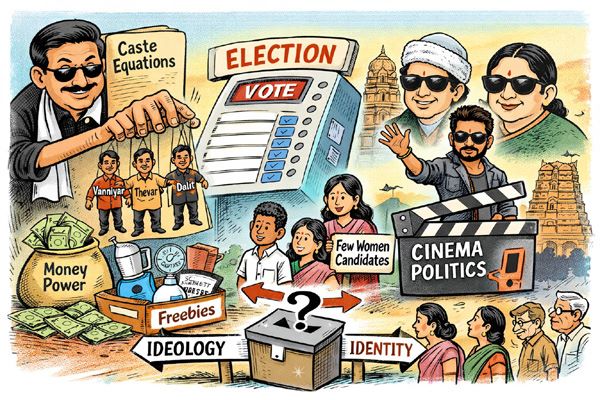
For a state that built its political identity on anti-caste mobilisation and social justice, Tamil Nadu continues to reveal a striking paradox: caste remains the invisible ink in which electoral strategies are written.
The recent allocation of Perambur to the Pattali Makkal Katchi, led by Anbumani Ramadoss, is not merely an alliance adjustment—it is a textbook case of demographic determinism shaping political choices. With a sizeable Vanniyar presence, the constituency fits squarely into PMK’s caste base, even if past electoral performance there has been modest.
- Caste arithmetic still anchors winnability despite decades of social justice politics
- Alliance engineering reveals micro-level caste balancing across regions
- Money power and welfare politics quietly shape voter behaviour
- Ideological legacy vs electoral pragmatism: the Dravidian contradiction
- Cinema-politics pipeline gets a fresh twist with Vijay’s expected entry
- Representation gaps persist: women, SC/ST dynamics and evolving voter expectations
Caste: The quiet determinant of winnability
Across Tamil Nadu, candidate selection is rarely accidental. It is calibrated to local caste equations:
- Vanniyars dominate northern belts, influencing PMK’s bargaining power
- Thevars remain critical in southern districts, often tilting contests
- Gounders shape outcomes in the western region
- Dalit communities form a decisive yet fragmented electorate
Even parties rooted in Dravidian ideology, such as the Dravida Munnetra Kazhagam and All India Anna Dravida Munnetra Kazhagam, quietly align candidates to these social realities.
As one DMK leader put it: “Our foundation is social justice, but representation must reflect ground realities.”
An AIADMK functionary was more candid: “Caste is never announced, but it is always accounted for.”
Alliance politics: Social engineering in motion
Seat-sharing arrangements are less about arithmetic and more about social mapping. The AIADMK-led alliance allocating seats to BJP, PMK, and AMMK is a reflection of caste clusters stitched into a coalition fabric.
Caste-based parties like PMK openly mobilise identity, while national parties like the Bharatiya Janata Party adapt to local caste equations to stay competitive.
Money power & welfare politics: The unspoken influencers
Tamil Nadu’s elections are also shaped by a parallel economy of influence:
- Allegations of cash distribution persist despite regulatory oversight
- Welfare schemes—often labelled as freebies—play a decisive role in voter choice
- Campaign spending influences turnout and last-mile persuasion
A BJP leader noted: “Development narratives matter, but mobilisation on the ground still depends on resources.”
Cinema-politics nexus: The enduring Tamil script
Few regions blend cinema and politics as seamlessly as Tamil Nadu. From M. G. Ramachandran to J. Jayalalithaa, screen legends have rewritten political history.
The possible candidature of Vijay under the banner of Tamilaga Vettri Kazhagam signals a continuation of this legacy—but with a modern twist driven by youth outreach and digital mobilisation.
Party leaders claim: “Connecting with over 40,000 people in a short time shows a new kind of political engagement.”
Ideology vs identity: A persistent tension
The Dravidian movement’s ideological core—rationalism, social equality, and anti-caste rhetoric—sits uneasily with ground-level caste calculations.
This duality defines Tamil Nadu politics:
- Public narrative: inclusive and anti-caste
- Electoral practice: community-specific targeting
The contradiction is not unique—but in Tamil Nadu, it is particularly pronounced.
Representation gaps: Beyond the numbers
Despite progressive credentials:
- Women remain underrepresented in candidate lists
- SC/ST reservations ensure presence, but not always influence
- Fragmentation of marginalised votes limits collective bargaining power
A leader from the Indian National Congress observed: “Reservation opens doors, but power still depends on alliances and organisational strength.”
The bottom line: A multi-layered electoral formula
In constituencies like Perambur and Ambattur, winnability is a composite equation:
- Caste consolidation
- Alliance dynamics
- Financial resources
- Welfare outreach
- Personal and star appeal
Tamil Nadu’s elections thus remain a complex interplay of identity and aspiration, where ideology provides the language, but caste often writes the script.