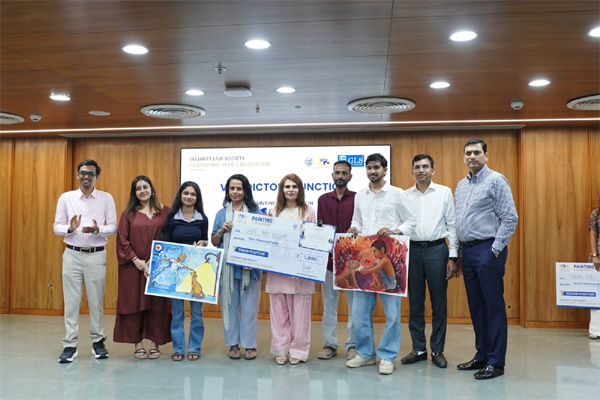

- ‘100 Hearts for the Voiceless’ reimagines animal welfare through art, conversation and youth engagement, transforming empathy into collective action
- Nearly 180 students paint stories of resilience, survival and kindness while actor Karan Tacker joins an inspiring dialogue on compassion and social responsibility
- From expressive canvases to thought-provoking discussions, the initiative proves that education is at its finest when it nurtures humanity alongside intellect
NE EDUCATION BUREAU
AHMEDABAD, JUNE 9
A university campus known for academic pursuits transformed into a sanctuary of compassion as GLS University hosted “100 Hearts for the Voiceless,” an innovative initiative that used art and dialogue to spotlight the lives of stray animals that quietly coexist with people but are often overlooked.
Replacing conventional conversations with colours, creativity and contemplation, the programme encouraged students to explore empathy through artistic expression and meaningful engagement.

At the heart of the initiative was the painting competition, “A Street, A Soul, A Story,” where nearly 180 students translated emotion into art, presenting moving depictions of loneliness, resilience, hope and the silent companionship shared between humans and animals.
Every canvas reflected a unique narrative. Some portrayed abandoned lives searching for care, others celebrated survival against adversity, while many captured simple acts of kindness that illuminate the everyday realities of street animals. Collectively, the artworks evolved into a compelling visual chronicle of unspoken emotions and invisible connections.
With on-the-spot registrations adding vibrancy and spontaneity, the venue transformed into a living gallery where creativity became a powerful medium for social awareness and compassion.
The dialogue extended beyond the exhibition as actor Karan Tacker participated in the Decoded talk series hosted by Dr Chandni Kapadia, engaging students in conversations on empathy, responsibility and the role of young citizens in creating a more compassionate society.
Interactive platforms including “The Pawdcast,” “Sip and Spill,” and “Label Lab” encouraged participants to exchange perspectives, challenge perceptions and deepen their understanding of coexistence with animals.
More than an event, “100 Hearts for the Voiceless” became a movement that demonstrated how education can transcend textbooks by inspiring emotional intelligence and social consciousness.
The initiative concluded with a powerful reminder that every act of observation can lead to understanding, every conversation can inspire change, and every brushstroke has the potential to become a voice for those who cannot speak.