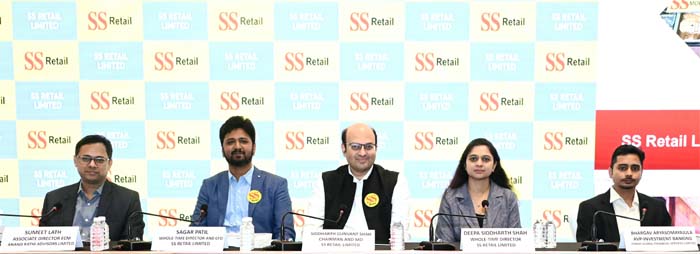
- Price Band fixed at ₹403 to ₹424 per equity share of face value of ₹10 each
- Eligible employees can apply at a discount of ₹25 per equity share to the Offer Price
- Anchor Investor Bidding Date: September 15, 2026
- Bid/Offer Opens: September 16; Closes: September 18, 2026
- Minimum bid: 35 equity shares and in multiples of 35 thereafter
NE BUSINESS BUREAU
AHMEDABAD, SEPT 11
₹500-crore IPO opens September 16; 536-store network, 47% revenue growth and Tier-II/Tier-III strategy put SS Retail’s profitable-growth credentials under the microscope
Can a mobile-phone retailer turn 536 stores into a much larger consumer-electronics franchise without allowing competition and thin margins to eat into growth?
That is the central investor question facing SS Retail Limited, which is set to tap the capital markets with a ₹500-crore mainboard IPO from September 16 to 18, 2026.
The issue comprises a fresh issue of up to about ₹360.75 crore and an offer for sale of ₹140 crore, with the shares proposed to be listed on the BSE and NSE.
The IPO price band is ₹403–₹424 per equity share, with a minimum lot of 35 shares, translating into a minimum investment of ₹14,840 at the upper end of the band. The issue has a 50% reservation for qualified institutional buyers, 15% for non-institutional investors and 35% for retail investors.
From 503 stores to 536—and counting
SS Retail’s expansion numbers provide the first pillar of its proposition.
The company had 503 stores across 215 cities as of March 31, 2026, including 458 stores in Maharashtra. The network expanded to 536 stores by July 31, 2026, covering around 2.61 lakh sq ft.
According to the company, an industry report places it as the largest mobile-phone retail chain in West India and Maharashtra and the third-largest in India among its peers.
Operating under brands including SS Mobile, Mobile Exchange Wala and The Mobile Space, SS Retail sells mobile phones, pre-owned smartphones, accessories, televisions, laptops and tablets, besides offering mobile protection plans, EMI facilities, anti-theft software and recharges.
Its strategic sweet spot is Tier-II, Tier-III and beyond cities, where organised mobile retail still has substantial room for expansion.
What makes the model difficult to copy?
Retail is intensely competitive and margin-sensitive. So the bigger question is not simply how many stores SS Retail can open, but what makes its model defensible when larger organised chains and aggressive regional players can replicate formats and products?
The company’s CMD said its in-house research is the backbone of the business, helping it identifies markets and opportunities beyond the major urban centres.
SS Retail combines COCO, COFO and FOFO formats, including partnerships with local franchisees, to expand its footprint.
This combination gives the company flexibility to deploy different operating models depending on market characteristics, while its Tier-II and Tier-III focus seeks to capture organised-retail demand beyond the metros.
47% growth—but can the profits keep pace?
The financial trajectory is compelling.
Revenue jumped to ₹2,352.85 crore in FY2026 from ₹1,599.96 crore in FY2025, a growth of about 47%. PAT rose to ₹59.28 crore from ₹39.86 crore, while EBITDA increased to ₹125.15 crore from ₹80.44 crore.
Net worth stood at ₹225.71 crore and total borrowings at ₹162.59 crore as of March 31, 2026. RoNW was around 32.6% and ROCE about 29.3%.
But the numbers also highlight the challenge: PAT of ₹59.28 crore on revenue of ₹2,352.85 crore represents a net margin of only around 2.5%.
That makes inventory turns, cash generation, store productivity and margin discipline more important than topline growth alone.
The competitive advantage: productivity, not just proliferation
The CMD’s response to the larger question of profitable growth goes to the heart of the IPO proposition.
SS Retail believes its ability to maintain margins, manage inventory, generate cash and extract higher productivity from every store will determine whether its 536-store network becomes merely a larger retail chain—or the foundation of a much bigger consumer-electronics franchise.
A key metric highlighted by the company is sales per square feet of ₹1,46,347.03 in FY2026, which it says was the highest among its peers.
That points to efficient space utilisation and store productivity across its formats—and potentially offers the company a way to grow without relying solely on adding more physical outlets.
Where will the IPO money go?
The RHP indicates that the company proposes to deploy the net proceeds primarily towards incremental working-capital requirements, with ₹416.53 crore earmarked for this purpose and ₹12.45 crore for fit-outs of new stores planned for FY2027 and FY2028.
The allocation makes working-capital efficiency a crucial post-listing monitor.
For a mobile retailer, inventory can quickly become a cash-flow challenge. The ability to turn stock rapidly, negotiate procurement effectively and preserve cash while expanding could ultimately determine whether revenue growth translates into sustainable shareholder returns.
From Maharashtra to a wider West India play
SS Retail’s strong Maharashtra presence provides scale and market familiarity, while its expansion into Karnataka, Madhya Pradesh, Goa and Gujarat broadens the addressable market.
Its Gujarat operations commenced in FY2027.
The acquisition of a 51.04% stake in Olineo Nexus India, which added 34 stores to the network, further strengthens its expansion strategy.
The larger proposition is therefore clear: combine company-owned and franchise-led formats, use local market intelligence and drive higher productivity from existing retail space while expanding into underpenetrated markets.
The bullseye investor question
The IPO ultimately turns on one deceptively simple question:
Can SS Retail grow faster without sacrificing margins?
As the CMD’s strategy suggests, the answer will depend less on the sheer number of stores and more on what each store contributes to the business.
“Retail growth can be bought by opening more stores—but profitable growth cannot.”
If SS Retail can sustain its store productivity, manage inventory tightly, generate cash and preserve margins while scaling its 536-store network, its IPO could mark the beginning of a significantly larger organised mobile and consumer-electronics retail story.
If not, rapid store additions could simply magnify the economics of a thin-margin business.
For investors, therefore, 536 is not the destination—it is the number to watch as the next chapter begins on Dalal Street.