NE NEWS SERVICE
CHENNAI, AUG 8
For Tamil Nadu, the political question is no longer simply whether delimitation should be discussed—it is whether the State can afford to let the Cauvery and Mekedatu issue slip down the priority list while another constitutional concern takes centre stage. The competing positions of the DMK and the TVK government have brought both issues into sharper focus, with the two sides differing over what demands immediate political action.
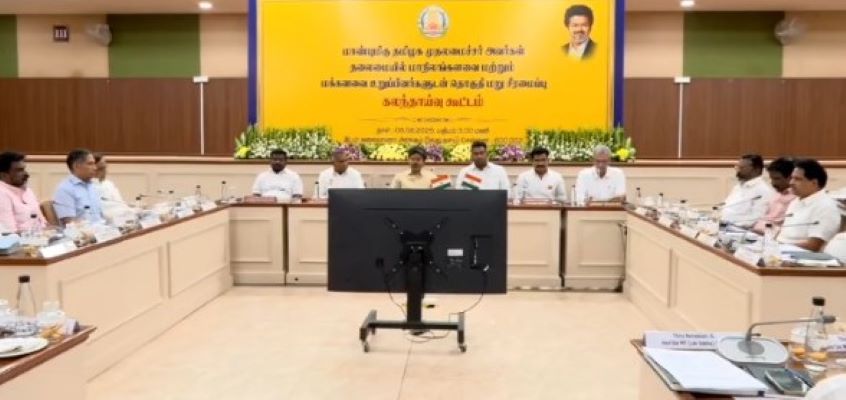
Defending the DMK’s decision to boycott the MPs’ consultation meeting on delimitation convened by the TVK government, party Deputy General Secretary Kanimozhi Karunanidhi questioned Chief Minister C. Joseph Vijay’s priorities and urged the government to demonstrate its commitment to Tamil Nadu’s Cauvery interests through concrete action against Karnataka’s proposed Mekedatu dam.
- DMK questions timing of delimitation meet, urges CM C. Joseph Vijay to lead an all-party delegation against Karnataka’s Mekedatu project
- Kanimozhi asks whether the government will take Tamil Nadu MPs and State representatives to meet Union Jal Shakti Minister
- DMK says there is no immediate Delimitation Bill before Parliament and calls the consultation a diversion from Cauvery concerns
- TVK government maintains delimitation is a critical issue for Tamil Nadu and requires wider political consultation
- With Cauvery Delta farmers watching closely, competing priorities put Centre–State water and political representation issues in sharper focus
Kanimozhi asked whether the Chief Minister would send representatives of the Tamil Nadu government, along with MPs from the State, to meet the Union Jal Shakti Minister and personally submit the Assembly resolution opposing the Mekedatu project.
DMK: ‘When there is nothing before us, what is there to discuss?’
Questioning the immediate need for the delimitation consultation, Kanimozhi said the Union government had neither announced plans to introduce a Delimitation Bill during the current Parliament session nor communicated any proposal to amend the existing law.
“When there is nothing before us, what is there to discuss?” she asked, explaining the DMK’s decision to stay away from the meeting.
She recalled that the previous DMK-led government had already convened an all-party meeting on delimitation and adopted a resolution articulating Tamil Nadu’s concerns.
According to the DMK, the State must oppose any delimitation exercise that could reduce its representation in Parliament or adversely affect its political interests. Kanimozhi also pointed out that the Congress, CPI, CPI(M), VCK and IUML had participated in the earlier all-party consultation and opposed any formula considered detrimental to Tamil Nadu.
She questioned whether the participating parties would alter their position merely because they were attending the consultation convened by the present government.
TVK: Delimitation cannot wait for a bill
The TVK government’s position, however, is that delimitation is too consequential for Tamil Nadu to be discussed only after a formal Bill is introduced.
The consultation with MPs is intended to build political consensus and ensure that the State’s concerns are articulated collectively ahead of any future constitutional or legislative developments relating to delimitation.
From the government’s perspective, waiting until a proposal reaches Parliament could leave Tamil Nadu reacting to developments rather than preparing its position in advance. A broad consultation therefore provides political parties an opportunity to place their concerns on record and work towards a common State position.
The TVK government’s initiative also reflects the view that issues affecting Tamil Nadu’s future representation require consultation beyond the ruling party and should involve elected representatives across political lines.
Mekedatu: The other battle front
Turning to the Cauvery dispute, Kanimozhi accused the TVK government of failing to convene an all-party meeting specifically on the Mekedatu project, despite demands from political parties.
She alleged that the government’s decision to prioritise a delimitation consultation, when there was no immediate legislative proposal before Parliament, risked diverting public attention from the Mekedatu controversy and the concerns of Cauvery Delta farmers.
The DMK’s argument is that the State government should use every available political channel to oppose the proposed project and directly convey Tamil Nadu’s position to the Union government.
Kanimozhi said the government could demonstrate its commitment by facilitating a delegation of State representatives and MPs to meet the Union Jal Shakti Minister.
“If the TVK-led government is genuinely concerned about the interests of Cauvery Delta farmers, will the Chief Minister send representatives of the State government to meet the Union Minister?” she asked.
TWO ISSUES, ONE STATE’S POLITICAL INTEREST
The emerging political contest places delimitation and Mekedatu on parallel tracks.
For the DMK, the immediate priority is protecting Tamil Nadu’s Cauvery interests and ensuring that the Mekedatu issue receives a united political response.
For the TVK government, delimitation is a strategic issue that could have long-term implications for Tamil Nadu’s representation and therefore warrants preparation and consultation before any formal legislative move.
The disagreement consequently goes beyond a single meeting or boycott. It raises a larger question about how Tamil Nadu should prioritise issues that could shape both its political representation and water security.
With the Cauvery Delta dependent on the river system and Tamil Nadu’s political parties already sensitive to the possible consequences of future delimitation, the challenge before the State leadership is to ensure that one concern does not become the casualty of another.
For now, the political spotlight remains firmly divided between the future of Tamil Nadu’s parliamentary representation and the future of its Cauvery waters.