NE AUTOMOBILE BUREAU
NEW DELHI, AUG 11
India’s electric-vehicle race just got two more years on the clock. The government has extended the PM E-DRIVE scheme until March 31, 2028, giving electric mobility manufacturers, buyers and charging-infrastructure developers a longer runway as the country accelerates its transition from internal combustion engines to cleaner propulsion.
- ₹11,900-crore PM E-DRIVE scheme gets two-year extension to March 31, 2028 as Centre pushes India deeper into electric mobility
- Electric two-wheelers remain eligible for purchase incentives from April 1, 2025 through March 31, 2028
- ₹2,500 per kWh incentive capped at ₹5,000 per e-scooter/e-bike; vehicle price ceiling fixed at ₹1.5 lakh
- Support covers up to 45.79 lakh electric two-wheelers, with ₹2,767 crore earmarked for the segment
- Fund-limited programme gets hard stop: claims close December 31, 2027 and all scheme components end March 31, 2028
But there is an important change beneath the headline extension: the runway is longer, while the purchase incentive for electric two-wheelers is leaner.
The Ministry of Heavy Industries has extended the scheme with a total outlay of ₹11,900 crore, focusing on faster EV adoption, charging infrastructure and strengthening India’s domestic EV manufacturing ecosystem.
E-2-wheelers stay in the fast lane
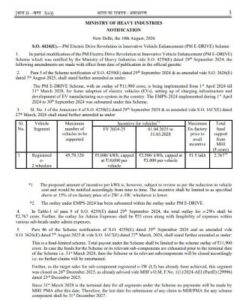
Under the revised provisions, registered electric two-wheelers will remain eligible for purchase incentives for the period from April 1, 2025 to March 31, 2028.
The incentive has been fixed at ₹2,500 per kWh, subject to a maximum benefit of ₹5,000 per vehicle.
There is, however, a crucial price filter: an eligible electric two-wheeler must have a maximum ex-factory price of ₹1.5 lakh.
The government has provided support for a maximum of 45,79,120 electric two-wheelers, with total funding support from the Ministry of Heavy Industries amounting to ₹2,767 crore.
For buyers comparing today’s incentive with the earlier regime, the difference is significant.
During FY2024-25, electric two-wheelers were eligible for an incentive of ₹5,000 per kWh, capped at ₹10,000 per vehicle.
The revised structure therefore halves both the per-kWh rate and the maximum incentive.
The incentive meter can shift with vehicle costs
The government has retained flexibility to revisit the per-kWh incentive periodically, depending on reductions in vehicle costs.
The incentive will remain subject to the specified ceiling or 15% of the vehicle’s ex-factory price, whichever is lower.
That provision could become increasingly relevant as battery costs, vehicle technology and manufacturing efficiencies evolve.
In effect, the policy is attempting to walk a tightrope: keep EV adoption moving while gradually recalibrating direct purchase support as the technology and economics mature.
For electric two-wheeler manufacturers, therefore, the extended scheme offers policy visibility — but not an unlimited subsidy cushion.
₹11,900 crore engine — with a fuel gauge that can hit empty
The PM E-DRIVE scheme will operate as a fund-limited programme, with total payouts capped at the overall ₹11,900-crore outlay.
That means the March 31, 2028 deadline is not necessarily the only clock manufacturers and other stakeholders need to watch.
If funds allocated to the scheme or any of its components are exhausted before March 31, 2028, the concerned component may be closed and no further claims will be entertained.
For the industry, this creates an important planning imperative: scheme eligibility may extend to 2028, but available funds could determine how long the incentive actually lasts for individual components.
Final lap: claims close before the scheme does
The government has also laid down two firm dates.
December 31, 2027 will be the last date for submission of claims.
March 31, 2028 will be the terminal date for all segments of the scheme.
For the EV industry, that creates a clearly marked final lap — with manufacturers, dealers, buyers and infrastructure players needing to factor both dates into their planning.
Longer road, leaner subsidy — India’s EV race enters its next lap
The extension of PM E-DRIVE gives India’s EV ecosystem something it needs almost as much as incentives: policy continuity.
Yet the reduced two-wheeler incentive signals that the next phase of electric mobility may increasingly depend on factors beyond subsidies — falling vehicle and battery costs, domestic manufacturing scale, charging availability, product quality and consumer confidence.
The government has effectively kept the green light on until 2028.
Now the industry has to prove it can keep the electric wheels turning even as the subsidy pedal becomes lighter.
The race continues. The runway is longer. But the acceleration will increasingly have to come from the market itself.