- Postal Business Development & Financial Inclusion Maha Mela showcases India Post’s expanding role in banking, insurance, digital payments and citizen services
- Krishna Kumar Yadav says the postal network is strengthening last-mile delivery, rural logistics and citizen-centric digital services
- Gandhinagar Division records 7.67 lakh savings accounts, 93,000 Sukanya Samriddhi accounts and over 94,000 IPPB accounts
- India Post expands global reach with International Tracked Packet Service now available in 135 countries and a 5-kg weight limit for major destinations
- ‘Postal Warriors’ campaign gives a new thrust to self-reliant Branch Post Offices, while hundreds of Gandhinagar villages achieve comprehensive financial-inclusion milestones
NE BUSINESS BUREAU
GANDHINAGAR, AUG 31
In an India where banking, payments, passports, Aadhaar services and e-commerce are increasingly expected to reach citizens at their doorstep, the humble post office is quietly acquiring a far bigger role than delivering letters.
From financial inclusion and digital payments to insurance, passports, Aadhaar services and international parcels, India Post is expanding its traditional last-mile network into a broad citizen-service and logistics platform.
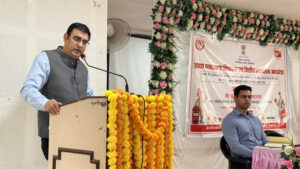
This transformation was in focus at the “Postal Business Development & Financial Inclusion” Maha Mela, inaugurated by Krishna Kumar Yadav, Postmaster General, North Gujarat Region, Ahmedabad, as Chief Guest at the Gandhinagar Municipal Auditorium on Monday.
Yadav said the Department of Posts continues to play a leading role in delivering reliable and accessible services across the country, particularly in rural, remote and inaccessible areas, guided by the principle of “Dak Sewa-Jan Sewa.”
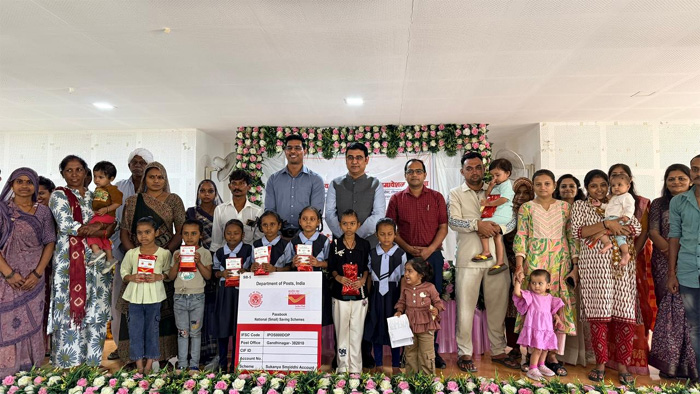
The Postmaster General distributed passbooks and policy bonds to beneficiaries of Sukanya Samriddhi Yojana, Postal Savings Schemes, Postal Life Insurance and India Post Payments Bank, besides felicitating postal employees for exceptional performance.
Shubham Dongardive, Senior Superintendent of Post Offices, Gandhinagar Division, welcomed the guests and customers.
From post office to multi-service gateway
Yadav said India Post is moving ahead with renewed energy and purpose, modernising its communication and logistics network while strengthening innovation and citizen-centric service delivery.
He highlighted initiatives aimed at financial inclusion, digital connectivity, rural logistics and greater citizen participation, saying India Post’s enormous physical network gives it a unique advantage in reaching the last mile.
The Department has also expanded its e-commerce logistics capabilities through partnerships with Amazon, Flipkart and other e-commerce platforms, strengthening parcel delivery and last-mile logistics.
The transformation is significant for India’s rural economy, where the nearest post office can often be more accessible than a conventional bank branch or specialised government service centre.
Digital India reaches the branch post office
Yadav also highlighted the growing use of technology across the postal network.
He said the Department is continuously adopting newer technologies and introducing digital initiatives and modern services to improve the citizen experience.
Inspired by the vision of Union Minister for Communications Jyotiraditya M. Scindia, an N-GEN Post Office at IIT Gandhinagar has been established with a focus on the youth.
At the same time, digital-payment services are being extended to rural Branch Post Offices, enabling citizens to access faster, safer and more convenient financial services closer to home.
The shift effectively turns the post office into a digital doorway for citizens who may otherwise remain outside the formal financial ecosystem.
Gandhinagar’s financial-inclusion numbers tell the story
Dongardive said the primary objective of the Maha Mela was to create awareness about welfare schemes available through post offices and bring more people into their fold.
The scale of financial inclusion in Gandhinagar Division is substantial:
- 7.67 lakh Savings Accounts
- 93,000 Sukanya Samriddhi Accounts
- More than 94,000 India Post Payments Bank accounts
- Over 8,000 passports issued through the Gandhinagar Post Office Passport Seva Kendra during the current financial year
- More than 32,000 people availed Aadhaar services through post offices
- 31,000 beneficiaries availed CELC services through India Post Payments Bank
Responding to rising demand for Aadhaar services, facilities are now available at Gandhinagar Head Post Office and Kalol Head Post Office from 8 am to 8 pm, improving accessibility for working citizens and families.
India Post goes global—and heavier
India Post’s logistics transformation is also visible in its international network.
The International Tracked Packet Service is now available in 135 countries, compared with 41 earlier.
For major destinations, the maximum permissible weight has also been increased to 5 kg.
Gandhinagar Division booked nearly 5,000 international mail articles during the current financial year, with more than 3,500 booked in the last two months alone.
The service witnessed additional demand during Raksha Bandhan, when sisters used the international postal network to send Rakhis to brothers living abroad.
The Department has also entered into an agreement with the Agriculture & Farmers Welfare Department, Government of Gujarat, for booking and delivery of pesticide, seed and fertiliser samples through Speed Post—an example of how the postal network is being integrated into specialised supply chains.
‘Postal Warriors’ put self-reliance on the map
One of the more distinctive initiatives highlighted at the event was the ‘Postal Warriors’ campaign, launched by Yadav in North Gujarat under the ‘Atmanirbhar Branch Post Office’ initiative.
In Gandhinagar alone, 251 Branch Post Offices have been declared Silver Postal Warriors, seven Gold Postal Warriors and one Platinum Postal Warrior so far.
The concerned Branch Postmasters were felicitated for their achievements.
The campaign seeks to encourage Branch Post Offices to become more proactive, self-reliant and commercially productive service centres rather than functioning merely as traditional mail points.
Villages move towards complete financial inclusion
The financial-inclusion drive is also producing village-level milestones.
More than:
- 403 villages in Gandhinagar have been declared ‘Sampoorna Sukanya Samriddhi Gram’;
- 133 villages have been declared ‘Sampoorna Bachat Gram’; and
- 130 villages have been declared ‘Sampoorna Bima Gram’.
These initiatives demonstrate how the postal network is being used to take savings, insurance and girl-child financial-security schemes deeper into rural communities.
The post office’s new business proposition
The changing role of India Post reflects a larger transformation in the country’s public-service infrastructure.
The traditional image of the post office—letters, stamps and money orders—is rapidly giving way to a broader ecosystem encompassing banking, insurance, digital payments, identity services, passports, e-commerce logistics and international delivery.
Its greatest competitive advantage remains its physical reach.
While digital platforms can connect citizens instantly, they cannot always bridge the final physical distance separating a service from a village household.
That is where the post office continues to matter.
And the Gandhinagar Maha Mela offered a glimpse of that emerging model: a centuries-old network adapting itself to the demands of a digital, financially inclusive and increasingly logistics-driven India.
Officials participate
The event was attended by Shubham Dongardive, Senior Superintendent of Post Offices; Sandeep Kushwaha, Deputy Superintendent; Niranjan Bhakta, IPPB Manager; N. G. Rathod, Assistant Superintendent; Hemant Kantar; Deepak More; Manohar Kumar; Ronak Shah; Sonal Desai, Postal Inspector; Vijay Rathod; H. M. Parmar; Bhavin Prajapati; and D. M. Rathod, Gandhinagar Postmaster, besides postal officials and local public representatives.
The message emerging from the Maha Mela was clear:
India Post is no longer merely carrying India’s messages. It is increasingly carrying its money, identity, commerce and essential services to the last mile.