- IIT Gandhinagar–ICAR breakthrough decodes the genes that make mustard reject its own pollen — opening a new breeding route to higher-yielding hybrids
- Four molecular switches mapped in toria and yellow sarson
- AI-powered AlphaFold3 helps reveal the protein machinery behind pollen recognition and rejection
- Discovery could aid development of oilseeds with higher oil content, disease resistance and greater climate resilience
- With India importing more than half its edible-oil requirement, a flower’s natural ‘self-defence’ may offer breeders a powerful new tool
NE SCIENCE & AGRICULTURE BUREAU
GANDHINAGAR, SEPT 1
A mustard flower’s refusal to accept its own pollen may hold an unlikely answer to one of India’s most persistent agricultural vulnerabilities — its dependence on imported edible oil.
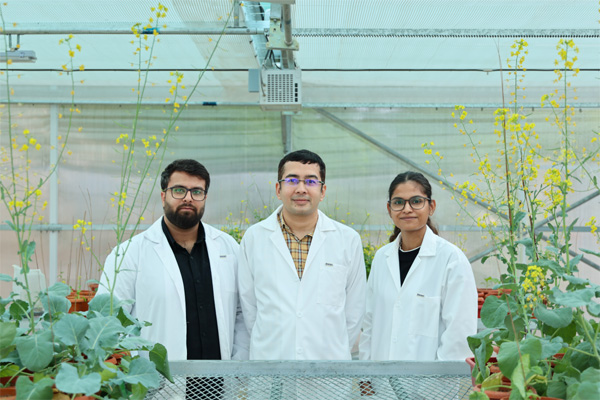
In a research breakthrough that takes plant science from the flower’s stigma to the nation’s cooking-oil basket, scientists at the Indian Institute of Technology Gandhinagar (IITGN) and the Indian Council of Agricultural Research–Directorate of Rapeseed-Mustard Research (ICAR-DRMR), Bharatpur, have decoded the molecular machinery that enables two commercially important mustard varieties to decide whether pollen should be accepted or rejected.
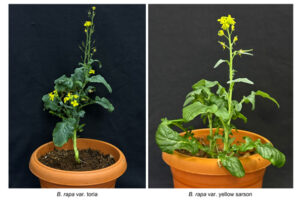
The researchers have identified and functionally tested four key genes — SRK, FER1, MLPK and ARC1 — that govern the natural self-rejection mechanism in Brassica rapa varieties toria and yellow sarson.
The discovery could give plant breeders a more precise biological tool for developing high-yielding hybrid mustard, potentially paving the way for varieties carrying a combination of desirable traits such as higher oil content, disease resistance and resilience to erratic weather.
That matters enormously for India.
The country imported more than half of its edible-oil requirement in 2023–24, with imports accounting for about 56% of domestic demand. Against this backdrop, every scientific advance capable of raising domestic oilseed productivity acquires significance far beyond the laboratory.
The study, carried out in collaboration with ICAR-DRMR, has been published in Frontiers in Plant Science under the title “Characterization of self-incompatibility genes in Brassica rapa var. toria and yellow sarson.”
The flower that refuses to marry itself
The mystery begins with something that appears deceptively simple.
While many people assume a flowering plant will accept pollen that lands on it, some plants possess an elegant biological screening system known as self-incompatibility (SI).
In effect, the flower can recognise its own pollen and say “not this one” — while accepting pollen from another plant.
Evolutionarily, this is a clever strategy. By preventing self-fertilisation, the plant promotes cross-breeding, maintains genetic diversity and reduces the risks associated with inbreeding.
For agriculture, however, this natural refusal can become a breeder’s advantage.
Hybrid seed production requires breeders to control exactly which pollen fertilises the female parent. Preventing self-pollination manually across thousands of flowers can be painstaking, expensive and labour-intensive.
A naturally self-incompatible plant can perform part of that job itself.
But there is a catch: breeders must first understand exactly how the plant recognises its own pollen and shuts the door.
That is where the IITGN–ICAR study enters.
“To maximise crop yields through hybridisation, we need precise control over pollination, which is aided by self-rejection,” said Dr Subramanian Sankaranarayanan, corresponding author of the study and Assistant Professor at IITGN’s Department of Biological Sciences and Engineering.
“Though SI has been extensively studied in Brassica napus (canola), the molecular basis of this mechanism is poorly characterised in India’s commercially grown Brassica rapa varieties, toria and yellow sarson.”
One mustard says no. The other says yes
The researchers, led by Dr Sankaranarayanan, with Hemal Bhalla and Kumari Ankita as co-first authors, began by examining a striking biological contrast.
Toria rejects its own pollen.
Yellow sarson accepts it.
The two varieties therefore provided an unusually useful natural experiment: why does one flower slam the door on its own pollen while the other allows it through?
Controlled pollination experiments supplied the first clues.
The researchers examined pollen attachment, pollen-tube growth and seed development.
When toria was self-pollinated, almost no pollen tubes developed. But when compatible pollen was introduced through cross-pollination, the stigma supported vigorous pollen-tube growth.
The battle over reproduction was therefore taking place at the surface of the flower’s female reproductive tissue — the stigma.
And the researchers set out to identify the molecular gatekeepers.
Four genes, one molecular gatekeeper
The team focused on four major genes:
SRK, FER1, MLPK and ARC1.
Together, the genes encode proteins that function as molecular sensors, signalling components and cellular executors in the self-rejection pathway.
The researchers cloned and sequenced the genes and compared their genetic sequences with those found in related Brassica species.
The analysis confirmed that the genes were genuine and highly conserved members of the known self-incompatibility machinery.
But the scientists wanted to know more than what the genes looked like.
They wanted to know what the molecular machines actually looked like.
That is where Artificial Intelligence entered the experiment.
When AI looks inside a mustard flower
The researchers used AlphaFold3, the AI-powered protein-structure prediction system developed by Google DeepMind, to model the three-dimensional structures of the proteins produced by the identified genes.
The approach essentially allowed the team to create molecular blueprints and examine whether the proteins possessed the structural features expected of self-incompatibility proteins.
The models revealed conserved functional domains consistent with roles in pollen recognition and cellular signalling.
But computational prediction alone was not enough.
The team then put the genes themselves to the test.
Turn off the gene — and the flower changes its mind
Researchers temporarily switched off each gene individually using short synthetic strands called antisense oligonucleotides.
These molecules bind to specific genetic instructions and prevent the cell from using them.
The technique was temporary and did not permanently modify the plant’s genome.
The researchers applied the molecules to the stigma and then observed what happened when the flower encountered its own pollen.
The answer was dramatic.
When SRK, FER or ARC1 were silenced, toria’s normally powerful self-rejection barrier broke down.
The flower began accepting its own pollen.
Fluorescence microscopy confirmed robust pollen-tube growth, providing direct evidence that the self-incompatibility barrier had been breached.
In other words, switching off the molecular gatekeepers changed the flower’s decision from rejection to acceptance.
The surprise hiding in MLPK
One of the study’s most intriguing findings involved MLPK.
The gene has traditionally been regarded as an important component of the self-rejection pathway in related mustard species.
But toria told a different story.
“Traditionally, this gene is considered vital to the self-rejection pathway in related mustard species,” said Hemal Bhalla, co-first author and PhD Scholar at IITGN’s Department of Biological Sciences and Engineering.
“But, in toria, switching off MLPK only partially weakened the rejection response, indicating it plays a secondary or redundant role in this specific variety.”
The finding suggests that nature may use the same broad self-incompatibility machinery differently in different mustard varieties.
For breeders, that distinction could prove valuable when designing future hybridisation strategies.
The flower has a second defence line
The researchers also uncovered another layer of the flower’s defence.
Within minutes of incompatible pollen arriving on the stigma, the plant produces a localised burst of Reactive Oxygen Species (ROS).
These reactive molecules help prevent incompatible pollen from germinating successfully.
The researchers tracked the biochemical response using Nitro Blue Tetrazolium, a dye that darkens where ROS accumulate.
Silencing SRK, FER or MLPK reduced ROS production.
But silencing ARC1 did not.
That difference suggests the flower does not rely on a single pathway. Instead, it appears to deploy two separate but interacting defence mechanisms to stop unwanted pollen.
The researchers propose that ARC1 may operate through an alternative cellular degradation pathway to neutralise incompatible pollen.
From a molecular ‘no’ to a high-yielding hybrid
The study found that the genes examined are highly conserved across Brassica species, indicating that the underlying molecular machinery has remained substantially intact through evolution.
The researchers also demonstrated that toria and yellow sarson can successfully cross, with the resulting seeds showing near-complete germination.
That finding strengthens the potential relevance of the mechanism for practical breeding programmes.
However, the scientists caution that the research represents a foundation for future breeding, rather than a finished commercial technology.
Permanent gene-editing approaches and transgenic validation remain future steps needed to establish how the pathway can be manipulated reliably in breeding programmes.
Why this matters to India’s oil basket
The science arrives at a time when India faces a double agricultural challenge.
It must increase domestic oilseed production while simultaneously preparing crops for a more unpredictable climate.
Erratic monsoons, rising temperatures, changing pest pressures and extreme weather can all threaten crop productivity.
At the same time, dependence on imported edible oil leaves Indian consumers and the domestic food economy vulnerable to international price movements.
This makes the development of productive, disease-resistant and climate-resilient oilseed hybrids an important national priority.
The research could therefore contribute to the scientific foundation supporting the objectives of the National Mission on Edible Oils–Oilseeds (NMEO-Oilseeds).
And the researchers see considerable scope beyond simply increasing yield.
“Our findings provide a clear molecular blueprint of how pollination is governed in India’s oilseed varieties,” said Kumari Ankita, co-first author and PhD Scholar at IITGN’s Department of Biological Sciences and Engineering.
“Foundational genetics like this creates an execution pipeline for developing hybrids that are stacked with favourable traits, including higher oil content, disease resistance, and resilience to erratic weather.”
That could ultimately transform a tiny event occurring on the surface of a mustard flower into something with much larger consequences.
A flower refusing its own pollen may seem like a minor biological curiosity. But once scientists understand the genes behind that refusal, the same natural mechanism could become a powerful breeding tool — helping India produce better hybrids, strengthen its oilseed basket and take another step towards edible-oil self-reliance.
AT A GLANCE
| What the researchers found | Why it matters |
| SRK, FER1, MLPK and ARC1 identified and functionally tested | Decodes the molecular basis of pollen rejection |
| Toria rejects its own pollen | Provides a natural platform for controlled hybridisation |
| MLPK has a partly redundant role in toria | Reveals variety-specific differences in the pathway |
| ROS forms a second defence mechanism | Shows self-rejection involves multiple cellular responses |
| AlphaFold3 mapped protein structures | Adds AI-powered structural insight to crop genetics |
| Toria and yellow sarson can cross successfully | Supports potential breeding applications |
| Future work: gene editing and validation | Could move discovery towards practical crop improvement |