NE WOMEN EMPOWERMENT BUREAU
NEW DELHI, APR 13
Prime Minister Narendra Modi on Monday described the proposed women’s reservation framework under the Nari Shakti Vandan initiative as a transformative step that could redefine India’s democratic future, asserting, “India is about to take one of the biggest decisions of the 21st century, a decision dedicated to Nari Shakti.”
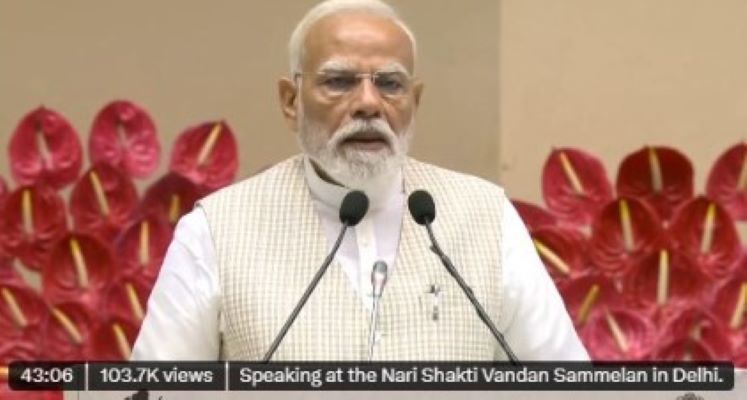
Speaking at the Nari Shakti Vandan Sammelan in Delhi. https://t.co/bnocSJqwYB
— Narendra Modi (@narendramodi) April 13, 2026
Addressing the ‘Nari Shakti Vandan Sammelan’ at Vigyan Bhawan, the Prime Minister termed the moment historic, stating, “Our country’s Parliament is on the verge of making new history—a history that will realise the concepts of the past and fulfill the resolutions of the future.”
- PM calls women’s reservation one of the biggest decisions of the 21st century
- ‘Parliament set to script new history’ as push begins for 2029 implementation
- From grassroots governance to global leadership—India’s women reshape power structures
- Government schemes create life-cycle support from birth to entrepreneurship
- Women breaking barriers across defence, startups, science and aviation
- Call for collective resolve to ensure equal participation in nation-building
Recalling the passage of the Nari Shakti Vandan Act in 2023, he emphasized that its timely implementation remains a priority. “We are keeping the 2029 deadline in mind… It is our endeavor that this work is carried out with mutual cooperation and participation,” he said, adding that a special parliamentary session beginning April 16 will deliberate on the roadmap.
Highlighting women’s growing aspirations, the Prime Minister said, “Women across the country are voicing their aspirations about reaching assemblies and the Lok Sabha… Their dreams have received new wings.” He urged them to actively engage with elected representatives and shape the discourse.
Tracing history, Modi underscored the pivotal role of women in India’s freedom struggle and governance. “India’s Nari Shakti has made immense contributions,” he said, adding, “From President to Prime Minister, wherever women have been, they have created their own legacy.”
Pointing to grassroots empowerment, he noted, “In our country, the Panchayati Raj institutions are a remarkable example of women’s leadership,” highlighting that over 14 lakh women are actively contributing to local governance, with participation nearing 50 percent in several states.
The Prime Minister stressed that increased participation of women in decision-making has made governance more sensitive and effective. “When women’s participation increased, it brought sensitivity to systems… leading to better work on water, education, health and nutrition,” he said, citing the success of welfare initiatives.
Detailing the government’s approach, Modi said, “The government is supporting women at every stage of life,” referring to schemes such as Beti Bachao-Beti Padhao, Sukanya Samriddhi Yojana, Ujjwala Yojana, Ayushman Bharat, and financial inclusion through Jan Dhan accounts.
On economic empowerment, he noted that property ownership and entrepreneurship are increasingly shifting towards women. “Over 3 crore women have become homeowners… and over 60 percent of Mudra loans have been taken by women,” he said.
Highlighting changing societal dynamics, the Prime Minister remarked, “Today, women are excelling even in sectors once considered male-dominated,” adding that Indian women are now leading in aviation, defence, startups and research. “India has the highest percentage of women pilots compared to any country in the world,” he stated.
Citing grassroots success stories, Modi said nearly 10 crore women are now part of self-help groups, with over 3 crore emerging as “Lakhpati Didis.” “These women are becoming brand ambassadors of Vocal for Local,” he added.
On safety and legal reforms, the Prime Minister said, “The Bharatiya Nyaya Sanhita prioritizes women’s safety… enabling e-FIR and faster justice delivery,” underlining the government’s commitment to a more responsive system.
Calling for a nationwide movement, he urged, “We must collectively give new energy to this power and expand opportunities for them… Let us resolve that Nari Shakti will have their rights and become full participants in decision-making.”
Adding perspective, Vijaya Rahatkar, Chairperson of the National Commission for Women, said, “Nari Shakti Vandan Adhiniyam is not merely about reservation… it is an effort to bring about a change in mindset that kept women away from decision-making for years. It takes India’s democracy beyond numbers towards greater sensitivity.”
She added that the legislation marks a decisive shift towards inclusive governance and leadership, reinforcing that women are “equal stakeholders in every sphere—neither less nor more, but equal in all respects.”