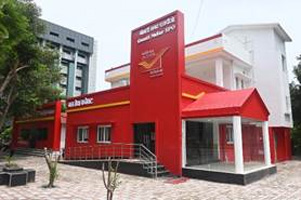
A POST OFFICE DESIGNED AROUND THE CITIZEN: A glimpse of the modernised interior of one of the newly inaugurated post offices, showcasing redesigned service counters, improved seating, clearer access and a contemporary India Post identity — Courtesy: PIB
- Upgraded apps put postal, banking and doorstep services at citizens’ fingertips as 14 modernised post offices open across India
- Dak MITRA empowers 1.4 lakh-plus Branch Post Offices with paperless, real-time transactions and doorstep services
- Dak Sewa brings tracking, booking, complaints, locators and financial tools to one 24×7 platform in 23 Indian languages
- 27 of 40 pilot post offices already transformed under new design manual, with another 60 proposed for modernisation this fiscal
- Technology, accessibility and citizen-centric design converge as India Post reinvents its trusted network for the Viksit Bharat era
NE BUSINESS BUREAU
NEW DELHI, AUG 24
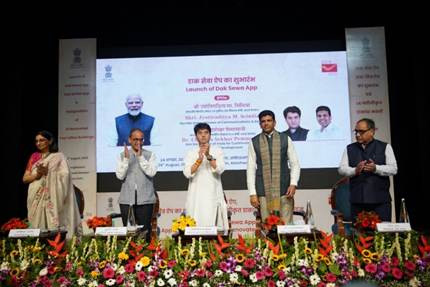
The post office is no longer waiting for citizens to walk through its doors — it is increasingly moving towards their fingertips and, where required, their doorsteps. In one of its most significant technology-and-infrastructure upgrades, India Post has rolled out enhanced Dak MITRA and Dak Sewa mobile applications and inaugurated 14 renovated post office buildings, signalling a decisive shift from a traditional postal network to a digitally enabled, citizen-centric public service platform.
The initiatives, launched virtually on Monday by Jyotiraditya M. Scindia, Union Minister of Communications, and Chandra Sekhar Pemmasani, Minister of State for Communications, seek to combine the trust built by India Post over generations with faster digital access, paperless transactions, doorstep services and modernised physical facilities.
Scindia described the transformation as much larger than a technology upgrade.
“Postal Services at the Click of a Button: India Post Enters a New Era of Technology-Enabled Jan Seva,” he said, emphasising that the Department of Posts is undergoing a comprehensive transformation driven by technology, policy reforms, organisational change and modern infrastructure.
He said Dak Sewa and Dak MITRA were designed to make postal services “easier to access, easier to use and relevant to every generation of Indians”, adding that the transformation was taking place across India Post in “the way it thinks, works and serves citizens.”
Dak Mitra: The post office in the postman’s hand
Developed indigenously by the Centre for Excellence in Postal Technology (CEPT) under the Advanced Postal Technology (APT) platform as part of DoP IT 2.0 modernisation, the upgraded Dak MITRA (Mobile Interface for Transactions & Rural Assistance) is being positioned as a unified operational platform for more than 1.4 lakh Branch Post Offices.
Running on Android-based handheld devices, the application enables Branch Postmasters to conduct paperless and real-time postal and financial transactions, potentially reducing dependence on paperwork while taking services closer to citizens.
Its functionalities include mail booking, OTP-based doorstep delivery, Core Banking Services, insurance services, Aadhaar-based biometric e-KYC, cash deposits and withdrawals, and PLI/RPLI premium collection at the doorstep.
Pemmasani said Dak MITRA would strengthen the ability of the postal workforce to provide services beyond the physical post office.
“Dak MITRA empowers the postal workforce with digital tools for doorstep service delivery, while Dak Sewa brings multiple postal services together through a single, accessible platform available in 23 Indian languages,” he said.
The larger objective, he added, was to combine “India Post’s traditional trust and service ethos with modern technology, greater speed and ease of access.”
Dak Sewa puts 24×7 postal access in the pocket
While Dak MITRA is focused primarily on empowering the postal workforce, Dak Sewa is designed around the citizen.
The app offers 24×7 access to a range of postal services, including tracking, booking, complaints, Post Office and PIN-code locators and financial calculators.
A major inclusion feature is its support for 23 Indian languages through BHASHINI, allowing technology-enabled postal access to reach users beyond the English-speaking population.
The two applications therefore address both sides of the postal ecosystem — Dak MITRA equips the frontline workforce, while Dak Sewa gives citizens a digital gateway to services.
Together, they represent a move towards an India Post in which a citizen may not necessarily need to visit a post office for every transaction or query.
14 post offices get a new identity
The digital transformation is being accompanied by a physical makeover.
The Department of Posts, in collaboration with the School of Planning and Architecture (SPA), New Delhi, has developed a Design Manual aimed at making post offices more functional, accessible, operationally efficient and customer-friendly, while retaining flexibility for local requirements.
The design philosophy rests on four principles: identity as a public service, citizen-centric service delivery, future readiness through technology and innovation, and standardisation with flexibility for local adaptation.
The five-zone spatial framework comprises the Urban Interface Zone, Open Access Forecourt, Open Access Services, Service and Transaction Zone, and Staff Zones, designed to improve movement, accessibility and operational efficiency.
Under the Proof of Concept, 40 post offices across 17 States were selected for transformation. Twenty-seven have already been completed, including four that had earlier been inaugurated, while another 14 were inaugurated on August 24.
The 14 newly renovated facilities are located at Patliputra, Vasant Kunj, Sector-56 Gurugram, Kakurgachi, Vidisha, Sanchi, Shillong, Kandivali West, Shankar Nagar, Ayodhya Nagar, Nirala Nagar, Gomti Nagar, Indira Nagar and Prayagraj.
The remaining post offices under the initial 40-post-office phase are targeted for completion by August 31, 2026.
From 40-post-office pilot to 100-post-office push
The Department intends to use the lessons from the pilot to expand the modernisation drive further.
Based on the experience gained from the initial transformation programme, another 60 post offices are proposed to be brought under the initiative during the current financial year.
The renovated facilities feature a distinctive India Post identity, improved signage, citizen-centric layouts, dedicated service areas and technology-enabled facilities. Wherever feasible, these include 24×7 Sewa facilities, ATMs, after-hours booking and smart parcel services.
The significance of the initiative lies in the combination of the physical and digital transformations.
A modern post office without digital access can still leave citizens waiting; a digital platform without an accessible last-mile network can leave large sections behind. By upgrading both the frontline workforce and the physical service network, India Post is attempting to bridge that gap.
The transformation is ultimately aimed at reinforcing the postal network as a modern public-service infrastructure supporting Digital India, Aatmanirbhar Bharat and Viksit Bharat.