NE DEFENCE BUREAU
CHENNAI, MAY 9
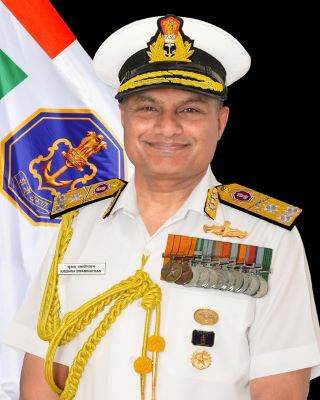
In a major leadership transition for the Indian Navy, the Government has appointed Krishna Swaminathan as the next Chief of the Naval Staff (CNS), placing one of the Navy’s most experienced operational commanders and strategic thinkers at the helm of India’s maritime force.
Government appoints Vice Admiral Krishna Swaminathan, PVSM, AVSM, VSM as the next Chief of the Naval Staff. Currently serving as FOC-in-C, @IN_WNC, the Admiral brings nearly four decades of distinguished service, with extensive operational, strategic & personnel management… pic.twitter.com/5tFs4eR2xJ
— Ministry of Defence, Government of India (@SpokespersonMoD) May 9, 2026
Vice Admiral Krishna Swaminathan, PVSM, AVSM, VSM, will succeed Dinesh Kumar Tripathi, who is scheduled to retire on May 31, 2026.
- Decorated naval strategist to take charge as Chief of the Naval Staff from May 31
- Communication and electronic warfare specialist brings nearly four decades of frontline maritime leadership
- Former commander of INS Vikramaditya and Western Fleet to steer India’s expanding blue-water ambitions
- Scholar-soldier with global military training set to lead Navy amid rising Indo-Pacific challenges
The appointment comes at a crucial time when India is rapidly strengthening its maritime posture across the Indo-Pacific region amid evolving geopolitical dynamics and increasing strategic competition in the Indian Ocean.
Currently serving as the 34th Flag Officer Commanding-in-Chief of the Western Naval Command since July 2025, Vice Admiral Swaminathan has built a distinguished career spanning nearly four decades in frontline operations, naval strategy, training and personnel management.
Commissioned into the Indian Navy on July 1, 1987, the Admiral is a specialist in Communication and Electronic Warfare — a domain that has become increasingly critical in modern network-centric maritime operations.
A graduate of the National Defence Academy, he has also trained at the Joint Services Command and Staff College in the United Kingdom, the College of Naval Warfare at Karanja and the prestigious United States Naval War College.
Vice Admiral Swaminathan’s operational career reflects a rare blend of combat leadership and strategic command. He has commanded missile vessels INS Vidyut and INS Vinash, missile corvette INS Kulish, guided missile destroyer INS Mysore and the aircraft carrier INS Vikramaditya — one of India’s most significant naval assets.
Defence analysts say his extensive command experience across surface combatants and carrier operations makes him exceptionally suited to lead India’s growing blue-water naval ambitions.
As a Rear Admiral, he played a major role in naval training reforms while serving as Chief Staff Officer (Training) at Southern Naval Command in Kochi. He was also instrumental in establishing the Indian Naval Safety Team, a key institutional mechanism overseeing operational safety across the Navy.
He later headed the Navy’s Work Up Organisation as Flag Officer Sea Training before commanding the prestigious Western Fleet — often referred to as the “Sword Arm” of the Indian Navy.
The Admiral also served as Flag Officer Offshore Defence Advisory Group and Advisor, Offshore Security and Defence to the Government of India, contributing to maritime security planning and offshore asset protection.
Following his promotion to Vice Admiral, he held several key leadership roles including Chief of Staff of Western Naval Command, Controller of Personnel Services and Chief of Personnel at Naval Headquarters. Prior to his current assignment, he served as Vice Chief of the Naval Staff.
Apart from his operational credentials, Vice Admiral Swaminathan is also widely recognised as a scholar-officer with an impressive academic profile. He holds degrees from Jawaharlal Nehru University, Cochin University of Science and Technology, King’s College London and University of Mumbai, including a PhD in International Studies.
Awarded the Param Vishisht Seva Medal, Ati Vishisht Seva Medal and Vishisht Seva Medal, the Admiral is expected to lead the Indian Navy through a transformative phase marked by indigenous warship induction, maritime modernisation and enhanced strategic presence across global sea lanes.