

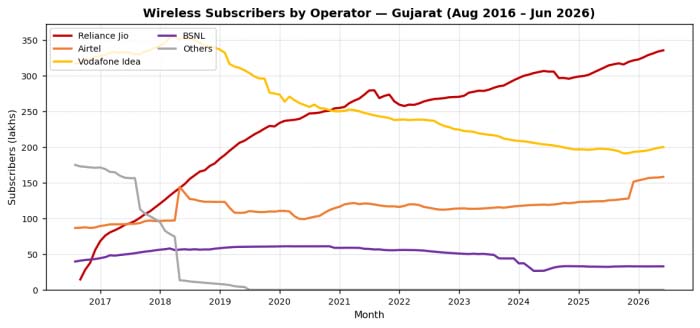
- From its September 2016 debut to 335.5 lakh subscribers, Reliance Jio has emerged as Gujarat’s undisputed wireless market leader
- Jio’s subscriber base has surged nearly 23-fold since its first reported month, clocking a 37.9% CAGR through June 2026
- Airtel grows steadily, Vodafone Idea loses ground as Gujarat’s once-crowded telecom market consolidates around four players
- Jio overtakes Airtel in July 2017 and Vodafone Idea in December 2020, retaining the No. 1 position ever since
- With the overall wireless base rising 14.7% to 727 lakh connections, Jio’s ascent points to market expansion as well as competitive displacement
NE BUSINESS BUREAU
AHMEDABAD, SEPT 7
A decade ago, Jio entered Gujarat with no reported subscribers. Today, nearly one in every two wireless connections in the State belongs to the operator—a transformation that has redrawn the competitive map of Gujarat’s telecom market.
Reliance Jio’s decade-long Gujarat story is nothing short of a telecom market takeover. From its first reported 14.6 lakh subscribers in September 2016, shortly after its commercial launch, Jio has raced to 335.5 lakh subscribers by June 2026, adding a staggering 320.9 lakh connections and securing a commanding 46.2% share of Gujarat’s 727.0 lakh wireless subscriber base, according to TRAI data.
What makes the journey particularly striking is not merely the number of subscribers added, but the speed at which Jio climbed from a standing start to the top of a market long dominated by established operators.
Over the period from its first data point in September 2016 to June 2026, Jio registered a 37.9% CAGR, calculated using September 2016 as its starting point because it had no reported subscribers in August 2016.
The climb: from newcomer to market leader
Jio’s Gujarat subscriber base expanded from 14.6 lakh in September 2016 to 335.5 lakh in June 2026, multiplying roughly 22.9 times.
The operator’s rise was remarkably swift. It overtook Airtel in July 2017 and subsequently Vodafone Idea in December 2020, becoming Gujarat’s largest wireless operator.
Since then, Jio has retained the top position, widening its lead to the point where its June 2026 subscriber base is more than twice that of Airtel and substantially ahead of Vodafone Idea.
The numbers tell a larger story: Jio did not merely enter an established market—it fundamentally altered its hierarchy.
Incumbents feel the Jio effect
The contrast with the established operators is stark.
Airtel, which had 86.8 lakh subscribers in August 2016, increased its base to 158.4 lakh by June 2026, adding 71.6 lakh subscribers and recording a 6.3% CAGR.
Vodafone Idea, representing the combined Vodafone and Idea base, travelled in the opposite direction. Its subscriber base declined from 316.8 lakh in August 2016 to 200.1 lakh in June 2026, a loss of 116.7 lakh subscribers and a -4.6% CAGR. The operator had reached a peak of 354.8 lakh subscribers in April 2018.
BSNL also contracted, moving from 39.8 lakh subscribers in August 2016 to 33.0 lakh in June 2026, equivalent to a -1.9% CAGR.
Jio’s 37.9% CAGR therefore towers over the growth rates of its surviving competitors. Airtel, at 6.3%, is the nearest incumbent—but still far behind Jio’s pace of expansion.
Eight-plus operators to a four-player market
Perhaps the most dramatic transformation lies beyond the individual company numbers.
In 2016, Gujarat’s wireless market featured a crowded field of eight or more operators. The category classified as “Others”, which included Tata, Reliance Communications, Aircel, Telenor, Videocon and other operators that subsequently exited the market, accounted for 175.0 lakh subscribers in August 2016.
By around July 2019, that entire category had fallen to zero.
The result was a sharp consolidation of Gujarat’s wireless market around four principal players: Jio, Vodafone Idea, Airtel and BSNL.
The Vodafone–Idea merger further reshaped the competitive landscape by bringing two major incumbents under one roof. Yet even the enlarged Vodafone Idea base has since surrendered significant ground, falling from its 354.8-lakh peak in April 2018 to 200.1 lakh in June 2026.
More connections, not just a reshuffling of subscribers
The most intriguing part of the decade-long data is that Jio’s rise cannot be explained entirely as a zero-sum transfer of subscribers from one operator to another.
Gujarat’s overall wireless subscriber base increased from 633.7 lakh in September 2016 to 727.0 lakh in June 2026, representing a 14.7% rise.
That suggests the Jio era coincided not only with competitive displacement but also with an expansion of wireless connectivity.
In other words, Jio’s dramatic rise helped reshape the market while the market itself continued to grow.
Gujarat’s telecom leaderboard: June 2026
The June 2026 snapshot places Jio firmly at the top:
| Operator | Aug 2016 | Jun 2026 | Absolute change | CAGR |
| Reliance Jio | —* | 335.5 lakh | +320.9 lakh | 37.9% |
| Airtel | 86.8 lakh | 158.4 lakh | +71.6 lakh | 6.3% |
| Vodafone Idea | 316.8 lakh | 200.1 lakh | -116.7 lakh | -4.6% |
| BSNL | 39.8 lakh | 33.0 lakh | -6.8 lakh | -1.9% |
| Others | 175.0 lakh | 0.0 lakh | -175.0 lakh | Exited |
All figures in lakhs.
*Jio had no reported subscribers in August 2016 as it launched in September 2016. Its first reported data point, September 2016, is therefore used for the 37.9% CAGR calculation. “Others” aggregates operators that subsequently exited the Gujarat circle. Source: TRAI Wireless Subscriber Base.
A decade that changed the telecom equation
Jio’s Gujarat journey is ultimately a story of scale, speed and structural disruption.
In just ten years, an operator that began with no reported subscriber base has become the State’s largest wireless player, commanding 335.5 lakh subscribers and a 46.2% market share.
Airtel has strengthened its position but remains well behind the leader, while Vodafone Idea has seen its once-formidable base shrink considerably. Smaller and exited operators have virtually disappeared from the competitive landscape.
The numbers leave little room for ambiguity: Gujarat’s wireless market of 2026 bears little resemblance to the market Jio entered in 2016.
And the most telling number of all may be 46.2%—a market share that turns Jio’s decade-long Gujarat story from a growth story into a case study in how quickly a telecom newcomer can rewrite an entire market.