

NE ENVIRONMENT BUREAU
NEW DELHI, APR 26
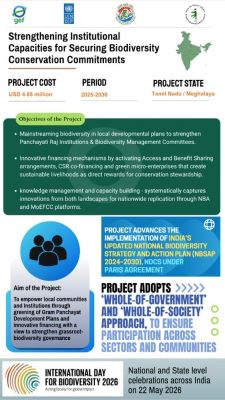
In a decisive step towards embedding ecology into governance, the Ministry of Environment, Forest and Climate Change and the National Biodiversity Authority have launched a landmark five-year initiative titled “Strengthening Institutional Capacities for Securing Biodiversity Conservation Commitments.”
Backed by the Government of India, the Global Environment Facility (GEF) and the United Nations Development Programme, the project carries a grant of USD 4.88 million for the 2025–2030 period, aiming to transform grassroots biodiversity governance through empowered local institutions and innovative financing.
- Ministry of Environment, Forest and Climate Change & National Biodiversity Authority roll out five-year mission with global backing
- $4.88 million GEF–UNDP project to embed biodiversity into village planning and local governance
- From Sathyamangalam to Garo Hills: communities at the frontline of conservation-led livelihoods
- Innovative financing, women-led participation and policy alignment to drive India’s 30×30 biodiversity goals
The initiative is rooted in two ecologically rich landscapes. In Tamil Nadu, the Sathyamangalam landscape—where the Western and Eastern Ghats converge—covers critical habitats including the Mudumalai Tiger Reserve and Sathyamangalam Tiger Reserve. Here, forest-fringe communities, long-time custodians of wildlife corridors, will see their traditional ecological knowledge integrated into Gram Panchayat Development Plans (GPDPs), ensuring biodiversity becomes central to local decision-making.
In Meghalaya’s Garo Hills, the project spans the Nokrek Biosphere Reserve, Balpakram National Park and Siju Wildlife Sanctuary—a mosaic of protected and community-managed forests. Here, conservation efforts will be anchored through Village Employment Councils (VECs), mirroring the role of gram panchayats and fostering community-led stewardship.
At its core, the project seeks to mainstream biodiversity into local development planning by strengthening Panchayati Raj Institutions (PRIs) and Biodiversity Management Committees (BMCs). Multi-stakeholder platforms will bring together forest departments, revenue authorities, elected representatives and civil society to craft community-owned and funded biodiversity action plans.
A defining pillar is the push for innovative financing—activating Access and Benefit Sharing (ABS) frameworks, encouraging CSR co-financing, and nurturing green micro-enterprises that reward conservation efforts with sustainable livelihoods. Simultaneously, the programme prioritises knowledge-sharing and capacity building, capturing best practices for nationwide replication while amplifying the roles of women, Scheduled Castes and tribal communities in biodiversity governance.
Grounded in a bottom-up governance model, the initiative aligns with India’s Updated National Biodiversity Strategy and Action Plan (NBSAP 2024–2030), the global Kunming-Montreal Biodiversity Framework’s 30×30 target, and India’s climate commitments under the Paris Agreement. It also supports state-level visions such as Tamil Nadu Vision 2030 and Meghalaya Vision 2030—ensuring a “Whole-of-Government” and “Whole-of-Society” approach to conservation.