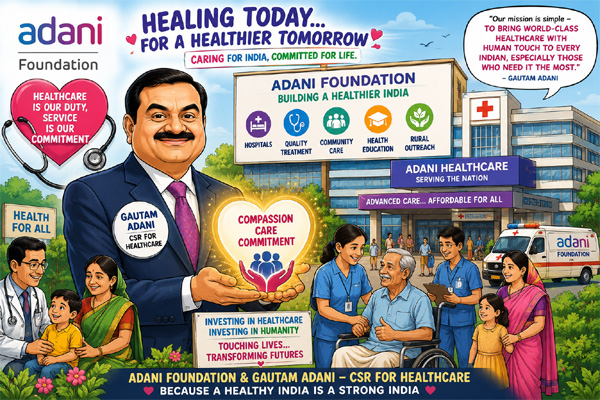
- Proposed New Town mega hospital signals one of eastern India’s biggest healthcare initiatives, blending world-class medicine with social equity
- West Bengal CM says Adani Group has given a written commitment for a 2,000-bed medical facility, with 1,000 beds dedicated to underprivileged patients
- Project builds on the Group’s nationwide ‘Healthcare Temples’ vision to make affordable, technology-driven healthcare accessible at scale
NE HEALTH BUREAU
KOLKATA, JULY 5
In what could emerge as one of eastern India’s most transformative healthcare initiatives, the Adani Group has committed to establishing a 2,000-bed state-of-the-art hospital in New Town, with half of its beds earmarked for free treatment of economically weaker patients—a move that reflects the conglomerate’s growing emphasis on combining nation-building with social responsibility.
Announcing the development on Saturday, West Bengal Chief Minister Suvendu Adhikari said the Adani Group had submitted a written commitment to develop the modern healthcare facility, where 1,000 beds will provide free medical care for the poor, while the remaining 1,000 beds will operate on a commercial basis, creating a sustainable cross-subsidy healthcare model.
“The Adani Group has given a written commitment to build a 2,000-bed modern hospital in New Town. Of these, 1,000 beds will be for the poor and another 1,000 will be used for commercial operation,” Adhikari said while interacting with members of civil society in his Bhabanipur Assembly constituency.
The announcement was made during a meeting organised by the Alipore Citizens’ Association and attended by members of civil society and representatives from the business community. While details regarding investment, construction schedule and project cost are yet to be officially disclosed, the proposal is already being viewed as a landmark addition to eastern India’s healthcare infrastructure.
Healthcare with a Human Face
The proposed Kolkata project fits seamlessly into the Adani Group’s larger healthcare vision unveiled by Chairman Gautam Adani, who has repeatedly emphasised that quality healthcare should not remain a privilege reserved for a few.
Last year, the Group announced its ambitious “Adani Healthcare Temples” initiative—AI-enabled integrated healthcare campuses beginning with Ahmedabad and Mumbai, developed in collaboration with Mayo Clinic. These campuses are designed to integrate super-specialty hospitals, medical colleges, research centres and advanced patient care under one ecosystem, backed by the Adani family’s ₹60,000-crore commitment towards healthcare, education and skill development.
Industry sources indicate that the proposed New Town project is expected to complement this broader vision and could evolve into a world-class health city equipped with cutting-edge medical technology, advanced robotic surgeries, medical education and research facilities. Reports suggest the project may involve an investment of around ₹2,500 crore, though no official confirmation has yet been issued by the Group.
A New Chapter for Eastern India’s Healthcare
If implemented as announced, the New Town hospital would significantly strengthen tertiary healthcare capacity in eastern India while ensuring that every alternate bed remains available free of cost to economically disadvantaged patients—an uncommon model among large private healthcare projects.
Beyond expanding medical infrastructure, the initiative underscores an emerging philosophy within the Adani Group that infrastructure development must also generate measurable social impact.
The proposed facility is expected to reduce the need for patients from eastern and northeastern India to travel long distances for complex treatments while creating opportunities in medical education, research and healthcare employment.
Although project timelines and execution details remain awaited, the announcement signals another significant step in the Adani Group’s evolving journey from building ports, airports and energy infrastructure to investing in institutions centred on human well-being.