R ARIVANANTHAM
CHENNAI, APR 15
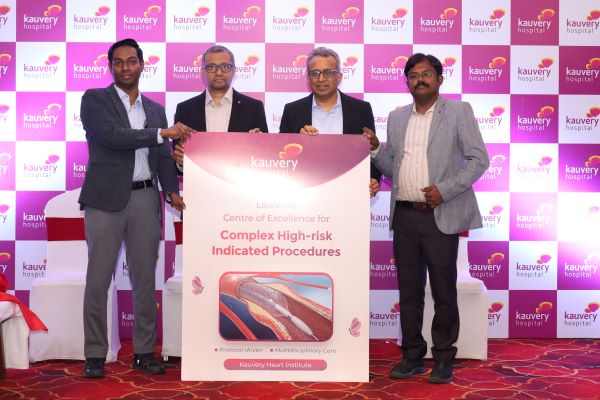
In a major leap for advanced cardiac care, Kauvery Heart Institute at Kauvery Hospital, Radial Road, has introduced Complex High-Risk Indicated Procedures (CHIP)—a specialised programme designed to treat some of the most critical and life-threatening heart conditions.
Positioning itself as a centre of excellence for high-risk cardiac interventions, the initiative focuses on patients presenting with severe heart attacks, advanced heart failure, and cardiogenic shock—cases where survival often depends on minutes and precision.
- Kauvery Heart Institute rolls out specialised high-risk intervention programme for near-fatal heart conditions
- Team-based global care model brings USA–Europe standards to Chennai’s emergency cardiac response
- Rapid-response protocol enables treatment within 10–15 minutes for critically ill patients
- Advanced tech like ECMO, Impella pumps and MitraClip procedures redefine survival chances
- Real-life success stories highlight turnaround of patients once considered beyond recovery
At the core of the programme is a multidisciplinary team approach, bringing together interventional cardiologists, cardiac surgeons, anaesthetists and critical care specialists under structured, rapid-response protocols.
Addressing a press conference to explain the urgency and precision involved, Prof. Dr. Ajith Pillai, Head of Cardiology, Kauvery Heart Institute at Kauvery Hospital, Radial Road said:
“When a critically ill patient arrives, the team is able to assess the condition and initiate treatment within 10–15 minutes, enabling timely life-saving interventions. In many cases, advanced mechanical circulatory support devices such as ECMO and micro-axial cardiac pumps are used to temporarily support the heart while complex cardiac procedures are performed. We adopt a team-based approach similar to the models existing in leading cardiac hospitals in the USA and Europe.”
He further noted that many patients reach the hospital in extremely critical condition—often at the brink of survival—due to sudden cardiac events or undiagnosed long-term disease.
“Through this coordinated approach and advanced technology, we have successfully turned around many near-fatal cardiac emergencies, offering new hope to patients who otherwise had very limited chances of survival,” he added.
The institute has already recorded remarkable success stories. A middle-aged woman with acute breathlessness caused by a leaking heart valve was stabilised through an emergency MitraClip procedure, leading to rapid recovery. In another case, an 85-year-old woman underwent Transcatheter Aortic Valve Implantation (TAVI) along with pacemaker support, regaining her quality of life. A 65-year-old man suffering a massive heart attack with multiple arterial blockages was treated using complex angioplasty supported by an Impella heart pump, restoring blood flow and cardiac function.
Explaining the the broader vision at the press conference, Dr. Aravindan Selvaraj, Executive Director, Kauvery Group of Hospitals, said:
“Treating patients who arrive at the hospital in an extremely critical condition involves timely intervention, clinical expertise, and close coordination across specialties. The adoption of CHIP reflects our commitment to bringing global standards of cardiac care closer to patients. By integrating advanced technology, multidisciplinary expertise, and robust systems of care, we aim to improve outcomes, particularly in high-risk and emergency cases.”
With the launch of CHIP, Kauvery Hospital reinforces its position at the forefront of next-generation cardiac care, where speed, skill and synergy come together to save lives once thought beyond reach.
Dr Stalin Rai, Senior Consultant, Cardiology, Kauvery Hospital Radial Road and Dr Bharath Kumar, Senior Consultant, Cardiology, Kauvery Hospital Radial Road were also present at the media briefing.